St. Mary’s Church: An Orthodox Church in Elbasan Fortress


Site at a Glance
- Rating
- 4.5
- Popularity
- Very Low
- Country
- Albania
- Primary era
- Early Modern
- Eras represented
- Early Modern, Modern
- Civilizations
- Ottoman
- Site type
- Religious
- Remains
- Church
On this page9 sections
History
St. Mary’s Church is an Orthodox church in Elbasan, Albania, within the northern part of Elbasan Fortress. Also called the Church of the Dormition of St. Mary, it belongs to the late Byzantine and post-Byzantine architectural traditions, which continued Byzantine forms in Orthodox regions after the Byzantine Empire’s political end. The present building was reconstructed between 1826 and 1833 after an earlier church was destroyed by fire.
Origins within the fortress
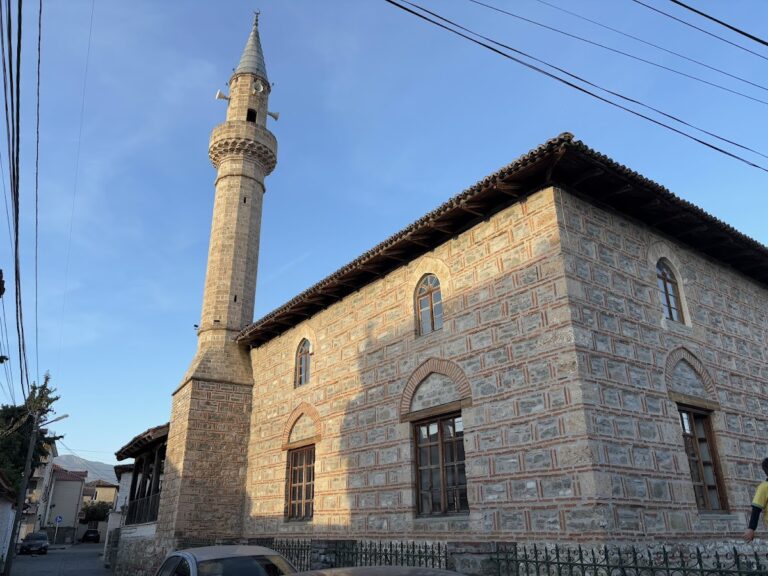
An earlier church stood within the fortress by 1656–1661 and functioned regularly with support from religious endowments and income. Its church codex preserved records of citizens’ donations, accounts, revenues, expenses, and real-estate holdings. Traditions place the church’s original construction after the Ottoman capture of Elbasan in 1466. Other traditions date it to 1486 and place its first service in 1556. They also connect the church with an earlier cemetery and hold that Ottoman authorities required its roof to remain lower than the minaret of the nearby fortress mosque.
Reconstruction in the nineteenth century
Fire destroyed the earlier church around 1818–1819. Reconstruction began in 1826 and was completed in 1833, with the work also dated to January–May 1833 and attributed to Krysanthos Karamalīs, the Orthodox Archbishop of Durazzo. The rebuilt church became an important religious institution during a period when Albanian language and cultural activity were gaining greater prominence.
Religious, educational, and national life
St. Mary’s served as both a place of worship and an educational and cultural center. During the Albanian National Awakening, the nineteenth- and early-twentieth-century movement promoting Albanian language, education, cultural identity, and political autonomy, Albanian patriots used the church for writing in Albanian and reciting psalms in Albanian. Those associated with these activities included Dhaskal Todhri, Teodor Haxhifilipi, Kostandin Kristoforidhi, and Aleksandër Xhuvani.
A Greek school near the church operated from the eighteenth into the twentieth century and became an important educational institution for Albanians. The Congress of Elbasan met there in 1909. Clergy and religious figures connected with the church included Fan Noli, an Albanian Orthodox bishop, writer, translator, and political figure; Visarion Xhuvani; Dhimitër Dhimitruka; and Veniamin Deliana. The Greek patriarchate, the jurisdiction headed by an Orthodox patriarch, excommunicated and anathematized Deliana for preaching the Gospel in Albanian with a translation by Kristoforidhi. Kristoforidhi, who was especially active in translating sacred texts into Albanian, is buried behind the church’s apse.
Renewal and present ecclesiastical position
The church reopened after 1990 through the initiative of its long-serving parish priest, At Spiro Veli, and Orthodox believers from the Kala neighborhood. Its revival received support from the local community, Albanian patriotic families living in the United States, and the Vatra society. Since the 1990s, the church has been administered de facto by an independent Albanian nationalist Orthodox group led by the priest Nikollë Marku. The canonical Orthodox Autocephalous Church of Albania also claims the church. Marku’s group rejects that church’s authority because it considers the institution strongly influenced by Greece, and Marku has opposed the policies of the canonical church under Archbishop Anastasio.
St. Mary’s Church was designated an Albanian cultural monument in 1963 and is protected as a first-category cultural monument. Restoration of the church and its iconostasis, the decorated screen separating the sanctuary from the main body of an Orthodox church, took place in 2008. Further state-supported reconstruction during the 2000s aimed to restore the building’s historical character. Its position near the King Mosque and the Catholic Church of St. Peter has made it a frequently cited example of interreligious coexistence.
Remains
Church plan and exterior
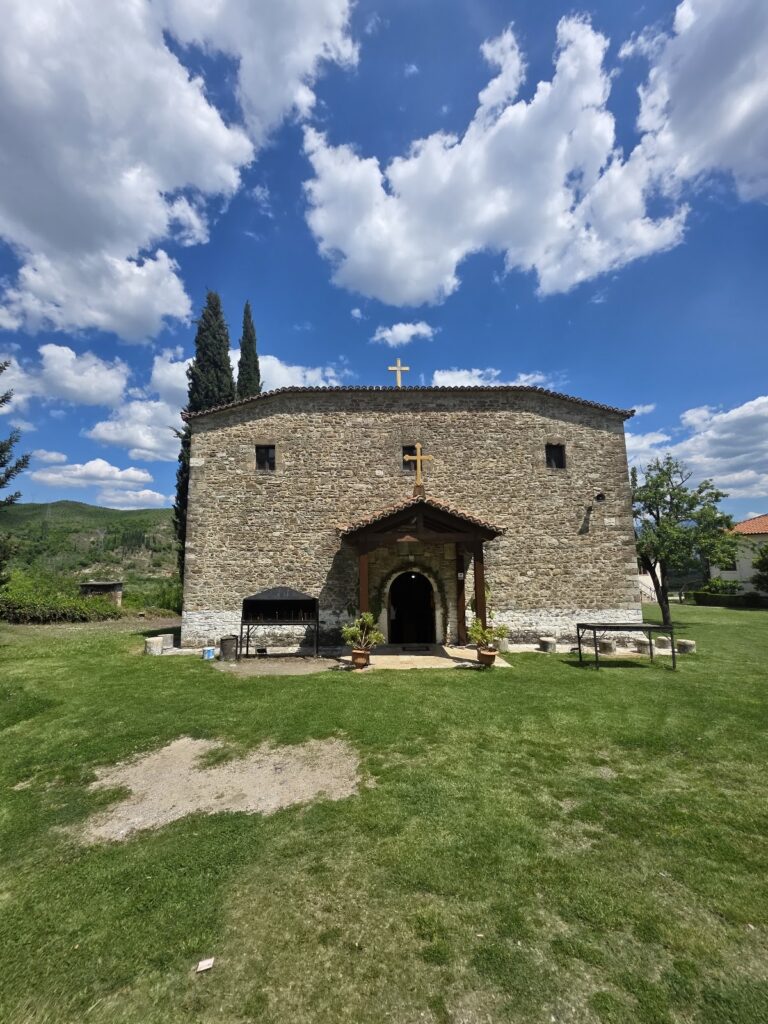
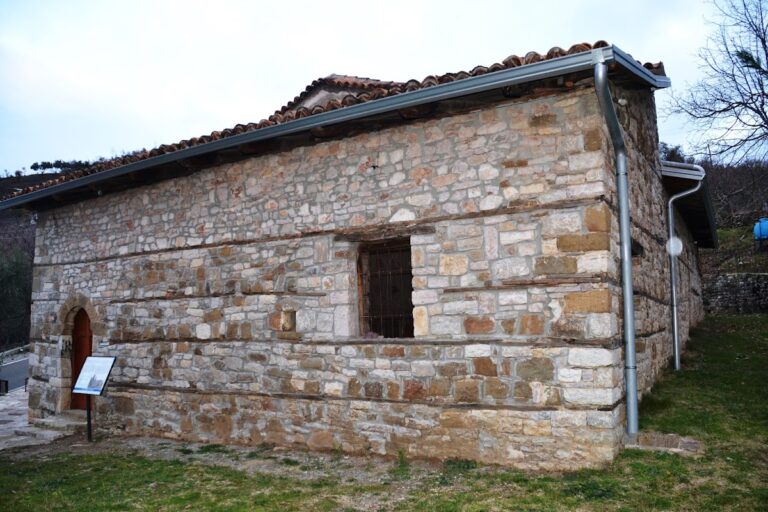
The surviving church is a stone-built basilica with three naves and a hemispherical dome. Its late Byzantine or post-Byzantine design occupies a building approximately 27.7 by 12.4 meters. At the western entrance, a longitudinal exonarthex, or outer church porch, carries an upper women’s gallery. Open porticoes supported by stone arches extend along the west, south, and north sides. Three apses occupy the eastern end, with the central apse considerably larger than the two side apses.
The reconstruction used dressed stone blocks approximately 1.2 meters thick. Its radial and angular construction was intended to resist natural forces. A later bell tower, built of red brick, belongs to a subsequent phase indicated by its architectural style and material. A small chapel was added along the northern side of the church.
Interior decoration
The church floor is formed from mosaics divided into four panels of marble slabs. Decorated slabs bearing Christian motifs also remain inside. Paintings on the dome were completed in 1859. The wooden iconostasis was made by craftsmen from Debar, a historic center of Christian woodcarving and church craftsmanship in the western Balkans, over approximately ten years from 1849 to 1859. Its details were coated with gold-colored lacquer.
The icons and royal doors of the iconostasis, whose central doors traditionally bear sacred images, are attributed to the Bulgarian craftsmen Mihail Anagnost and his son Dimitar Mihailov of Samarina. Their work dates from 1826–1828. Mihail is credited with the throne icons of St. George, St. Nicholas, the Virgin Mary Queen with Christ, Jesus Christ, and St. John the Baptist, as well as the royal doors and other iconostasis icons, some dated 1828.
Burial features
Catacombs within the church were used for burials. The northern chapel contains two burial places. One grave had a stone bearing the Latin inscription “Ika Abus,” while the other bore the name Stefan, identified as the bishop who headed the Diocese of Butrint in 458. The Diocese of Butrint was a Christian episcopal jurisdiction centered on the ancient city of Butrint.
Possible underground corridors leading toward the lower part of the city and the mountains remain a matter of interpretation rather than certainty. Behind the church’s apse is the burial place of Kostandin Kristoforidhi, whose translation work helped connect the church’s religious life with Albanian-language culture.
Nearby sites