St. Jovan Vladimir’s Church: A Medieval Orthodox Monastery in Albania
Site at a Glance
- Rating
- 4.9
- Popularity
- Very Low
- Country
- Albania
- Primary era
- Medieval
- Eras represented
- Medieval, Early Modern
- Civilizations
- Ottoman
- Site type
- Religious
- Remains
- Monastery
On this page13 sections
History
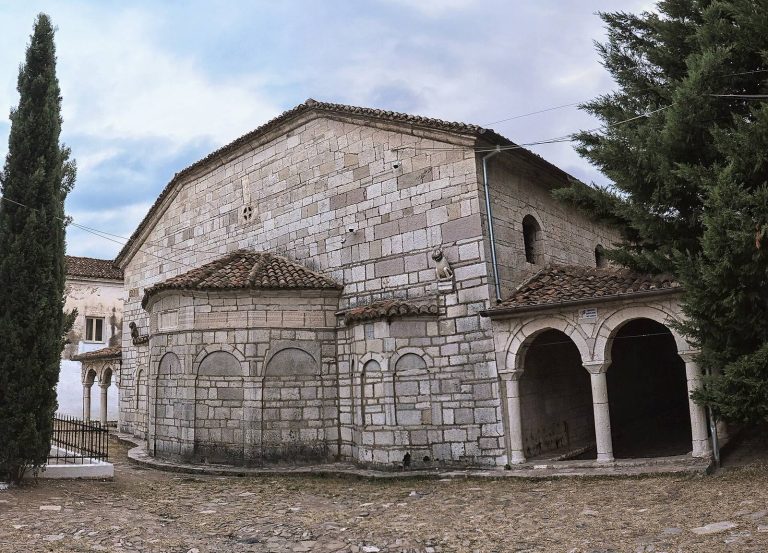
St. Jovan Vladimir’s Church is a medieval Orthodox monastery in Shijon, near Elbasan, Albania, founded in 1381 by Karl Topia in the Byzantine architectural tradition on the foundations of an older church. Dedicated to Jovan Vladimir, an early medieval ruler and Christian martyr associated with Duklja and the western Balkans, the monastery became a religious, cultural, and educational center in the region.
Origins and Foundation
Jovan Vladimir lived approximately from 1000 to 1016 and was martyred on 22 May 1015. His burial and relics became associated with the church, while later tradition credited his tomb with healing powers. The monastery consequently developed into a pilgrimage center for Orthodox believers in Albania.
The monastery was established as a Serbian Orthodox institution. A tradition connects it with an earlier Church of the Holy Trinity that was destroyed by an earthquake, while another historical tradition links that disaster with the destruction of Durrës. An inscription states that Karl Topia rebuilt the temple from its foundations and made the new building four times larger than its predecessor. Topia, a fourteenth-century Albanian ruler and patron, founded the monastery in 1381.
Ecclesiastical and Cultural Life
In the eighteenth century, the monastery became the center of the newly established Diocese of Durrës. Gregory, who later served as Archbishop of Durrës from 1768 to 1772, is traditionally associated with writing the Elbasan Gospel there in 1761. The manuscript is described as the oldest Albanian-language manuscript. During the same century, the iconographer Kostandin Shpataraku painted the church walls.
For more than seven centuries, the monastery served as a major ecclesiastical and cultural center and influenced the cultural and educational life of Elbasan. It later came under the Albanian Orthodox Church and is associated today with its Diocese of Elbasan, Shpat, and Librazhd. Before the Second World War, Visarion, a metropolitan of the Albanian Orthodox Church, also served as its abbot. Between the two World Wars, the monastery operated a shelter for impoverished and infirm older people from the area around Shkodra.
The monastery also attracted large gatherings for the feast of St. Jovan Vladimir. Hahn recorded fairs on 22 May and 4 June, each lasting three days, when pilgrims received bread, water, olives, and cheese. The saint’s feast continues to be celebrated on 4 June.
Decline, Damage, and Protection
In 1890, the monastery was described as part of the Diocese of Durrës, impoverished, declining, and frequently attacked and looted. It then housed four or five monks under an abbot of Vlach origin. During the First World War, Austro-Hungarian soldiers occupied the monastery and caused extensive damage. Further major damage and destruction took place during the twentieth century, although the precise date and manner of its later destruction remain uncertain.
The monastery was placed on Albania’s religious cultural-monument list in 1948 and received further cultural-heritage protection in 1971. These protections reflect its status as an important medieval historical monument in Albania. The complex is now associated with the Albanian Orthodox Church, after its earlier Serbian Orthodox institutional history.
Remains
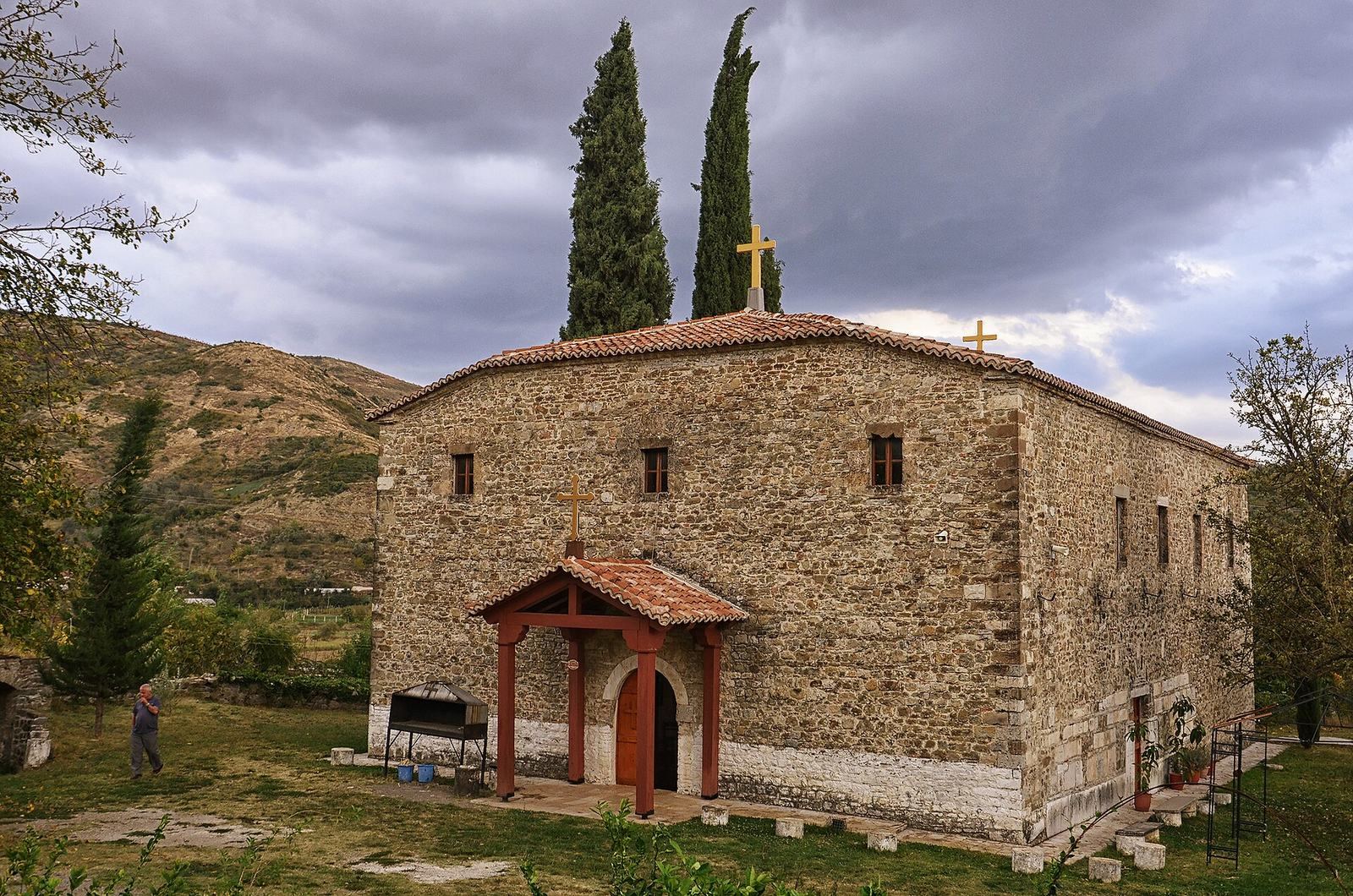
The monastery is enclosed by walls, with the church on the northern side and monastic residential buildings arranged around a courtyard. The complex is associated with the ancient Egnatia Road, the Roman route across the Balkans, and with a branch leading toward Petrela. Its surviving features combine the stone church, religious furnishings, inscriptions, sculptural elements, and evidence of successive periods of use.
Church and Monastic Buildings
Stone Basilica
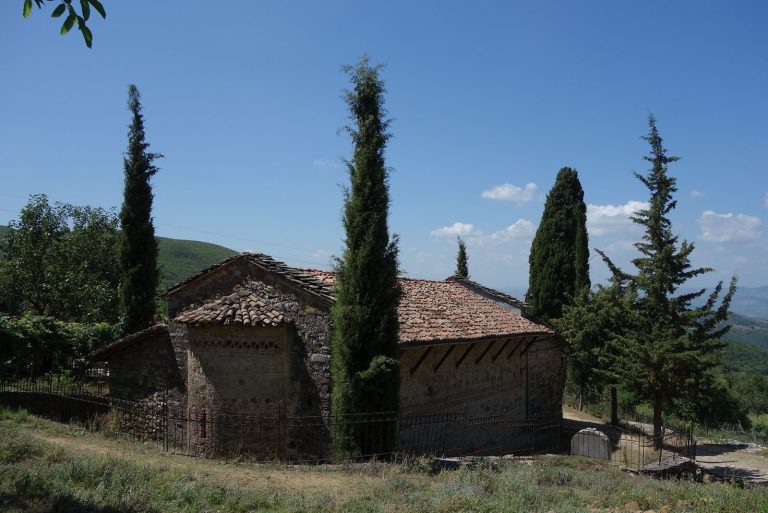
The church is a stone Byzantine-style building without a dome. Its plan is also described as a three-aisled basilica, meaning that a central nave is flanked by two side aisles arranged between two rows of columns. The church stands within the walled monastery, whose courtyard contained residential buildings for the monastic community.
Sacred Courtyard and Interior
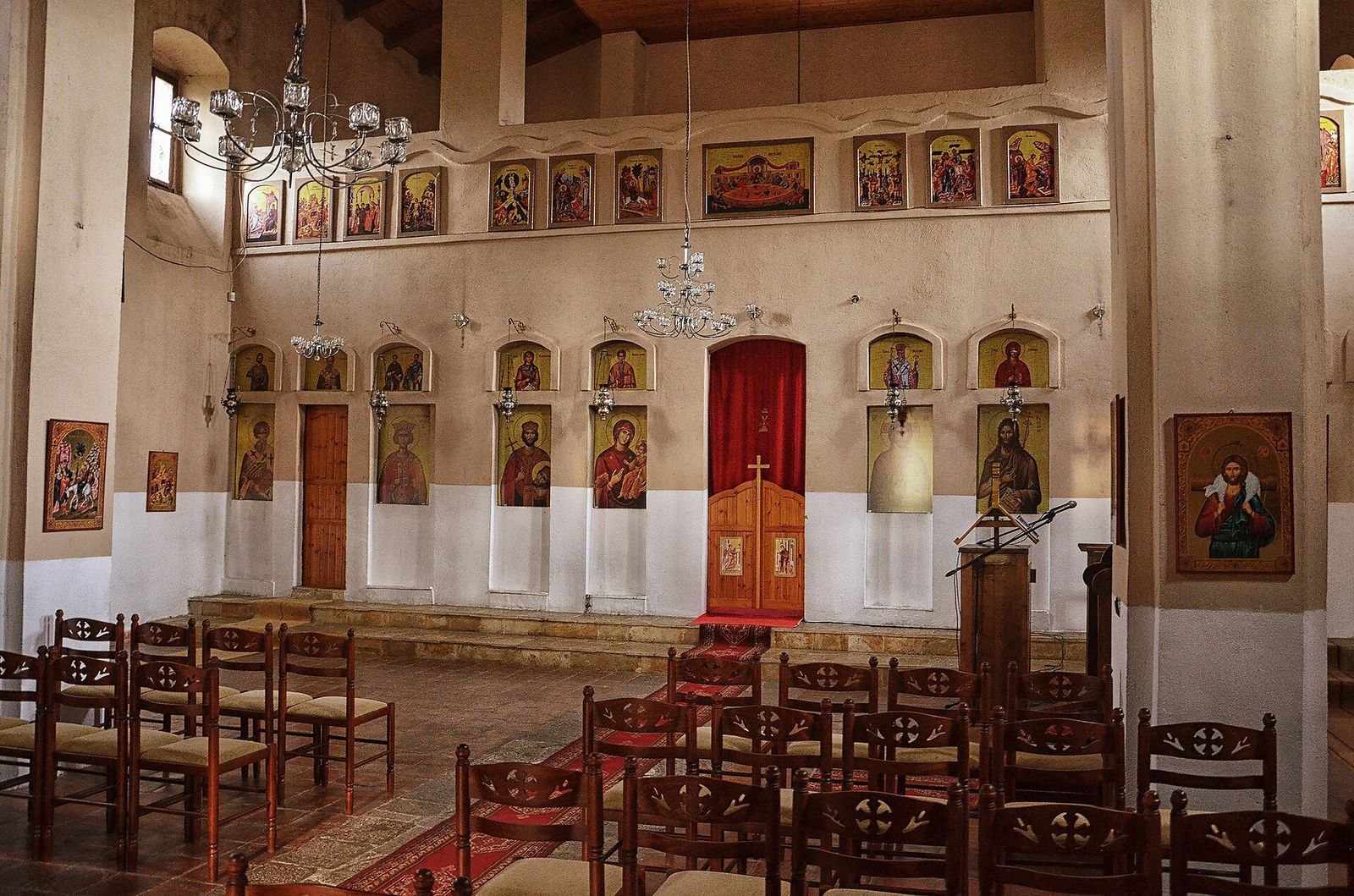
A small stone slab in the courtyard is traditionally identified as the place where Jovan Vladimir stood while praying. Inside the church, the saint’s relics were kept in the altar on the right, in a wooden reliquary set within a stone sarcophagus. The sarcophagus was secured by a padlock and sealed with three seals. A treasury and library occupied the altar area on the left. The monastery also possessed an important collection of icons, including works made on leather, copper, and wood, while its large library has been lost.
Wall Paintings
During the eighteenth century, Kostandin Shpataraku covered the church walls with icons regarded as having high artistic value. These paintings formed part of the monastery’s later artistic and religious furnishings and remain associated with the period when the complex served as a center of the Diocese of Durrës.
Inscriptions and Founder’s Memorials
Doorway Inscription
A large inscription measuring 2.20 by 0.27 metres was carved into the stone lintel of the southern doorway. It states that an earthquake had destroyed the earlier temple to its foundations and that Karl Topia rebuilt it at four times the former size. The text identifies Topia as a descendant of the king of France and includes chronological and calendrical information connected with the construction.
Coat of Arms and Tomb
A stone bearing Karl Topia’s coat of arms is set into the southern monastery wall. Measuring 0.98 by 0.68 metres, it has a square field divided at the center and carved with five crosses, with the central cross enclosed in a circle. A helmet, descending lilies, and two raised lions appear above the field. The inscription reads, “These are the signs of the great lord Karl Topia.” Its position above the tomb indicated that Topia, the monastery’s founder and patron, was buried there.
Removed Portal and Later Plaque
A finely carved portal was removed from the monastery and installed in the National Historical Museum. The monastery walls also contain sculptures and ornaments earlier than the fourteenth century, together with later inscriptions. An original marble plaque bearing the founder and patron’s name in Cyrillic script was removed in 2006 and replaced by a plaque carrying a Greek inscription.