Khor Virap: An Armenian Apostolic Monastery and Pilgrimage Site


Site at a Glance
- Rating
- 4.8
- Popularity
- Medium
- Country
- Armenia
- Primary era
- Early Modern
- Eras represented
- Medieval, Early Modern
- Civilizations
- Armenian
- Site type
- Religious
- Remains
- Monastery
On this page8 sections
History
Khor Virap is an Armenian Apostolic monastery and pilgrimage site in Armenia, near Artashat, whose principal church was built in the seventeenth century around an earlier chapel. It stands in the Ararat Plain near the Turkish border, within the territory of ancient Artaxata, and its religious importance is linked to the traditional conversion of Armenia to Christianity.
Artaxata and the royal prison
Before the monastery existed, the site served as a royal prison associated with nearby Artashat, also known as Artaxata. King Artashes I founded the city around 180 BC as the capital of the Artashesid dynasty, the Armenian ruling house he established. Artashat retained that status until the reign of Khosrov III, when the capital was transferred to Dvin. The ancient city was later destroyed by the Persian king Shapur II.
The name Khor Virap comes from virap nerk’in, meaning “bottommost pit,” and was later shortened to “Virap” or expressed as “deep dungeon.” The prison tradition gives the site its central place in Armenian religious history.
Gregory the Illuminator and Armenia’s conversion
According to Armenian tradition, King Tiridates III imprisoned Gregory the Illuminator in the dungeon for approximately 13 years. Gregory, the Christian missionary traditionally credited with converting Armenia and regarded as its patron saint, had refused to sacrifice to the goddess Anahita. Tiridates also held Gregory responsible for the actions of his father, Anak the Parthian, whom the king blamed for murdering his own father.
After the persecution and killing of Hripsime, Gayane, and other Christians, Tiridates reportedly became severely deranged. His sister Khosrovidhukt repeatedly dreamed that Gregory could end the king’s afflictions. Prince Awtay was sent to bring Gregory out of the pit. Gregory cured Tiridates, who sought forgiveness, and then allowed him to preach Christianity to the king, his court, and his army.
Tiridates proclaimed Christianity the state religion of Armenia in 301 after Gregory’s intervention. Gregory later became Bishop of Caesarea and remained in the king’s service until about 314. Another interpretation treats the conversion as a political strategy intended to strengthen national unity against Persian Zoroastrian and Roman pagan influence.
From chapel to monastery
Nerses III the Builder, a seventh-century Armenian religious leader, built a chapel over Gregory’s prison in 642. The chapel was repeatedly rebuilt. In 1662, a larger church dedicated to the Holy Mother of God was constructed around the earlier chapel’s ruins, together with the monastery, refectory, and monks’ cells.
Khor Virap served as a theological seminary and as a residence of the Catholicos, the chief bishop and spiritual head of the Armenian Church. It remains a functioning religious institution with regular services and continues to receive pilgrims. Baptisms take place at the monastery, while some couples perform a matagh, a traditional Armenian Christian ritual animal sacrifice, after their weddings. The anniversary of Gregory’s deliverance is commemorated, and New Year’s Day ceremonies carry light from Khor Virap. In a modern symbolic ceremony, Catholicos Garegin II descended into the prison pit and emerged holding a lit candle.
Archaeological excavations began in 1970 on the thirteen hills surrounding Khor Virap and extending toward the river valley. Work also took place outside the monastery walls at Artashat. During the mid-1990s, volunteers from the Canadian Youth Mission to Armenia helped renovate and restore the monastery church.
Remains
The monastery complex
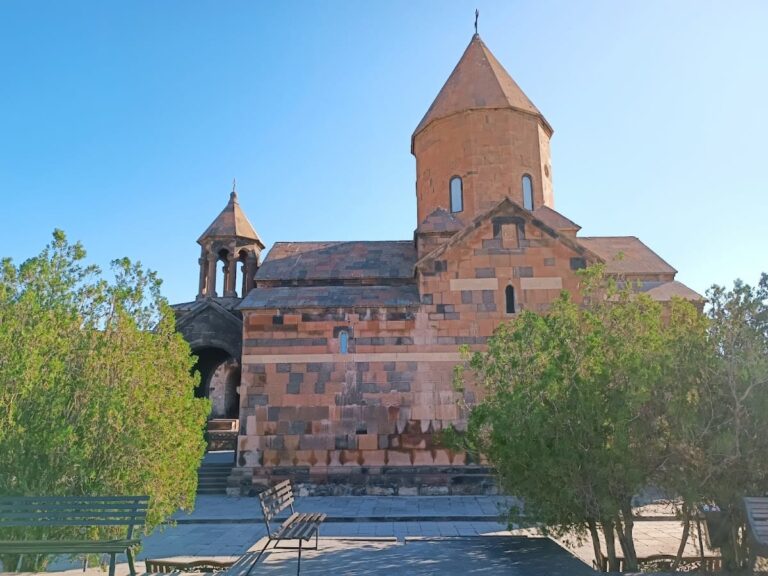
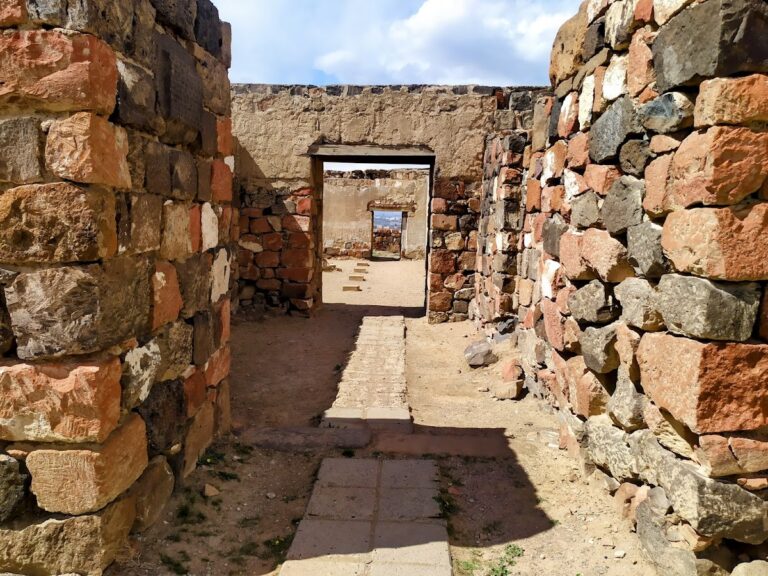
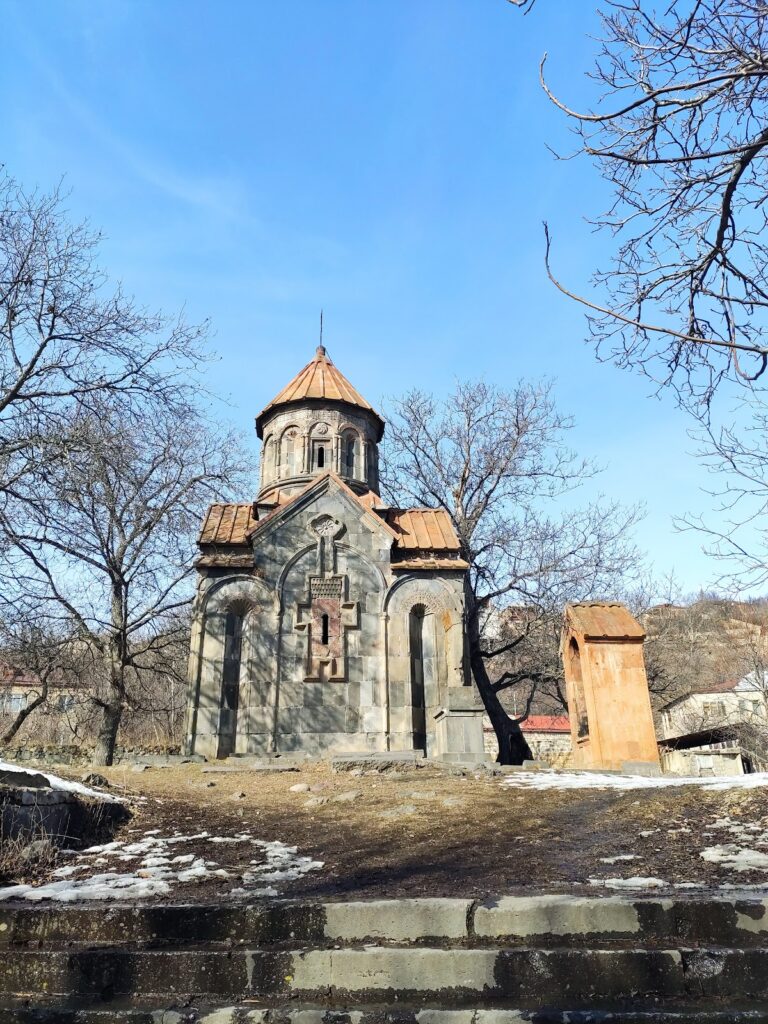
The main surviving structure is the seventeenth-century Church of the Holy Mother of God, also called Surb Astvatsatsin. Built around the remains of the earlier chapel, it has a twelve-sided drum, the supporting architectural base beneath its dome, as well as a dome and richly decorated altar pulpit. The church stands within an enclosure containing a refectory, monks’ cells, and a large courtyard. Together, the church and courtyard create a simple fortified-looking complex whose appearance has been compared to an old feudal castle.
St. George Chapel and the prison
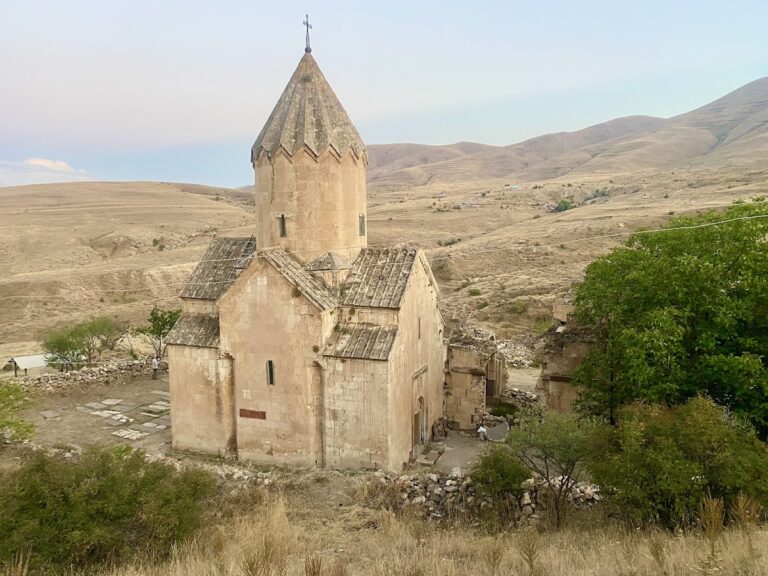
St. George Chapel, or Surb Gevorg, stands over the underground prison pit. The small basilica has a semicircular apse, the rounded end of the building containing the sanctuary. Its northwest-to-southeast orientation differs from the usual east-to-west alignment of Armenian churches. The earlier chapel over the prison was built from white limestone, and the later monastery was arranged around its ruins.
Gregory’s prison lies southwest of the principal church beneath St. George Chapel. Two pits are located inside the chapel, and Gregory’s is the farther one. It is approximately 6 metres deep and 4.4 metres wide. Small openings lead to a chamber, a winding stairway, and a ladder. From the chamber beside the altar, a long ladder descends to the relatively large cell associated with Gregory. The underground space becomes especially humid during summer.
The surrounding archaeological landscape
The archaeological landscape around the monastery consists of thirteen hills extending toward the Arax River valley. The hills reach a maximum height of approximately 70 metres. Excavations have focused on Hill 1, Hill 4, parts of Hills 5, 7, and 8, and the landform between Hills 1 and 2.
Ancient coins and pottery fragments have been recovered from the surrounding hills. Well-preserved mud-brick fortifications were exposed on the northern slope of the third hill from the northeast. The monastery itself stands on a hillock among the pastureland and vineyards of the Ararat Plain. It overlooks Mount Ararat, while the Arax River flows nearby and the Turkish settlement of Aralik lies across the river. The closed Turkish-Armenian border is approximately 100 metres from the site.