Sultan Murad Mosque: An Early Ottoman Sultanic Mosque in Skopje


Site at a Glance
- Rating
- 4.8
- Popularity
- Low
- Country
- North Macedonia
- Primary era
- Medieval
- Eras represented
- Medieval, Early Modern, Modern
- Civilizations
- Ottoman
- Site type
- Religious
- Remains
- Mosque
On this page10 sections
History
Sultan Murad Mosque is an early Ottoman mosque in Skopje, North Macedonia, completed in 1436 as a Sunni Islamic endowment commissioned and financed by Sultan Murad II. Located east of Bit Pazar in the Old Skopje Bazaar, it stands on the site of an earlier monastery dedicated to Saint George. It is the oldest surviving mosque in Skopje, the city’s only sultanic mosque, and one of the oldest surviving mosques in the Balkans.
Foundation and Ottoman patronage
The mosque was established as a sultanic foundation, meaning a religious institution endowed by an Ottoman ruler. Its alternative name, Hünkâr Mosque, means “imperial” or “sultanic” mosque. The building belongs to the Sunni Islamic tradition and continues to serve as an active religious building. Its early form is believed to have resembled two contemporary mosques endowed by Murad II in Bursa and Izmir, although repeated repairs and alterations have left its original appearance unknown.
Sixteenth-century restoration
In 1537, a fire destroyed the upper part of the mosque and its minaret. Sultan Suleiman the Magnificent ordered its restoration, which an inscription dates to 1539–1542. This rebuilding formed one of the major stages in the mosque’s long architectural history, as later interventions further changed the appearance inherited from the fifteenth-century building.
Damage and later rebuilding
The mosque was severely damaged when Skopje was burned in 1689 during the campaign of the Austrian general Johann Piccolomini. Sultan Ahmed III ordered another restoration around 1712. A further major renovation took place in 1912 by order of Sultan Mehmed V, whose visit to Skopje is also associated with some of the paintings inside the mosque.
The 1963 Skopje earthquake caused extensive damage, which was subsequently repaired. These successive fires, wartime destruction, renovations, and earthquake repairs explain why the mosque’s original appearance cannot now be established with certainty. It is protected as a cultural monument and is regarded as one of the most important Ottoman religious monuments in the Balkans.
Remains
Main mosque
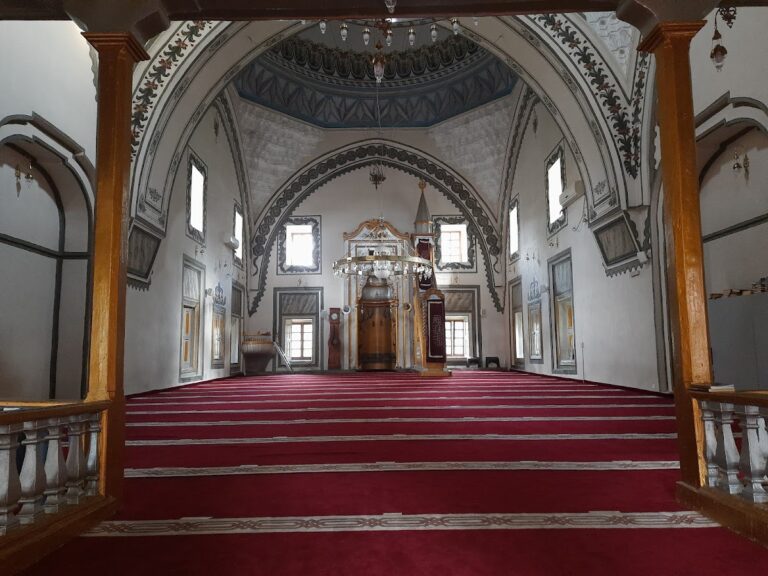
Sultan Murad Mosque occupies a prominent hill in the center of Skopje’s bazaar. The building follows early Ottoman Bursa-style architecture and uses alternating stone and brick in a decorative masonry technique. Its interior is square and arranged like a three-aisled basilica. Two rows of three columns divide the prayer space, with the columns joined by semicircular arches. Large, flat timber beams support the wooden ceiling, while a hipped, tiled roof covers the building.
Along the northwest side, a porch rests on four stone columns with ornamental capitals. Five pointed-arch arcades connect the columns. A slender minaret rises at the western corner. Built of finely cut stone, it has tiered three-dimensional ornament, known as muqarnas, beneath the balcony. The minaret and the porch form part of the surviving exterior arrangement, although the building as a whole reflects its many stages of repair.
Interior decoration and furnishings
The interior contains nineteenth-century paintings and vegetal ornament around the windows. Rectangular panels show landscapes with sacred and secular buildings. One image above the entrance to the prayer space probably represents the Suleymaniye Mosque in Istanbul, recognizable by its four minarets, each with three balconies. Another landscape depicts Istanbul. The paintings were made in different periods with different materials and techniques, and some date from 1912, when Sultan Mehmed V visited Skopje.
The mihrab, the prayer niche indicating the direction of Mecca, the minbar, the pulpit used for the sermon, and the mahfil, an elevated gallery or platform, date from the early twentieth century. Their decoration has been compared with that of the Isa Bey Mosque in Skopje.
Courtyard structures
The courtyard contains a clock tower and two mausoleums. The presence of the clock tower has given the mosque another name, Saat Mosque, or Clock Mosque. The two mausoleums belong to Biki Han and Ali Pasha of Dagestan and add separate commemorative structures to the mosque’s courtyard complex.
Biki Han Mausoleum
The Biki Han mausoleum stands south of the mosque and is the largest surviving structure of its type in North Macedonia. An inscription above the entrance places its construction around the middle of the sixteenth century. It has a square plan and a dome carried on squinches, architectural devices that transform a square room into a suitable base for a dome. The exterior is richly painted, with rectangular geometric forms at the corners and beneath the squinches. Part of the interior ornament survives, and five uninscribed graves remain inside.
Ali Pasha of Dagestan Mausoleum
The mausoleum of Ali Pasha of Dagestan stands beside the mosque’s eastern facade and dates from 1774. Its hexagonal plan is covered by a lead dome supported on six columns. Reliefs on the facade depict a mosque with a minaret, a twisted minaret, and two flower vases. Inside, two sarcophagi contain the remains of the pasha’s wife and daughter.