Old Bazaar: Skopje’s Historic Commercial and Cultural Quarter
Site at a Glance
- Rating
- 4.5
- Popularity
- Very High
- Country
- North Macedonia
- Primary era
- Early Modern
- Eras represented
- Medieval, Early Modern, Modern
- Civilizations
- Byzantine, First Bulgarian Empire, Ottoman, Serbian
- Site type
- Economic
- Remains
- Market
On this page40 sections
History
The Old Bazaar is a historic commercial and cultural quarter of Skopje, North Macedonia, developed by successive Byzantine, medieval Serbian, and Ottoman communities from documented commercial activity in the twelfth century onward. Extending between the Stone Bridge, Bit-Pazar, Skopje Fortress, and the Serava River, it became one of the oldest and largest marketplaces in the Balkans and remains a dense record of the city’s changing political, religious, and economic life.
Early settlement and the medieval city
Archaeological evidence from Skopje Fortress indicates habitation in the surrounding area by about 4000 BC. The Paeonians were the earliest historically recorded settlers, appearing in the area during the sixth century BC. Under Roman rule, Scupi acquired temples, baths, and theatres and developed into an important religious and cultural centre.
An earthquake in 518 heavily damaged Scupi. After Justinian I became Byzantine emperor, a new capital was established away from the ruined city, and inhabitants settled on a nearby hill. Justinian ordered the construction of the fortress now known as Skopje Fortress, creating the elevated stronghold that would later border the developing bazaar.
During the reign of Samuel, Skopje gained strategic, political, economic, and cultural importance. Defensive walls and a large gate, later called the Watertower Gate, were built around the fortress area. These works helped protect the settlement’s wealth and resist Byzantine attacks, including campaigns led by Basil II in 1001.
Byzantium conquered Samuel’s state in 1018. Skopje then became the seat of a Byzantine theme, an imperial administrative and military district, and an episcopal see, the seat of a bishop. In the eleventh century, Romanos III Argyros undertook measures to restore the Monastery of St George. Tradition places the monastery on the hill now occupied by the Sultan Murad Mosque, although its precise location remains disputed.
Fairs, markets, and the emergence of the bazaar
The Monastery of St George organized an annual fair on 21 November and a weekly market, first on Fridays and later also on Tuesdays. These markets were held between 1028 and 1034 on the monastery’s meadow beside the Serava, at the site of present-day Bit-Pazar. Their regularity encouraged merchants, craftsmen, storage, and supporting services to gather around the northern side of the settlement.
Relative stability after the rise of the Komnenian dynasty, which ruled the Byzantine Empire during a period of renewed political stability and building activity, allowed further development. Walls and towers were constructed around Dolengrad, while monasteries and churches were built nearby. The fairground lay beneath the northern wall beside the gate leading toward Constantinople, and merchants from Dubrovnik and Venice attended the markets.
Traders who could not sell their goods in a single day began spending nights on the monastery meadow. Because the monastery administration did not permit permanent buildings there, merchants gradually sought shelter inside Dolengrad’s walls. By the late twelfth century, permanent storage facilities, charges for land use, and sales on ordinary days had created a settled commercial quarter that developed into the Old Bazaar.
During the thirteenth century, shops multiplied and the commercial area spread around the northern gate, inside Dolengrad, and near the Church of the Nativity of the Virgin. Southern Dolengrad contained a large commercial and craft structure with 15 elongated arches and an area of about 1,200 square metres. Its final remains disappeared during the first half of the twentieth century, although Jacobus Haverin depicted the building in an engraving of 1594.
Medieval Serbian Skopje
Stefan Uros II Milutin conquered Skopje in 1282, bringing it into Raska and then into the medieval Serbian state. Under Stefan Dusan, Skopje became the capital in 1345, and Dusan was crowned emperor there the following year. The city was already a major trading centre with active crafts and merchants from Dubrovnik and Venice, although the bazaar was not yet described as a separate commercial quarter. Some historians place Dusan’s palace on the site later occupied by the Sultan Murad Mosque.
Ottoman transformation
Skopje entered the Ottoman Empire in 1392. The conquest altered the city’s population and political role, and Skopje became a military stronghold. Dolengrad and the medieval bazaar were reshaped by the construction of Ottoman religious, commercial, and civic buildings, many of which established the urban framework still associated with the Old Bazaar.
Pasha Yigit Beg built a mosque in the early fifteenth century on the site of the Church of the Holy Physicians. Major building activity followed under Ishak Beg and his son Isa Beg. Ishak Beg initiated the Sultan Murad Mosque, completed in 1436, and began the Ishak Beg Mosque in 1438 on the former monastery meadow. After his death, Isa Beg built or commissioned the Bezisten, Cifte Hamam, Suli Han, and Kapan Han between 1445 and 1469. His endowment was followed by the Isa Beg Mosque in 1475, the Haji Kasam Mosque in 1489 and 1490, and the Mustafa Pasha Mosque in 1492.
Daut Pasha financed several buildings between 1489 and 1497, most notably the Daut Pasha Hamam. Imarets, charitable public kitchens attached to religious foundations, distributed prepared food to homeless people and travellers. These religious and charitable institutions operated alongside shops, inns, workshops, and markets, making the quarter both a commercial district and an important centre of urban life.
Commercial prosperity and destruction
The Old Bazaar reached its urban and economic peak during the sixteenth and seventeenth centuries. It became one of the largest Oriental bazaars in the Balkans, with specialized areas for leatherworkers, coppersmiths, ironsmiths, cloth merchants, goldsmiths, and other trades. A night watch guarded the shops and charged 12 akches, an Ottoman silver currency unit.
Yahya Pasha built a mosque near the bazaar in 1504. Kuršumli Han was rebuilt in the mid-sixteenth century, and restoration of the Church of the Holy Salvation began in 1543. An earthquake in 1555 caused extensive damage, but trade soon recovered, supported especially by Jewish and Dubrovnik merchant communities.
A clock tower was erected in the courtyard of the Sultan Murad Mosque between 1566 and 1572. Seventeenth-century travellers, including Evliya Celebi, described the bazaar’s streets and commerce. Edward Browne, who visited in 1669, noted the lead-roofed Bezisten, plank-covered streets, craft shops, and exports such as wool, wax, tobacco, cloth, silk, silver goods, and ornaments.
In 1689, after the failed Ottoman siege of Vienna and the advance of Austrian forces commanded by General Piccolomini, Skopje was burned. The fire of 26 and 27 November almost completely destroyed the bazaar, leaving only a few mosques and hamams, or public bathhouses. Reconstruction continued throughout the eighteenth century, although the weakened Ottoman economy and repeated epidemics slowed recovery.
Reform, guilds, and nineteenth-century change
Reforms during the first half of the nineteenth century improved economic conditions and protected craftsmen, encouraging renewed trade and production. Macedonian Christian craftsmen and merchants helped restore churches, while Skopje’s Jewish community rebuilt the Bet Yaakov Synagogue. New construction incorporated elements of older Macedonian architecture, eclecticism, and Baroque design, gradually reducing the bazaar’s earlier Oriental character.
Between 50 and 90 types of craft operated in the bazaar during the second half of the nineteenth century. Guild-organized quarters grouped related trades. Apprentices usually trained for five to ten years or longer, while masters supplied their tools. Craftsmen were expected to train at least one son, a practice that helped create hereditary craft families.
War, persecution, and twentieth-century disruption
Political unrest, war, and economic change shaped the bazaar during the early twentieth century. It suffered damage during the First World War and expanded across the Stone Bridge onto the right bank of the Vardar toward the railway station. The Great Depression brought impoverishment, unemployment, and debt among craftsmen. By 1934, the Bezisten was described as neglected, closed, and rented out.
During the Second World War, the bazaar became economically inactive but served the National Liberation War in Vardar Macedonia. A house near the Ishak Beg Mosque accommodated members of the Regional Committee of the Communist Party of Yugoslavia for Macedonia and its operational headquarters between 1942 and 1944. Another house near the Stone Bridge contained the first clandestine workshop in the area for weapons, ammunition, and sabotage materials.
The deportation of Skopje’s Jewish population to Treblinka began on 11 March 1943. Bulgarian fascist authorities looted and burned the nearby Church of the Virgin. The Yigit Pasha Mosque was destroyed during the bombing of Skopje, and the Bet Yaakov Synagogue was demolished. The iconostasis of the Church of the Holy Salvation was dismantled for removal to the National Bank’s vaults, but it was returned after the war.
Earthquake, reconstruction, and protection
After the Second World War, the Old Bazaar again became a major commercial centre. The Institute for Protection of Monuments and Culture began systematic research, and legal protection was extended to 25 buildings between 1950 and 1967.
The earthquake of 26 July 1963 destroyed many shops and severely damaged historic buildings. Suli Han, Kapan Han, the Arasta and Kazandjiler mosques, and Gulciler Hamam were almost completely destroyed. Cifte Hamam, Kuršumli Han, the Church of the Holy Salvation, the Bezisten, Kose Kadi Mosque, and Sultan Murad Mosque suffered partial destruction.
Post-earthquake reconstruction introduced modern construction materials. During the early 1970s, water and sewage networks were renewed and streets were paved, replacing traditional Turkish cobblestones. A bridge and department-store structure over Goce Delcev Boulevard reconnected divided parts of the bazaar. Kapan Han, Suli Han, and other damaged monuments were restored, while new buildings were constructed for the Museum of Macedonia and the Museum of Contemporary Art.
On 13 October 2008, the Macedonian Parliament designated the Old Bazaar cultural heritage of particular importance and placed it under permanent state protection. The law defined the bazaar’s boundaries and three contact zones, protected its urban structure and authenticity, restricted construction and industrial pollution, and required archaeological investigation before foundation, basement, or other building work.
A documentation project presented in late 2008 recorded about 600 buildings, with an individual identity file planned for each. A five-year revitalization programme began in February 2010, combining facade restoration, support for crafts, and economic and cultural measures intended to preserve the bazaar’s character. The area was also incorporated into the Skopje 2014 project. The Skanderbeg Monument was unveiled at the bazaar entrance on 28 November 2006, while a foundation stone for Skanderbeg Square was laid on 17 January 2012. The square was completed in 2018 and incorporated space over Goce Delcev Boulevard.
The Old Bazaar Museum was founded in May 1983 as an affiliated institution of the Museum of the City of Skopje. Its 473-square-metre premises include 355 square metres of exhibition space. Archaeological, historical, artistic, and ethnological displays present the bazaar from its medieval and Ottoman periods, including its buildings, crafts, and social life. The historical section opened in 1985.
Remains
The Old Bazaar occupies the eastern bank of the Vardar and is organized as a medieval-Oriental bazaar, with principal streets linked to networks of narrower craft lanes. Its surviving fabric is predominantly Ottoman, while Byzantine remains and later modernist interventions reflect the quarter’s long development. More than 50 urban blocks retain much of the historic street network. The area contains shops, mosques, tombs, churches, caravanserais, bathhouses, a clock tower, museums, and later cultural buildings.
Bridges, churches, and civic buildings
Stone Bridge
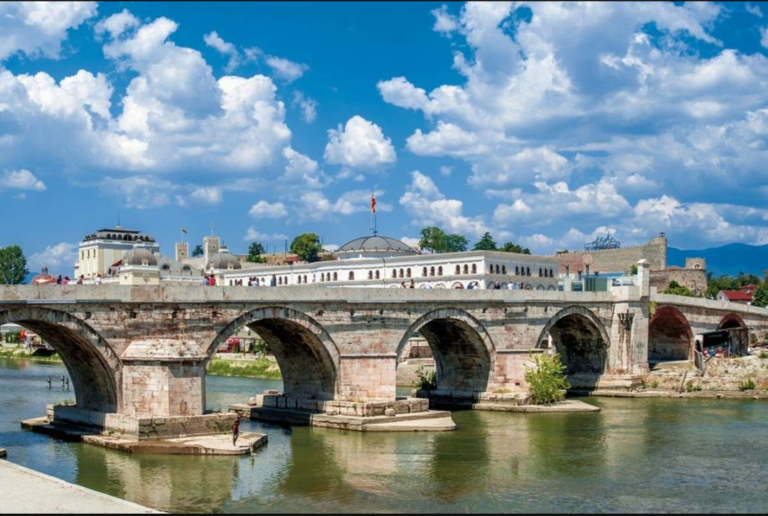
The Stone Bridge links the bazaar on the left bank of the Vardar with Macedonia Square on the right bank. Its date remains disputed. One attribution places its construction in the sixth century, after the earthquake of 518 under Justinian I, while another dates it between 1451 and 1469, during the reign of Mehmed II. The bridge was altered under Suleiman the Magnificent and Stefan Dusan, mined during the Second World War without being demolished, and later repaired in an effort to bring it closer to an earlier appearance. Its original form is described as having 13 semicircular arches, a length of 213.85 metres, and a width of 6.33 metres. It is now pedestrian-only and is also known as Dusan’s Bridge.
Church of St Demetrius
The Orthodox Church of St Demetrius stands near the Stone Bridge beneath the fortress. An inscription records an earlier church on the site in the sixteenth century, and the building was mentioned as a cathedral in 1727. It housed the Skopje Metropolitanate during the nineteenth century and received its present form in 1896; its bell tower was added in 1907 and 1908. Built of stone and mortar, it has three naves and an apse, or semicircular sanctuary end. The interior includes a gallery, choir area, bishop’s throne, and a dome painting of Christ Pantocrator, the image of Christ as ruler of all. The tombs of Dositej and Angelarij, the first two heads of the Macedonian Orthodox Church, are in the porch and beside the east wall.
Daut Pasha Hamam
Near St Demetrius, the Daut Pasha Hamam was built between 1489 and 1497. This rectangular bathhouse contains 15 rooms and 13 domes, including two large domes on the western side. Star-shaped glazed openings admitted light, and separate entrances served men and women. The building was damaged in 1689 and abandoned. It was restored as an art gallery in 1948 and repaired after the 1963 earthquake. It now houses the National Art Gallery. Two legends explain why it ceased to operate as a bathhouse, attributing the change either to a shortage of firewood after the forests of Mount Vodno were depleted or to the death of Daut Pasha’s daughter from a snakebite.
Skanderbeg Monument
The bronze Skanderbeg Monument at the bazaar entrance commemorates George Kastrioti Skanderbeg, a fifteenth-century Albanian military leader and political figure. Designed by the Albanian sculptor Toma Tomai, the monument is 5.5 metres high and weighs 2.7 tonnes.
Caravanserais and covered markets
Kapan Han
Kapan Han is a former caravanserai, an inn and commercial complex for travelling merchants, their goods, and often their animals. Isa Beg built it in the second half of the fifteenth century. The rectangular complex covers 1,066 square metres and has an enclosed exterior, a central courtyard, and 44 rooms arranged on two levels. The upper floor has a wooden porch, while entrances open to the south and north. The surrounding area was known as Kapan Bazaar, a name connected with the Arabic term for the large public weighing scale once located near the entrance.
Suli Han
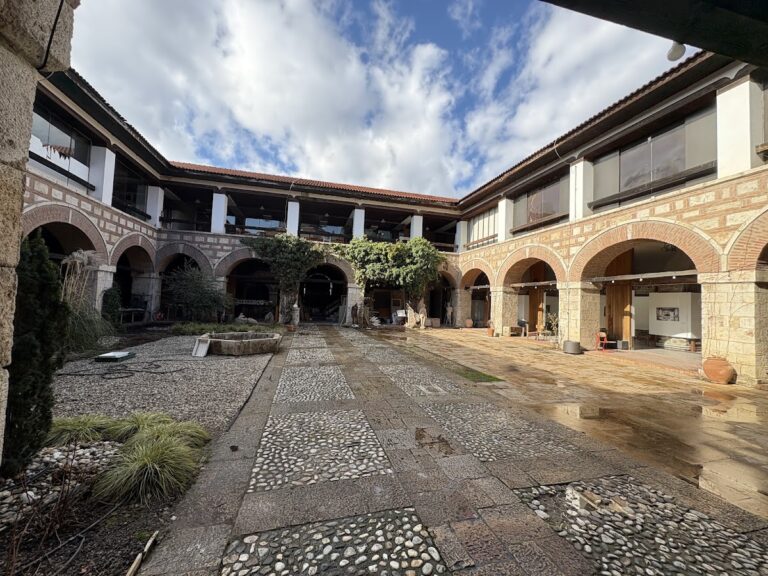
Near Cifte Hamam and Bit-Pazar, Suli Han was built in the first half of the fifteenth century by Ishak Beg as an endowment of the Ishak Beg Mosque. During the sixteenth century it was converted into shops, many of them owned by Jewish merchants. Damage in 1689 was followed by near destruction in 1963 and subsequent restoration. The square complex covers 2,101 square metres and has massive walls, vaults, rooms on all four sides, an 18-column porch, and east and west entrances. Goods were kept on the ground floor and travellers lodged above. The name means “water inn,” referring to its former proximity to the Serava. Suli Han now houses the Old Bazaar Museum and, since 1982, the Academy of Art.
Kuršumli Han
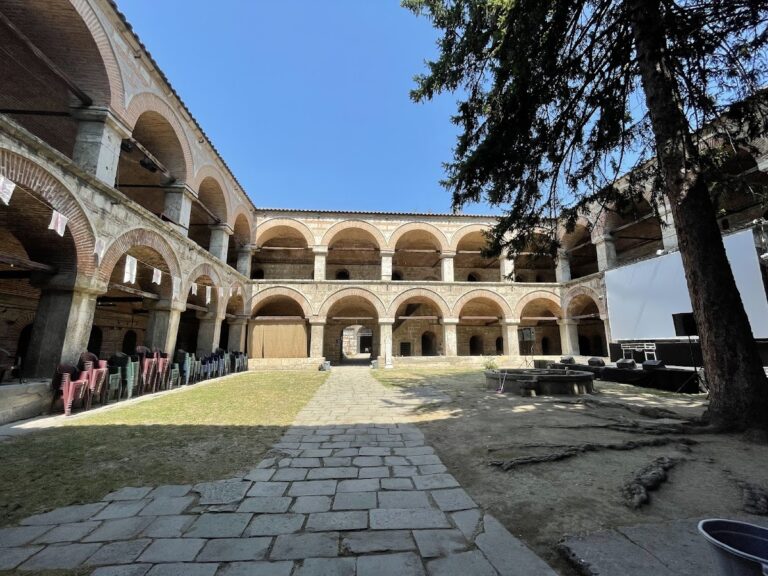
Kuršumli Han is the largest of the former caravanserais in the bazaar. Its construction date is disputed, with proposed dates ranging from the sixth to the sixteenth century and attributions to Isa Beg, Dubrovnik merchants, or Mula Musledin Hodja. It served as a commercial and craft inn, later becoming a prison in 1787 and again from 1904 to 1912. The building covers about 2,800 square metres and contains 60 rooms on two floors, stables, a courtyard fountain, and open porches. Alternating brick-and-stone masonry forms its walls, while small pyramid-like domes were formerly covered with lead. It was restored after the 1963 earthquake. Its name means “lead inn.”
Bezisten
The Bezisten, a covered commercial market, stands above the western entrance of Suli Han. Originally built in the fifteenth century under Ishak Beg, it was destroyed in the fire of 1689 and rebuilt in 1899 and 1900. Archaeological work in 1964 and 1965 revealed foundations, wall remains, and two columns belonging to the earlier vaulted market. The present rectangular stone building has four entrances, internal lanes, two-storey shops, a timber roof, and two isolated two-storey structures.
Mosques, religious foundations, and the clock tower
Murat Pasha Mosque
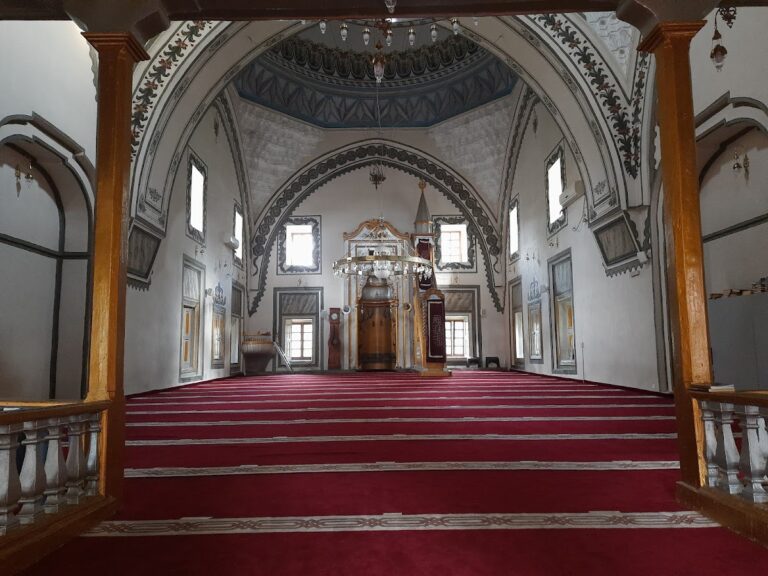
The present Murat Pasha Mosque was erected around 1802 and 1803 after an earlier mosque burned in 1689. Its square building combines Ottoman Baroque architecture with Neoclassical Islamic elements. It has a four-sided roof, a wooden coffered ceiling, a gallery, a mihrab, or prayer niche indicating the direction of Mecca, and a minbar, the pulpit used for sermons. The courtyard contains a fountain from 1937 and three gravestones dated 1741, 1790, and an uncertain year.
Cifte Hamam
Between Murat Pasha Mosque and Suli Han, Cifte Hamam was built in the second half of the fifteenth century as an endowment of Isa Beg. It is a double bathhouse with separate men’s and women’s sections that join in the bathing area. Stone, brick, and mortar form the structure, which has two large domes and several smaller ones. The facilities included changing rooms, heated side rooms, tiled seats, and marble basins. One women’s room was adapted for the ritual bathing of Skopje’s Jews. Damaged in 1963, the hamam was restored and now houses part of the National Gallery’s collection.
Mustafa Pasha Mosque
Mustafa Pasha Mosque was built in 1492 on the foundations of a medieval church. The square, early Constantinopolitan-style building has a dome 16.3 metres in diameter and a marble porch with four columns, semicircular arches, and three small domes. Its minaret is about 47 metres high. The complex includes the domed tomb of Mustafa Pasha, the sarcophagus of his daughter Umi, a fountain, gravestones, and remains of an imaret and madrasa, an Islamic educational institution.
Ishak Beg Mosque
The Ishak Beg Mosque, also called the Decorated or Aladja Mosque, was built in 1438 and enlarged in 1519 by the addition of two side aisles. It suffered major damage in 1689 and 1963. Its tomb, or turbe, was restored and new faience tiles were installed in 1972. The complex formerly included a tomb, madrasa, charitable kitchen, residences, and an early Islamic library. The madrasa contained ten rooms and taught religious studies, Islamic law, Oriental languages, philosophy, and mathematics.
Isa Beg Mosque
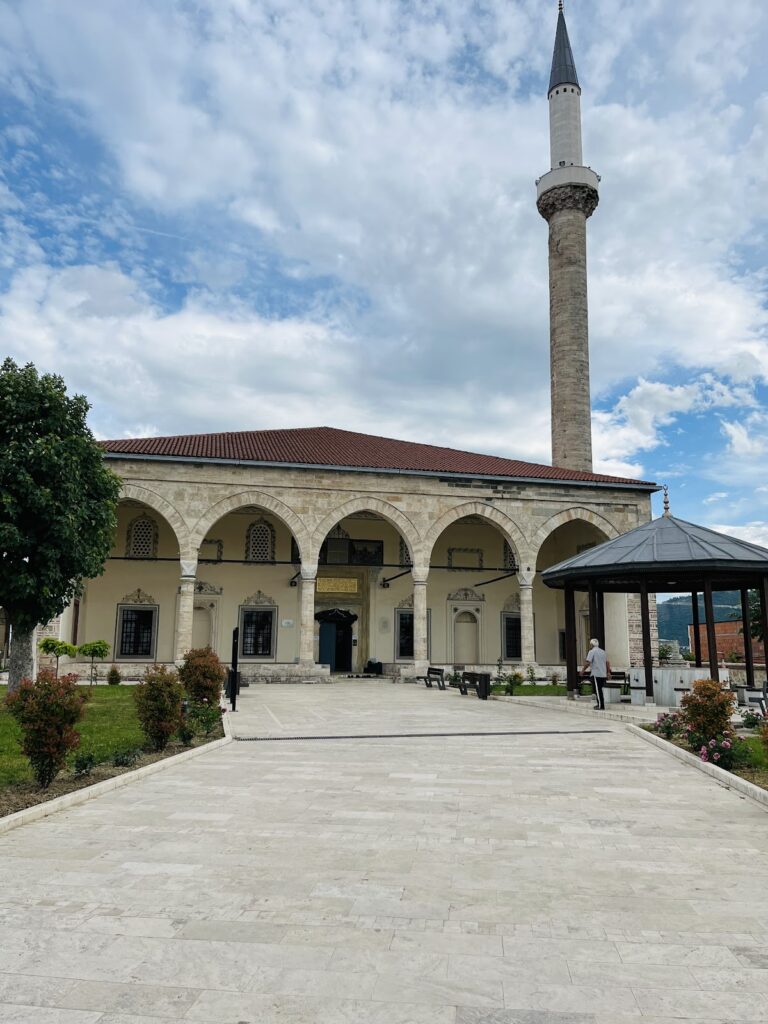
North of the Sultan Murad Mosque and opposite Bit-Pazar, the Isa Beg Mosque was built in 1475. Its minaret collapsed during the 1963 earthquake, and the mosque and minaret were later restored. Two large lead-covered domes rise above the building, while the porch has five small domes. Other features include a 34-metre minaret, carved wooden doors, and the marble sarcophagus of Haznadorat, Isa Beg’s bookkeeper. The former complex also contained a madrasa and a library that held more than 320 manuscripts.
Sultan Murad Mosque and Clock Tower
The Sultan Murad Mosque stands east of Bit-Pazar on the traditionally accepted site of the former Monastery of St George. Built in 1436 as an endowment of Sultan Murad II, it burned in 1537 and was restored by Suleiman the Magnificent. Severe damage in 1689 led to rebuilding in 1712 under Ahmed III, followed by further alterations in 1912 and repairs after 1963. Its courtyard contains the tombs of Bikij Han and Ali Pasha of Dagestan, as well as the Clock Tower.
The Clock Tower was built between 1566 and 1572 on the remains of an earlier defensive tower associated with the Monastery of St George. It reportedly received its clock from the conquered Hungarian town of Sziget. The tower was damaged in the 1689 fire and remodelled in 1904 under Hafiz Pasha. The 1963 earthquake badly damaged it and destroyed its mechanism, while new clocks were installed in 2008. Its earlier form had a hexagonal base and a wooden upper structure; the upper part was later rebuilt in brick. A stairway of 105 steps leads to the clocks.
Other surviving and reconstructed mosques
Kose Kadi Mosque, near the Bezisten, is generally placed in the eighteenth century, although its construction date is uncertain. Reconstruction began in 1992 and the mosque reopened in 1996, with shops on the ground floor and the prayer space above. Hudaverdi Mosque, between Kuršumli Han and Bit-Pazar, is generally dated to the late fifteenth or early sixteenth century and was rebuilt repeatedly, most recently in 1995. Haji Balaban Mosque, between Kuršumli Han and Dukandjik Mosque, has an uncertain fifteenth-century date and survives in altered but generally good condition.
Dukandjik Mosque stands at the edge of the bazaar. Its exact date is unknown, although a document concerning its builder, Muazzin Hodja the Merchant, gives 1549 as the latest possible date. The 1963 earthquake largely destroyed it, leaving the minaret. Reconstruction began in 2004 and the mosque reopened in 2007. It is a single-space domed building with a high drum, pendentives, a two-dome porch, an external mihrab, stalactite ornament, and a polygonal minaret.
Fortress, markets, and museums
Skopje Fortress
Skopje Fortress occupies Kale Hill on the Vardar’s left bank and partly borders the western side of the bazaar. The hill contains evidence of prehistoric occupation, later settlements, successive walls, and medieval fortifications. The oldest principal wall elements are attributed to the period of Samuel, while further walls and towers were added in the eleventh century, under the Komnenian dynasty, and under later medieval rulers. The fortress has a triangular plan, steep southern and western slopes, and an eastern side descending toward the Serava.
Until the army left in 1951, the fortress was used for stores, powder magazines, a military hospital, and a prison. The 1963 earthquake damaged its walls, towers, and buildings. Archaeological investigations took place between 1953 and 1967 and resumed from 2007.
Bit-Pazar
Bit-Pazar occupies the northern entrance to the bazaar beside the former main northern gate. It stands on the medieval fairground and monastery meadow where the annual and weekly markets were held between 1028 and 1034. Its enclosed area contains stalls and temporary shops, while permanent construction is not permitted.
Museum of Macedonia
The Museum of Macedonia occupies a group of buildings near Kuršumli Han and beneath the fortress. The complex covers more than 10,000 square metres, including about 6,000 square metres of exhibition space, and contains archaeological, historical, ethnological, and art collections together with a conservation laboratory. Its institutional predecessors include an archaeological museum founded in 1924, the National Museum founded in 1945, separate archaeological and ethnological museums established in 1949, and a historical museum founded in 1953. Buildings were constructed in 1976, the three museums merged in 1984, and an art department was added in 1991.
Old Bazaar Museum
The Old Bazaar Museum occupies part of Suli Han. Its displays include archaeological material, historical photographs, maps, plans, artworks depicting the bazaar, and ethnological presentations of local crafts. Together they explain the quarter’s medieval and Ottoman buildings, trades, and social life.
Churches, former buildings, and lost communities
Church of the Holy Salvation
The Church of the Holy Salvation was built in the mid-sixteenth century on the foundations of an older church. Its present nineteenth-century appearance followed damage in the 1689 fire. The iconostasis was completed in 1824, and Dico Zograf painted small icons in 1867. Ottoman restrictions on the height of Christian buildings required the church to be built partly underground. Its carved iconostasis measures about 10 metres long and 6 metres wide. A marble sarcophagus containing the remains of Goce Delcev stands in the porch.
Former Monastery of St George
The former Monastery of St George was probably founded by Romanos III in the eleventh century and flourished especially between the eleventh and thirteenth centuries. It possessed extensive lands and produced milk, cheese, and wine, selling its surplus at the fairs. The monastery probably stood on the hill now occupied by the Sultan Murad Mosque and Clock Tower, although other locations have been proposed. Its destruction may have occurred in 1436.
Former Old New Bath
The former Old New Bath is generally dated to the fifteenth or sixteenth century. The 1963 earthquake destroyed its front changing-room section. Ruined remains include bathing rooms, a reservoir, and a furnace. The former single bath had a large dome on an octagonal drum, a lantern, a central fountain, and stalactite ornament.
Former synagogues and mosques
The former Bet Aharon Synagogue is dated to 1366 in the surviving historical account and was the first synagogue in Skopje. Its destruction date and circumstances are unknown. The former Bet Yaakov Synagogue stood in the Jewish quarter and contained the Talmud Torah school from 1674. It was rebuilt during the nineteenth century and destroyed during the Second World War. A 1937 parochet, a synagogue curtain, survives in the new synagogue of Skopje’s Jewish community, while the community register known as its pinkas, preserved from 1749 to 1913, is held in the Jewish Historical Museum in Belgrade.
The former Ibni Payko Mosque stood near the Daut Pasha Hamam. Its construction date is unknown; it was recorded until 1946 or 1947 and was probably destroyed during or after the Second World War. The former Yigit Pasha Mosque was built in 1445 on the site of the Church of the Holy Physicians and destroyed during the bombing of Skopje in 1943. Its minaret and open hexagonal tomb were later destroyed, although Pasha Yigit Beg’s grave remains identifiable.
Former Kazandjiler Mosque and Gulciler Hamam
The former Kazandjiler Mosque was built in the seventeenth century by the coppersmiths’ guild and destroyed in the 1963 earthquake. Gulciler Hamam was built in the second half of the fifteenth century by Mula Musledin Hodja and operated as a bathhouse until the fire of 1689. It was destroyed in 1963, leaving wall remains. The bathhouse was also known as Kuri Hamam, meaning “dry bath.”
Urban form and surviving character
The historic Imperial Road ran from the Stone Bridge past the Jewish quarter, a vanished monumental caravanserai, a mint, and the Daut Pasha Hamam. The bazaar’s boundaries were not formally defined until 2008, although its streets and building groups had long formed a recognizable urban quarter. Parts of the area and many buildings were altered after 1963, yet the surviving network of more than 50 historic blocks, narrow craft lanes, religious buildings, inns, bathhouses, and public institutions continues to express the layered development of Skopje’s Old Bazaar.
Nearby sites