Church of Saint Catherine, Thessaloniki: A Late Byzantine Orthodox Church


Site at a Glance
- Rating
- 4.8
- Popularity
- Low
- Country
- Greece
- Primary era
- Medieval
- Eras represented
- Medieval
- Civilizations
- Byzantine
- Site type
- Religious
- Remains
- Church
On this page7 sections
History
The Church of Saint Catherine is a late Byzantine church in Greece, built in Thessaloniki during the Palaiologan period, the later Byzantine era associated with the Palaiologos dynasty. Its construction belongs to the late thirteenth or early fourteenth century, and the building was completed in the fourteenth century. It stands in Ano Poli, Thessaloniki’s historic upper district, and remains an active Greek Orthodox church.
Late Byzantine origins
The church’s precise construction date and first dedication are uncertain. Surviving fragments of its interior decoration date to around 1315, and the building has therefore been identified as a possible katholikon, or principal church, of the Monastery of Christ Pantokrator. The detailed scenes from Christ’s life in the fresco program also support the proposal that the church was originally dedicated to Christ Pantokrator, the Orthodox image of Christ as Almighty or universal ruler.
Ottoman conversion
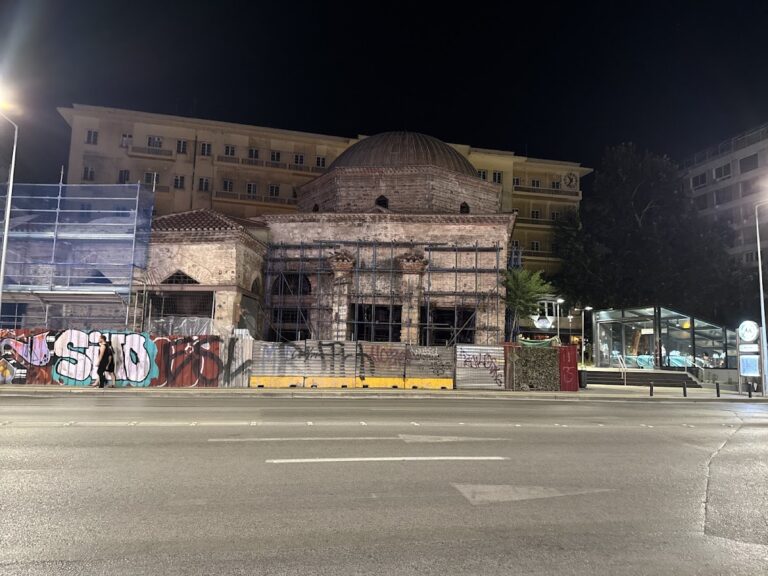
After Thessaloniki came under Ottoman rule during the reign of Sultan Bayezid II, who ruled from 1481 to 1512, Yakup Pasha converted the church into a mosque. Yakup Pasha was an Ottoman pasha, a senior official or military commander, and the building became known as the Yakup Pasha Mosque. Its Islamic phase lasted approximately from the sixteenth century until 1921.
Return to Orthodox use
Thessaloniki was incorporated into Greece in 1912. From 1921, the building entered its present phase as a church dedicated to Saint Catherine of Alexandria, a Christian martyr venerated as one of the great martyrs in Eastern Christianity. The church belongs to the Metropolis of Thessaloniki within the Ecumenical Patriarchate of Constantinople, one of the principal patriarchates of Eastern Orthodox Christianity. In 1988, it became part of the UNESCO World Heritage property “Paleochristian and Byzantine Monuments of Thessaloniki.”
Remains
Plan and sanctuary spaces
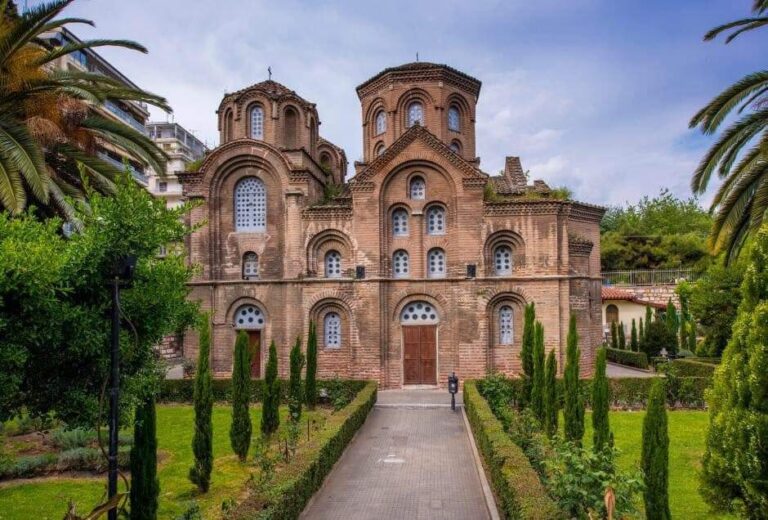
The church has a complex four-part cruciform plan crowned by five domes. A closed outer porch leads eastward toward the prothesis, the chamber where Eucharistic offerings are prepared, and the diakonikon, a service chamber associated with the sanctuary. These eastern spaces now function as the Chapel of Saint Euphemia, giving the building a layered arrangement of central, sanctuary, and subsidiary areas.
Fresco decoration
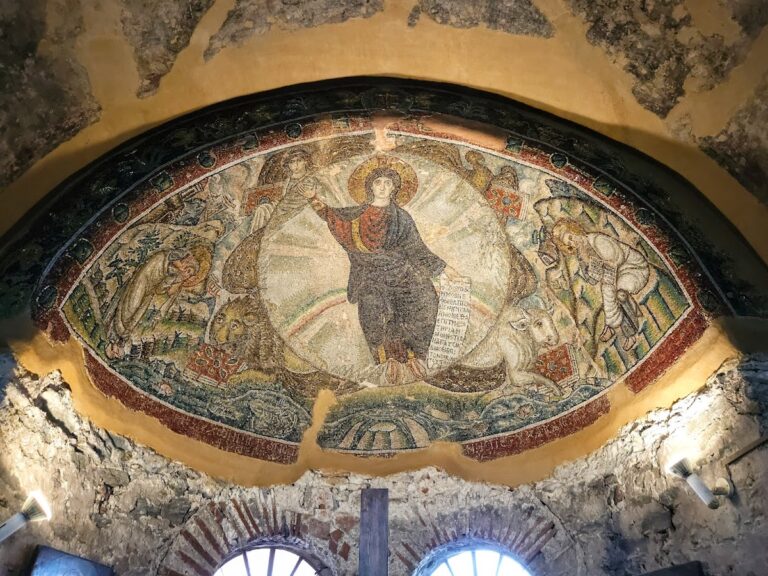
Fragments of the painted interior survive throughout the church. In the apse, the semi-circular end of the sanctuary, frescoes show hierarchs, or senior church leaders, and apostles. One dome contains prophets and angels gathered around Christ Pantokrator, while the northwestern dome bears an image of Christ Emmanuel, a representation of Christ associated with the biblical name meaning “God with us.”
The main church preserves fragmentary scenes of Christ’s miracles, including the Wedding at Cana, the healing of the paralytic, the healing of the blind, the healing of the leper, the calming of the lake’s waters, and Christ’s conversation with the Samaritan woman. Other surviving paintings depict saints and ascetics. Together, these detailed scenes form the artistic basis for connecting the church with an original dedication to Christ Pantokrator.
Nearby sites