Beška Monastery: A Serbian Orthodox Monastic Complex in Montenegro


Site at a Glance
- Rating
- 4.9
- Popularity
- Very Low
- Country
- Montenegro
- Primary era
- Medieval
- External website
- Open
- Eras represented
- Medieval
- Civilizations
- Unclassified
- Site type
- Religious
- Remains
- Monastery
On this page9 sections
History
Beška Monastery is a Serbian Orthodox women’s monastery in Montenegro, situated on Beška Island in Skadar Lake. Its foundation date is uncertain, but it probably began when the Church of St. George was built in the late fourteenth century. The monastery belongs to the Metropolitanate of Montenegro and the Littoral, the Serbian Orthodox Church jurisdiction covering Montenegro and the Littoral region, and stands within the historical region of Zeta.
The Balšić Foundation
The Church of St. George was built in the 1380s or 1390s by Đurađ II Stracimirović Balšić, who ruled Zeta from 1385 to 1403. Zeta was a medieval polity in the southern Adriatic and western Balkan region, ruled during this period by the Balšić dynasty. The monastery became a center of religious and intellectual life during the fifteenth century. Its scriptorium, a monastic workshop for copying and producing manuscripts, created notable works including the Hexaemeron, a religious text concerning the six days of Creation, and the Gorica Collection, a compilation of spiritual and personal correspondence.
After Đurađ II died, his widow Jelena Balšić restored the neglected Church of St. George between 1438 and 1440. She also founded the Church of the Annunciation to the Theotokos as her burial church. In Orthodox Christianity, the Theotokos is the Virgin Mary understood as the God-bearer. The Annunciation church’s ktetor inscription, which records the foundation or patronage of a church, identifies Jelena as its founder and principal donor.
Ottoman Devastation and Later Restoration
The monastery was devastated during the Ottoman period. Its churches were damaged or destroyed, and their frescoes were lost. The church estates later became waqfs, charitable or religious endowments under Islamic law, and were treated as mosque endowments.
At the beginning of the twentieth century, King Nicholas I of Montenegro restored the Church of the Annunciation for the health of his wife, Milena. The Gorica Collection was not yet known, and the church’s original dedication had not been identified, so the restored building was dedicated instead to the Feast of the Deposition of the Robe of the Theotokos. During the rule of Yugoslav leader Josip Broz Tito in the mid-twentieth century, the monastery again fell into neglect.
Renewal and Contemporary Religious Life
Archaeological excavations in the 1980s revealed fragments of monastic cells west of the Church of St. George and a road linking the landing place with the monastery gate. From 1 to 7 February 2002, followers of Mihailo Dedeic, head of the Montenegrin Orthodox Church, occupied the monastery. After they departed, Metropolitan Amfilohije Radovic performed a rite of purification on 8 February, and restoration began later that year.
The Metropolitanate reconstructed the Church of the Annunciation in 2002. Jelena Balšić’s sacred remains were then placed in a new stone reliquary. Her connection with Beška was further commemorated when the Metropolitanate of Montenegro and the Littoral canonized her in 2006, granting her the honorific Blagovjerna, meaning pious or blessed.
Beška is now a women’s monastery. An hieromonk, an ordained Orthodox monk able to perform priestly duties, named Efrem Dabanovic lived there in 2002. Since 28 June 2004, the monastery has been headed by Abbess Fotina Hasl, the female head of the convent. The community is stated to include six sisters, comprising two nuns and four novices, one of them from Moscow.
The complex has also been involved in disputes over ownership. One church was reportedly uninhabited and owned by a local mosque until negotiations transferred ownership to the Serbian Orthodox Church. In 2019, about twenty people from nearby Donji Murici claimed that the monastery’s land was mosque-endowment property, creating a dispute with the nuns.
Remains
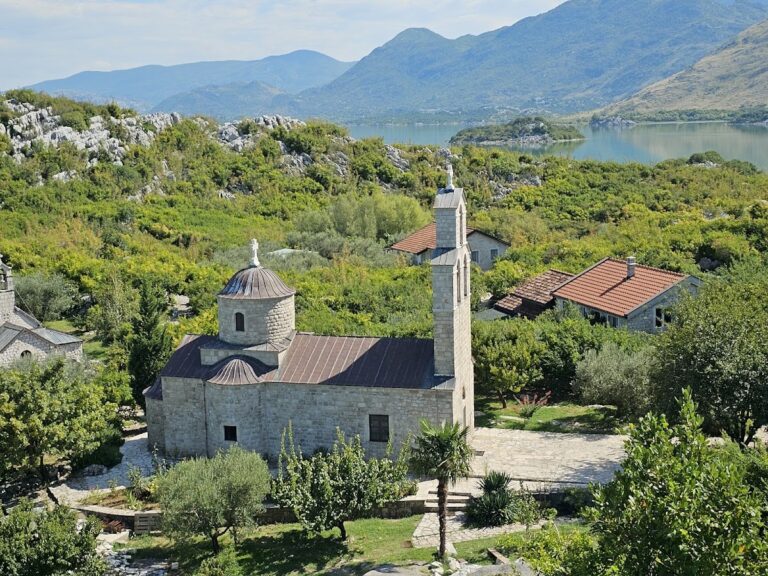
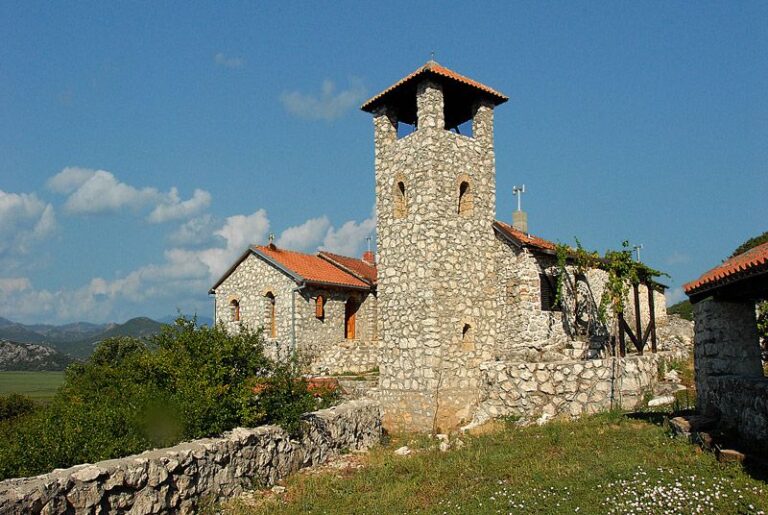
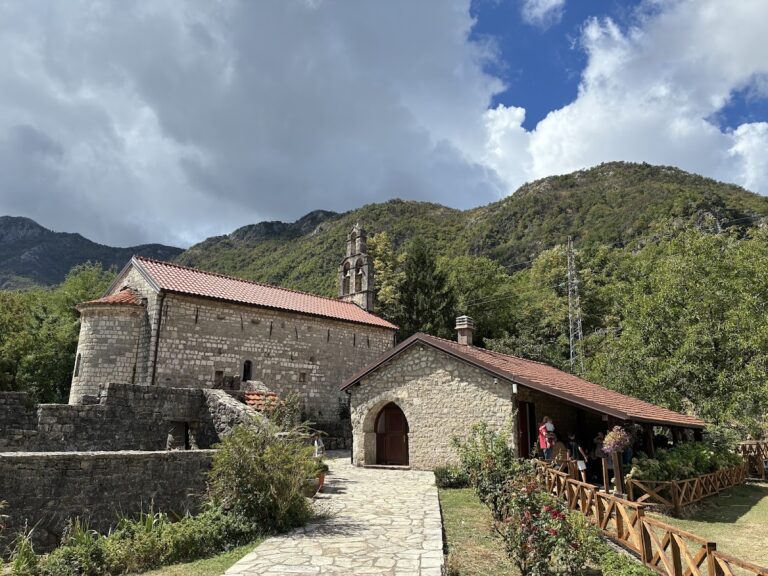
Beška Monastery occupies an island in the southwestern part of Skadar Lake, approximately 15 kilometres from Virpazar. Its surviving complex is organized around two churches, the larger Church of St. George and the smaller Church of the Annunciation to the Theotokos. The buildings combine medieval Serbian Orthodox church forms with later repairs and reconstruction.
The Two Churches
Church of St. George
The Church of St. George stands on an open plateau. Built as a single-domed church, it follows the Serbian three-conch, or trefoil, plan, in which the eastern end and sides form a three-lobed arrangement. A tall, flat bell tower with three bells crowns the facade. The church was originally painted, but its wall paintings have not survived.
A grave beside the church’s south wall is traditionally regarded as the burial place of Đurađ II Balšić, the founder associated with the building. His burial and Jelena Balšić’s burial within the complex preserve the connection between the monastery and the Balšić ruling family.
Church of the Annunciation
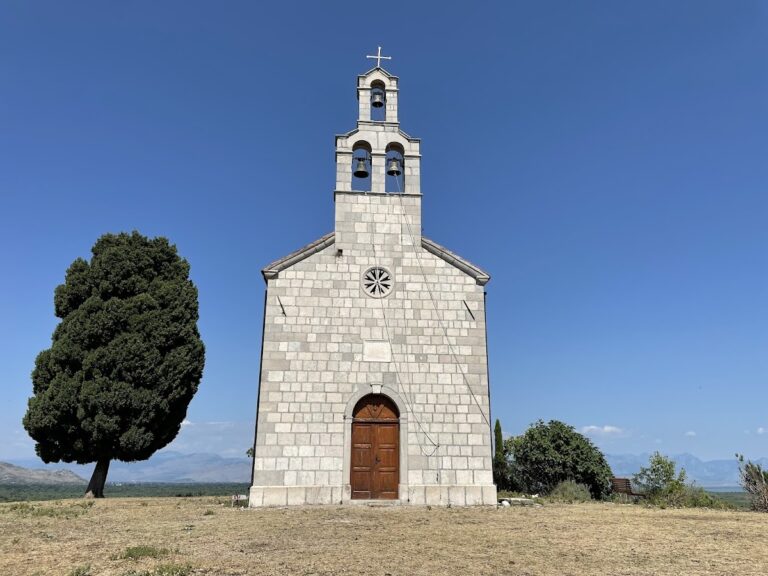
The Church of the Annunciation is smaller than the Church of St. George and has a small bell tower. Its western facade is fully covered with stone carving. Above the entrance, a ktetor inscription states that the church was built through the efforts and expense of the pious Jelena, daughter of the deceased Prince Lazar and wife of Lord Đurađ Stracimirović, in the year corresponding to 1438.
Jelena Balšić’s tomb lies in the church’s southern chapel. Two chapels were added to the building at a later date, and the southern chapel served as a burial chapel. Only its ruins remain. The church was originally decorated with frescoes, which have not survived. Following the 2002 reconstruction, Jelena’s sacred remains were placed in a stone reliquary.
Monastic and Archaeological Features
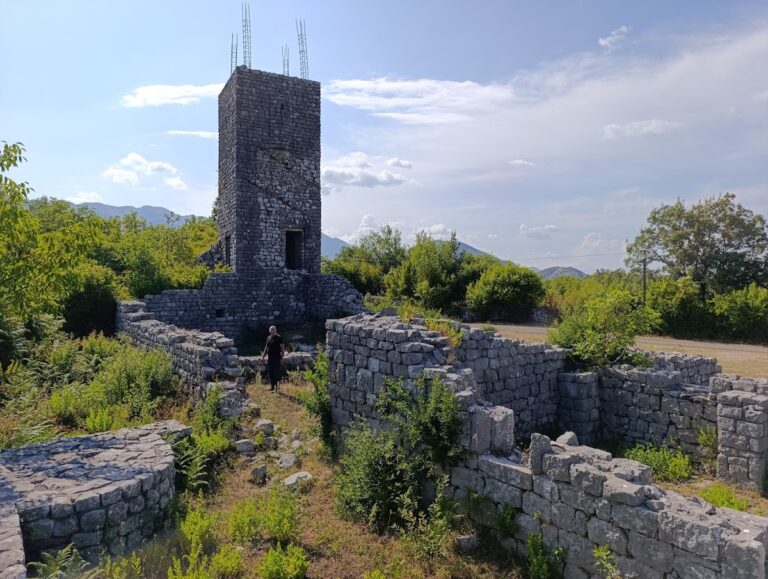
Excavations on the island uncovered fragments of monastic cells west of the Church of St. George. They also revealed a route running from the landing place to the monastery gates, providing archaeological evidence for how the monastic complex was connected to the island’s arrival point. Together with the two churches, these remains define the surviving physical arrangement of Beška Monastery.
Nearby sites