Saint George Monastery, Ritini: A Late-Medieval Orthodox Monastery in Greece


Site at a Glance
- Rating
- 4.9
- Popularity
- Very Low
- Country
- Greece
- Primary era
- Medieval
- External website
- Open
- Eras represented
- Medieval, Early Modern
- Civilizations
- Ottoman
- Site type
- Religious
- Remains
- Fortified Monastery
On this page12 sections
History
Foundation in the Late Middle Ages
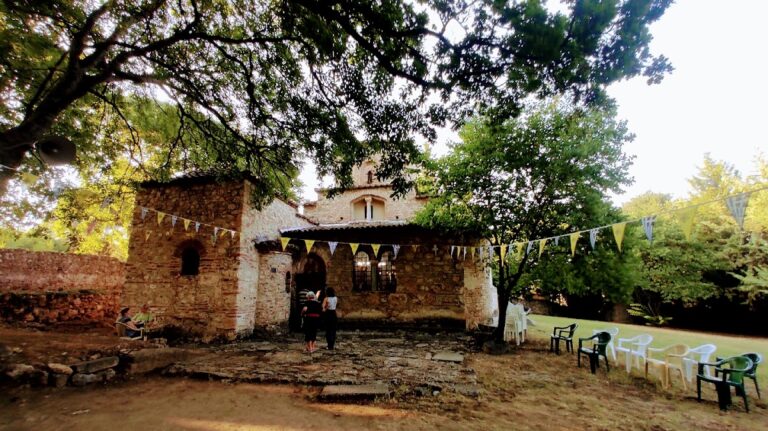
Saint George Monastery, Ritini is a late-medieval Orthodox monastery in Greece. Its principal church, known as the katholikon, or main church of an Orthodox monastery, was built in 1493–1494. The monastery belongs to the Ecumenical Patriarchate, a senior institution within the Eastern Orthodox communion, and to the Diocese of Kitros, Katerini, and Platamon.
A founder’s inscription on the church’s western exterior names Kiryak Lambu as the patron. Lambu is also associated with patronage of churches in Bel. The position and wording of the inscription indicate that he may have financed only the fresco in the entrance niche rather than the entire church. Another inscription inside the building names Bishop Akakios of Petrena, the patron monk Dionysius, and Tryphon, the monastery’s abbot.
Later Ecclesiastical and Military History
The monastery was formerly subordinate to the Diocese of Petrena. A third inscription, placed on the royal doors of the iconostasis, gives the date 1618–1619. The iconostasis is the screen separating the sanctuary from the main body of an Orthodox church, and its royal doors provide the central entrance through that screen. The restored frescoes correspond chronologically with these doors and with the royal icons of the iconostasis.
During the Greek armed propaganda in Macedonia, the monastery served as a base for Greek andart bands. Andartes were irregular armed guerrilla fighters, particularly those associated with nationalist movements in the Balkans. In 1967, the church was declared a protected cultural monument. It remains an active place of worship.
Remains
Setting and Monastic Layout
Defensive Setting
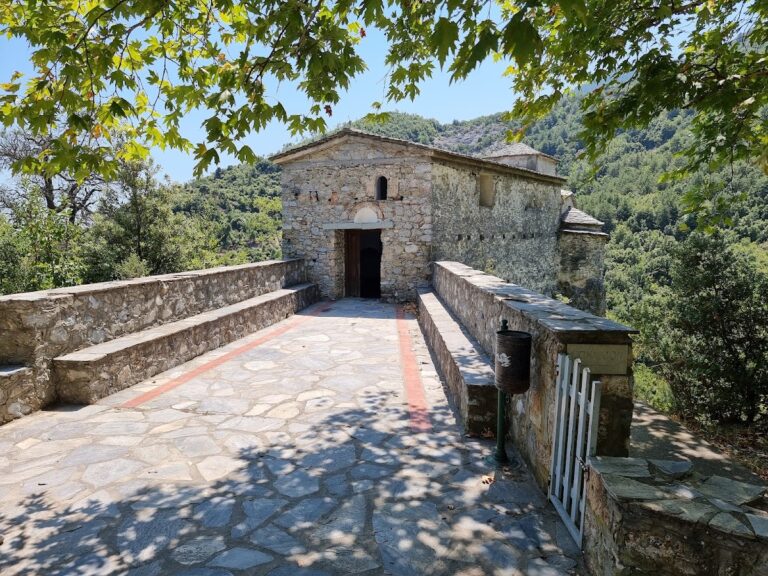
The monastery stands about 2 kilometres northeast of Ritini, on a rock of Mount Flambouro in the Pieria range. Steep slopes protect the site on three sides. The southwest side offers the easiest access, and a defensive wall was built there. Within the courtyard, monastic cells occupy the southern and western sides.
The Monastery Church
The katholikon is a single-nave basilica with a wooden roof. Excluding the narthex, or entrance hall, it measures 11 metres by 5 metres. Its height ranges from 3.75 metres along the long northern and southern walls to 5.50 metres at the gable ends on the narrower eastern and western sides.
The building is set 0.30 metres into the ground. Its masonry is 0.50 to 0.80 metres thick and becomes thinner toward the top. The walls consist of undressed stone with ceramic material in the joints, while horizontal wooden beams reinforce the framework. On the eastern exterior, a projecting semicylindrical apse, the rounded sanctuary end, corresponds to the central niche of the altar. A second niche, the prothesis, is set within the thickness of the eastern wall. The prothesis is the sanctuary area used to prepare the Eucharistic gifts.
Inscriptions, Frescoes, and Icons
Saint George in the Western Niche
The niche above the entrance contains an image of Saint George dated 1493–1494. Saint George was a Christian martyr and widely venerated saint, traditionally shown as a mounted warrior defeating a dragon. Here he appears frontally before a lake, riding toward the viewer’s right and thrusting a spear into a thin, elongated serpent beneath the horse’s feet.
The saint wears a cloak. His horse has a pearl-encrusted crown and a richly formed tail tied twice in a knot. The praying princess of Lazia stands beside the dragon’s head. Behind her, a walled city and a royal couple appear on the fortifications. The accompanying inscription presents Saint George as triumphant and victorious. This image may belong to the first decorative phase of the church.
Seventeenth-Century Interior Frescoes
The interior paintings were produced on two occasions and were repeatedly covered with lime. The surviving frescoes date from the seventeenth century and are arranged in two zones. The upper zone presents scenes from four cycles: the Twelve Feasts, the Passion, the Life of Saint George, and the Martyrdom of Saint George. The Twelve Feasts are the major festivals commonly represented in Orthodox church decoration.
The lower zone contains full-length saints and a Deesis, an Orthodox composition centred on Christ with intercessory figures. Conservation by the Ninth Ephorate of Byzantine Antiquities confirmed the surviving paintings as seventeenth-century work.
Sanctuary Imagery
The sanctuary contains scenes connected with liturgical and Eucharistic cycles, together with images of the Virgin Mary and Christ concerning worship and salvation. A half-length Virgin Mary appears in a sanctuary niche under the title Wider than the Heavens. She is shown in the Blachernitissa type.
In a northeastern sanctuary niche, Christ appears in the Tomb up to the thighs, standing inside a sarcophagus with his hands crossed high on his chest. Behind him are the cross, spear, and sponge, the instruments associated with Christ’s suffering and crucifixion.
The Nineteenth-Century Saint George Icon
An icon of Saint George dated 1852 was made by Yoan Samarinski and his brother Simo. It forms part of the later devotional history of the monastery alongside the earlier wall paintings and the dated royal doors.
Nearby sites