Ardenica Monastery: An Albanian Orthodox Monastic Complex


Site at a Glance
- Rating
- 4.7
- Popularity
- Low
- Country
- Albania
- Primary era
- Early Modern
- External website
- Open
- Eras represented
- Medieval, Early Modern, Modern
- Civilizations
- Byzantine, Ottoman
- Site type
- Religious
- Remains
- Monastery
On this page11 sections
History
Ardenica Monastery is an Albanian Orthodox monastery in Albania, dedicated to the Nativity of the Theotokos, an Eastern Christian title for Mary meaning “Mother of God.” Affiliated with the self-governing Orthodox Autocephalous Church of Albania, the monastery occupies the Ardenica Hills and combines Byzantine Orthodox architecture with Romanesque features. Its foundation date remains uncertain, but the complex has been associated with medieval Byzantine history, the religious life of the region, and the cultural development of Albanian Christianity.
Origins and Medieval Setting
The monastery’s construction is traditionally linked with Andronikos II Palaiologos, the Byzantine emperor who ruled from 1282 to 1328. According to this tradition, he began the monastery in 1282 as a thanksgiving offering after the Byzantine victory over Angevin forces during the siege of Berat in 1280–1281. The Angevins belonged to a ruling dynasty originating in Anjou that controlled territories in southern Italy and elsewhere during the medieval period. Another date associated with the monastery’s foundation is 1600, so its early history cannot be reduced to a single confirmed construction date.
Ardenica was built beside an older Chapel of the Holy Trinity. One further hypothesis proposes that the chapel or monastery occupied the site of an earlier pagan temple dedicated to Artemis, the ancient Greek goddess especially associated with hunting and wilderness. The possible connection between Artemis and the name Ardenica remains an etymological hypothesis. The monastery stands about one kilometer west of the southern branch of the ancient Via Egnatia, a major Roman road linking the Adriatic coast with the eastern Roman and Byzantine territories. Older construction remains around the complex suggest that a settlement may once have occupied the area. An Ottoman register from 1431–1432 lists a village called Ardenica with eight households, which may have extended around the monastery.
Skanderbeg’s Marriage
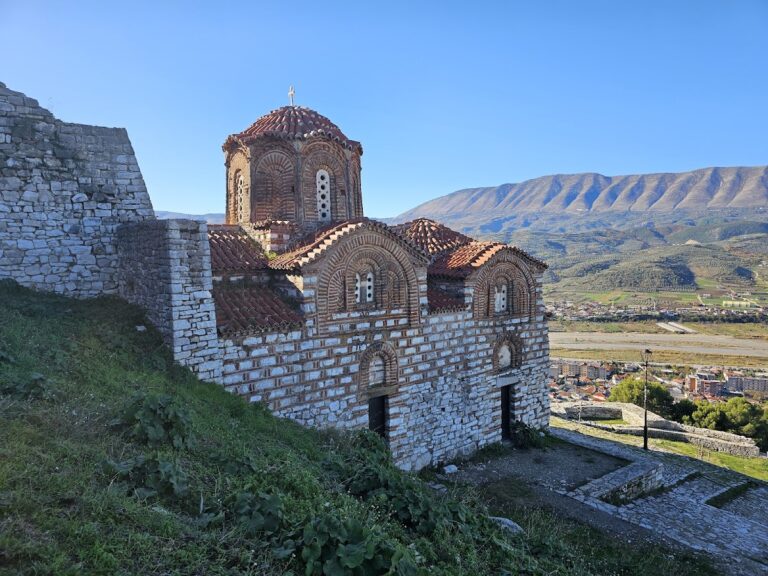
The monastery’s Church of the Holy Trinity was the setting for the marriage of George Kastrioti, widely known as Skanderbeg, and Andronika Arianiti, also identified as Donika Muzaka, on 21 April 1451. Skanderbeg was a fifteenth-century Albanian military leader and national hero. The ceremony took place at midday and was conducted by Felix, Bishop of Kanina, in the presence of Albanian princes and ambassadors from Naples, Venice, and Ragusa. The event was first recorded in 1940 by the Italian writer A. Lorenzoni. The tradition of this marriage later helped protect the monastery during Albania’s atheist campaign.
Renovation and Religious Education
In 1743, Methodius, Bishop of Berat and a native of Bubullime in Myzeqe, initiated renovation and repair work at Ardenica, including work on the Church of Saint Mary. The church was painted the following year by the brothers Kostandin Zografi and Athanas Zografi. Their decoration formed part of a wider eighteenth-century renewal of the monastery, which also included the creation of an elaborate painted and carved interior.
From 1780, Ardenica operated an elementary school in Greek for the training of Orthodox clerics. Its instruction covered the Bible, the liturgy, and the Greek language. During the Albanian National Awakening, the school also became a center for teaching Albanian. In 1817, it was converted into a secondary school with boarding facilities. One of its graduates was Josif, who later became Bishop of Berat.
Library and Religious Traditions
The monastery once possessed a library of approximately 32,000 volumes. Its collection grew during the seventeenth and eighteenth centuries, with support from the Society of the Monastery of Ardenica in Moscopole. The society obtained books from Western Europe, Hungary, and Poland. A fire in 1932 destroyed almost the entire library, removing much of the written record accumulated over the preceding centuries.
Ardenica also preserves traditions connected with Saint Cosmas of Aetolia. Father Mark, a priest serving at the monastery, is traditionally credited with recovering the saint’s body from the Seman River after Turkish cavalrymen had thrown it into the water. He buried the body at the Church of Saint Mary in Kolkondas. Ali Pasha of Tepelena later established a monastery dedicated to Saint Cosmas at that location. Ardenica has also been associated with pilgrimage by Christians and Muslims, partly because of a spring regarded as miraculous.
Twentieth-Century Changes
In the late 1960s, Archbishop Irene Banushi, a former primate of the Orthodox Autocephalous Church of Albania, spent the final years of his life at Ardenica. During Albania’s atheist campaign, which sought to suppress religious practice, the monastery escaped demolition in 1967 after a local priest invoked the tradition that Skanderbeg had married there. The communist state took control of the complex in 1969, closed it to public and clerical use, and allowed its buildings and surroundings to deteriorate.
Partial reconstruction and conservation followed in 1988 because of the monastery’s historical importance. After the fall of the communist regime, the Orthodox Autocephalous Church of Albania recovered possession in 1992. Ardenica had already been placed on Albania’s list of religious cultural monuments in 1948, a status that recognized its value within the country’s religious and historical heritage.
Remains
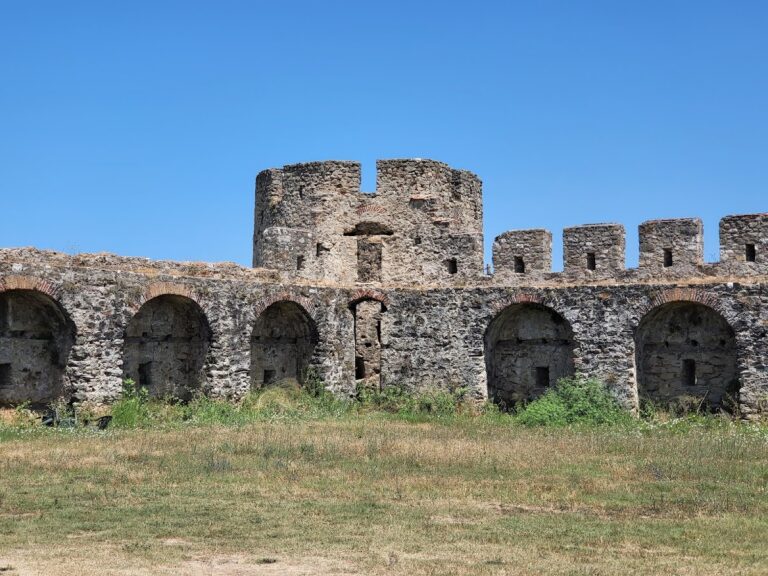
Ardenica Monastery covers approximately 2,500 square meters on the Ardenica Hills, at an elevation of 237 meters above sea level. The complex includes the Church of Saint Mary, also called the Church of the Nativity of the Theotokos, the Chapel of the Holy Trinity, residential monastic buildings, an entrance gate, an oil mill, a bakery or oven, a barn, and a stable. A wall incorporating the entrance gate is described as dating from the thirteenth century. The buildings together preserve the working, residential, and religious components of the monastery.
Central Church
The central Church of Saint Mary is a basilica, meaning a church with a longitudinal plan. It was built partly from stone brought from Apollonia and partly from tuff, a stone formed from compacted volcanic ash. The large church has a wooden roof and a flat ceiling. Its interior is organized into the naos, the principal worship space, the narthex, or entrance hall, and a two-story exonarthex, an outer vestibule. A 24-meter-high gate-type bell tower is attached at the end of the church and was added in 1925.
An open portico on the southern side is formed by columns and arches. Two rows of wooden columns divide the naos into three sections, while an iconostasis, a decorated screen separating the altar area from the main body of an Orthodox church, marks the boundary with the altar. Stone slabs cover the floor of the church, including the narthex and exonarthex. The arrangement preserves the church’s principal processional and worship spaces within the wider monastery.
Holy Trinity Chapel
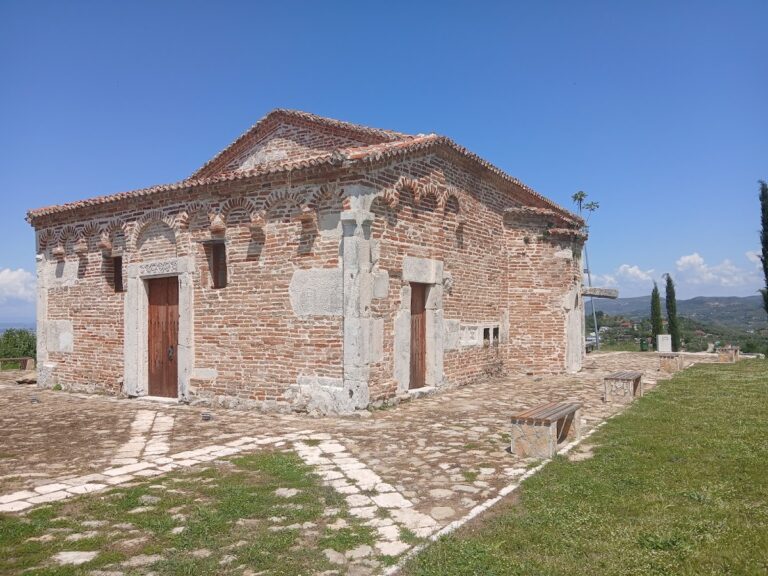
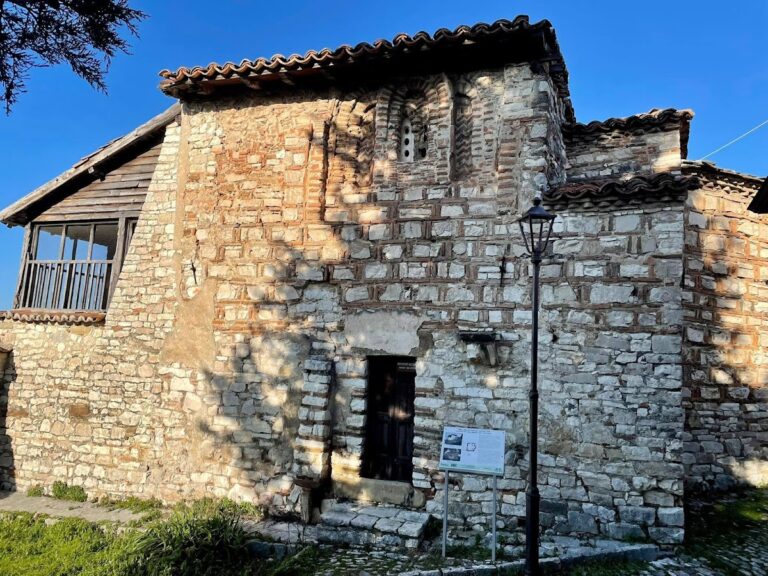
The Chapel of the Holy Trinity stands in the northeastern part of the complex and measures 7.50 by 3.70 meters. Built of tuff, it has an entrance on the western side and two small windows in the southern wall. Inside, a semicircular wall separates the chapel space from a water cistern. The doorway has a stone arch, and a ceramic relief is positioned near the eastern window. The chapel’s location beside the monastery’s main church reflects its importance in the early history of the complex.
Frescoes and Iconostasis
The Church of Saint Mary contains frescoes painted in 1744 by Kostandin Zografi and Athanas Zografi, painters from Korca. Their subjects range across the Old and New Testaments, Orthodox doctrine and liturgy, the lives of saints, the Feasts of the Virgin, the life and Passion of Christ, the Dormition of Saint Mary, and the Descent of the Holy Spirit upon the Apostles. A fresco also depicts John Kukuzelis of Durres, a Byzantine church musician and saint.
The eastern wall of the narthex is occupied by a large Last Judgment scene, a Christian representation of the final judgment of humanity. Another notable work is the fresco of the Seven Holy Men, dated to 1744. These wall paintings, executed in fresco, a technique using paint on plaster, remain central to the church’s interior decoration and religious interpretation.
The carved wooden iconostasis is polychromed and gilded, with two rows of large and small icons. Its icon decoration dates from 1744 and was produced with assistance from coppersmiths and masons from Moscopole. The icons are attributed to the eighteenth-century miniaturist Kostandin Shpataraku. They include the Nativity of the Theotokos, Christ Enthroned, Saint Mary with Christ, John the Baptist, the Meeting of the Archangels, and the Crucifixion.
One icon of Saint Jovan Vladimir includes an image of the fourteenth-century Albanian prince Karl Topia wearing a crown and holding a scepter. The painter identifies him as King of Albania, making the icon an important meeting point between Orthodox religious imagery and Albanian political memory.
Inscriptions and Dated Marks
Dated inscriptions and marks occur throughout the monastery. A dated inscription at the principal entrance records 1477. Another, placed on a lamp in the central church, gives the date 24 March 1724. Above the main entrance to the naos, an inscription records 1744, the year associated with the Zografi frescoes. Additional plaques date from 1754, on the western side of the church’s portico, and 1770, in one of the oven’s arches. A plaque at the present entrance bears the date 1777 and may mark the construction of a new entrance, while the earlier entrance was on the northwestern side. Dates also appear on the monastery’s bells.
Most of the inscriptions and dated marks are in Greek. An important exception is a short prayer written in 1731 by Hieromonk Nektarios Terpos, a monk ordained as a priest. Painted on the northern side of the church, the prayer uses Latin, Greek, Aromanian, and Albanian. Aromanian is a Romance language of the Balkans, and the non-Latin portions of the prayer use the Greek alphabet. Signed by Nektarios Terpos, the text is regarded as the earliest Albanian text written in a Byzantine-era church and as the oldest known Aromanian text.