Bistrița Monastery: A Medieval Moldavian Orthodox Foundation in Romania


Site at a Glance
- Rating
- 4.7
- Popularity
- Medium
- Country
- Romania
- Primary era
- Medieval
- External website
- Open
- Eras represented
- Medieval, Early Modern
- Civilizations
- Ottoman, Principality of Moldavia
- Site type
- Religious
- Remains
- Fortified Monastery
On this page14 sections
History
Bistrița Monastery is an active Eastern Orthodox male monastery in Romania, in the Bistrița River valley near Piatra Neamț. Founded under the Moldavian voivode, or ruling prince, Alexandru cel Bun, its church was built between 1400 and 1402 and dedicated in 1402. The monastery was first mentioned in a document in 1407. Its Byzantine architecture and Classic Moldavian style reflect the Orthodox building traditions of medieval Moldavia, while its religious, cultural, and defensive roles made it an important foundation in the region.
Foundation and princely patronage
Alexandru cel Bun endowed the monastery with villages, estates, and valuable church treasures. Bistrița is traditionally regarded as a foundation shaped by four rulers of the Mușatin dynasty, the ruling house associated with medieval Moldavia: Alexandru cel Bun, Ștefan cel Mare, Petru Rareș, and Alexandru Lăpușneanu. Their patronage produced successive additions, repairs, and renewals that transformed the monastery while preserving its role as a princely religious center.
Ștefan cel Mare added the bell tower in 1498. Petru Rareș later restored the monastery, built the surrounding defensive wall between 1541 and 1546, and renewed the princely residence. Alexandru Lăpușneanu undertook a comprehensive restoration in 1554. Tradition holds that an earlier enclosure wall was destroyed in 1538 by the army of Suleiman the Magnificent, the Ottoman sultan whose campaigns extended Ottoman power across southeastern Europe. The replacement wall was constructed during Petru Rareș’s reign and rebuilt in 1776 by Iacov the Archimandrite, the monastery’s abbot.
Later alterations and restoration
The princely residence was repaired in 1792, when its windows and doors were enlarged. This work caused the loss of substantial portions of its original frescoes. A further major reconstruction took place in 1855 under the architect Carol Benesch. Major restoration works carried out between 1967 and 1984 recovered much of the monastery’s earlier appearance.
Bistrița remains an active monastery and is under the Metropolitan of Moldavia and Bukovina. Its historical and archaeological importance is associated with its medieval buildings, princely burials, religious objects, manuscripts, paintings, and inscriptions. The monastery is included in Romania’s national register of historic monuments under classification code NT-II-a-A-10593.
Religious memory and scholarship
The monastery church contains the burials of Alexandru cel Bun, his wife Ana, Alexandru, the son of Ștefan cel Mare, Chiajna, the wife of Ștefan Lăcustă, and Anastasie, Metropolitan of Suceava. Bistrița also became a religious and cultural center for calligraphers, miniaturists, and chroniclers, linking prayer and commemoration with the production of written and illuminated works.
The monastery’s icon of Saint Anne is traditionally associated with a gift made in 1401 to Lady Ana, the wife of Alexandru cel Bun. According to this tradition, Empress Irena, also called Ana, wife of the Byzantine emperor Manuel II Palaiologos, and Matthew, Patriarch of Constantinople, sent the icon to Suceava through the hieromonk Grigorie Țamblac and Manuil Arconti. Lady Ana and the abbot Dionisie, also called Dometian, brought it to Bistrița in 1407 or 1408. Saint Anne, regarded in Christian tradition as the mother of the Virgin Mary, has been venerated at the monastery as a protector of families, children, and the sick.
The icon was restored in the eighteenth century. In 1853, after recovering from a serious illness at Pângărați Monastery, its abbot Varnava donated a carved and gilded wooden setting. An inscription above the setting records the circumstances associated with this donation.
Bistrița’s memorial register, or Pomelnicul de la Bistrița, was begun, continued, and completed at the monastery. A memorial register, known in Orthodox practice as a pomelnic, is a liturgical record of people commemorated in prayer. The Bistrița register also preserves names of Moldavian rulers and their families, hierarchs, abbots, monks, donors, high officials, and soldiers who died at the Battle of Vaslui in January 1475. It therefore provides important information about the early political and ecclesiastical history of Moldavia.
Axinte Uricarul first cited the register in the eighteenth century. Its introductory entry gives 1407 as the beginning of its compilation. The first three leaves were probably copied during Ștefan cel Mare’s reign from an earlier register begun in 1407, perhaps written on wooden tablets or painted on the wall of the proskomideion, the part of an Orthodox church where the bread and wine are prepared for the Eucharistic liturgy. Further names and notes were added until the final entry in 1682, and the text was later rendered into Romanian. Changes in handwriting indicate that several scribes contributed to it, probably monks working under the abbot’s direction in the sanctuary, the abbot’s residence, or the monastic cells.
Remains
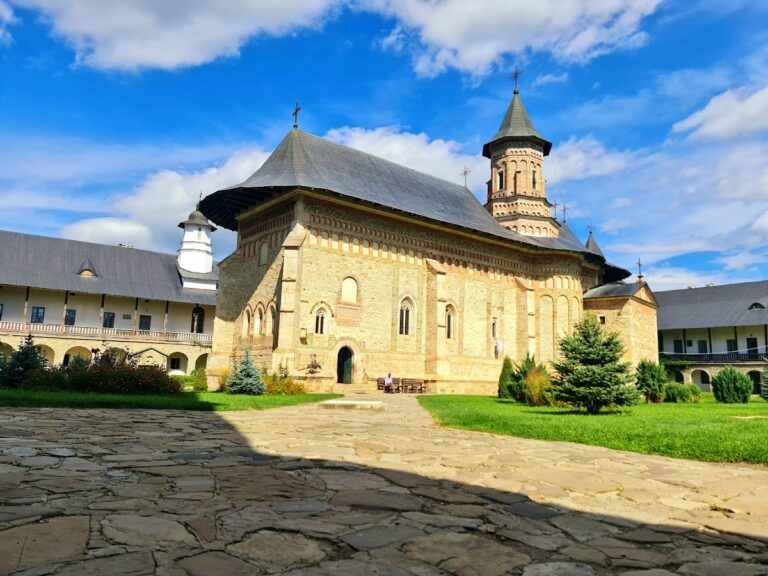
The monastery occupies an almost square precinct enclosed by a stone wall approximately 4 to 6 metres high. The church stands at its center, while towers, residences, monastic cells, and service buildings occupy the surrounding spaces. Parts of the enclosure retain battlements and a guard parapet, or defensive walkway, reflecting the combination of religious and defensive functions that shaped the complex.
Church and central precinct
Monastery church
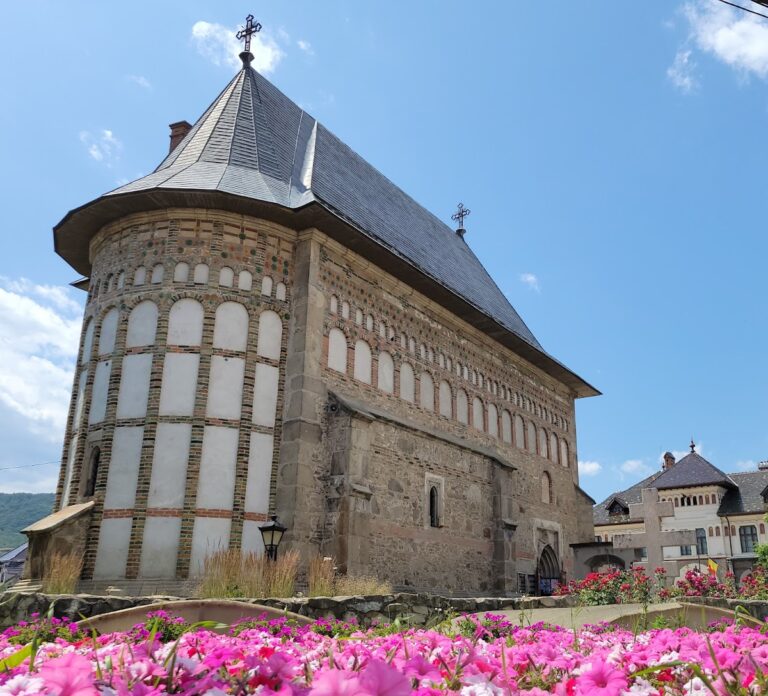
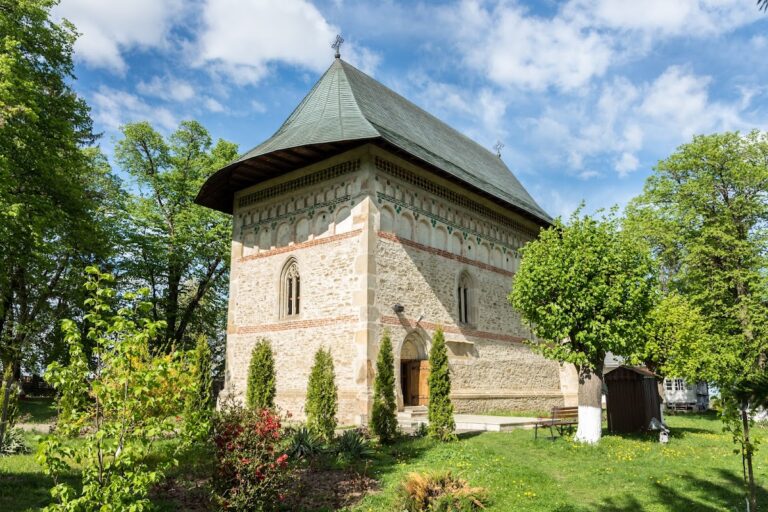
The church is built in Byzantine style and is also classified as an example of Classic Moldavian architecture, a regional form combining Byzantine elements with Moldavian forms and decoration. It has a south-facing façade, measures approximately 40 metres in length, and reaches about 45 metres at its greatest height. Rich ornament and detailed frescoes contribute to its interior and exterior character. Its fifteenth-century entrance door survives from the period of construction and is noted for its elaborate workmanship.
Defensive enclosure and entrance tower
Entry to the precinct is through the vaulted passage of a tower. A chapel dedicated to Saint Nicholas occupies the tower’s upper floor. The entrance tower, the building immediately to its left, and the surrounding wall were constructed during Petru Rareș’s rule, between 1541 and 1546. Their arrangement forms the principal fortified entrance to the monastic enclosure.
Medieval towers and residences
Bell tower and Saint John chapel
In the northeastern part of the enclosure stands the bell tower erected by Ștefan cel Mare in 1498. Its upper chapel is dedicated to Saint John the New of Suceava, an Orthodox martyr associated with Suceava. An adjoining extension, built by Petru Rareș between 1541 and 1546, completes the chapel complex.
Princely residence and monastic ranges
The princely residence of Alexandru cel Bun occupies the northwestern corner of the precinct. Petru Rareș restored and renewed the building. An eighteenth-century range of monastic cells is attached to it and now contains the refectory and kitchen. Other cell ranges extend along the eastern and northern sides. The northern range contains the vestments room, library, and chancery.
Outer buildings and commemorative features
Buildings beyond the enclosure
Outside the northern wall are the present abbot’s residence, another range of cells, the guesthouse, and service and agricultural buildings. Near the southern entrance are the cemetery, a cemetery church, another cell range, and accommodation for pilgrims. The monastery orchard lies to the left of the entrance.
Statue and preserved objects
A marble statue of Alexandru cel Bun stands outside the southern entrance. The statue is 3 metres high and was erected in 1982 to commemorate the 550th anniversary of the founder’s death. The icon of Saint Anne is preserved and venerated at the monastery in its carved and gilded wooden setting, with the associated inscription on a medallion above it.
The monastery museum houses an important collection of medieval art, including medieval iconographic material. The Pomelnicul de la Bistrița is preserved as a medieval memorial manuscript and historiographical work produced at the monastery. Its entries cover rulers, ruling families, church hierarchs, monastic officials, monks, donors, nobles, clergy, and soldiers, while the changes in handwriting reflect its compilation by several scribes between 1407 and 1682.
Nearby sites