Simonopetra Monastery: An Athonite Monastic Foundation in Greece


Site at a Glance
- Rating
- 5
- Popularity
- Medium
- Country
- Greece
- Primary era
- Early Modern
- Eras represented
- Medieval, Early Modern, Modern
- Civilizations
- Byzantine, Greek, Ottoman, Serbian
- Site type
- Religious
- Remains
- Monastery
On this page12 sections
History
Simonopetra monastery, also known as Simonos Petra, is an Eastern Orthodox monastery in Greece, founded by tradition in 1257 on Mount Athos. It belongs to the autonomous Athonite monastic state and follows Eastern Christian monasticism under the Athonite constitutional charter. The monastery ranks thirteenth in the contemporary hierarchy of Athonite monasteries, after holding twenty-third place in an earlier Athonite constitutional order.
Foundation and Serbian Patronage
Tradition attributes the foundation to Simon the Athonite, later venerated as Saint Simon the Myrrh-bearer. While living as an ascetic in a nearby cave, Simon reportedly received repeated visions in which the Theotokos, the Orthodox Christian title for Mary, the mother of Jesus, instructed him to build on the conical rock opposite the cave. He called the new foundation New Bethlehem, and its dedication to the Nativity of Jesus grew from this tradition.
Between 1364 and 1371, the Serbian ruler Jovan Ugljesa financed the monastery’s renovation and enlargement. A royal chrysobull, a ruler’s formal charter confirming privileges or protection, was issued for Simonopetra in 1368. Ugljesa is therefore remembered as the monastery’s second founder. By the end of the fifteenth century, the Russian pilgrim Isaiah described Simonopetra as Bulgarian.
Fires, Taxation, and Rebuilding
The monastery’s history was repeatedly shaped by fire. A destructive blaze in 1581 killed many monks. Afterward, Abbot Evgenios travelled to the Danubian Principalities to gather funds for rebuilding, and Michael the Brave, Prince of Wallachia, gave substantial landed property and money. Another fire in the seventeenth century damaged manuscripts, while the great fire of 1891 led to the reconstruction that produced the monastery’s present form. That rebuilding was completed in 1902.
In the seventeenth century, Simonopetra changed from coenobitic monasticism, communal life under a common rule, to an idiorrhythmic system, which allowed monks greater control over their daily life and resources. Although pirates did not raid the monastery, heavy Ottoman taxation contributed to the departure of monks. In the eighteenth century, the priest-monk Josaphat of Mytilene helped restore the community’s life.
The monastery’s arsanas, or monastic port facility, was completed in 1567 with financial support from a Wallachian noble. Its long network of dependencies also developed over time. These included farms, cells, small residences, hermitages, affiliated foundations, and other properties connected with Simonopetra’s religious and economic life.
Asia Minor Brotherhood and Twentieth-Century Revival
For approximately 150 years, most of the brotherhood came from Asia Minor, giving Simonopetra the character of an Asia Minor monastery. Seraphim of Alatsata was its first abbot from that region, followed by Neophytos and Ioannikios, also from Alatsata. Ieronymos of Simonopetra served as abbot from 1920 to 1931, Kaisarios of Vourla until 1940, and Charalambis of Vourla until his death in 1973. Emilianos, who also had Asia Minor origins, was abbot from 1974 to 2000.
After the brotherhood declined sharply in the mid-twentieth century, Emilianos and monks from the Monastery of Great Meteoron at Meteora moved to Simonopetra in 1973. Their arrival repopulated the nearly abandoned monastery, and the community began to recover during the 1970s after an unsettled period around the middle of the century.
Simonopetra is associated with Ieronymos of Simonopetra, who died in 1957 and is venerated as a twentieth-century saint. His memory is celebrated on 9 May. The principal feast is the Nativity of Jesus on 25 December; the monastery also commemorates Saint Simon on 28 December and Saint Mary Magdalene on 22 July, honoring her as a co-founder. The monastery belongs to the Ecumenical Patriarchate of Constantinople and is headed by its hegumen, or abbot, Archimandrite Elder Eliseus.
The community comprises approximately 50 to 54 monks. A broader count including monks, novices, and attached brothers within Mount Athos gives about 85 people, with approximately 40 additional attached monks living in external dependencies. Three female foundations depend spiritually on Simonopetra: the Annunciation coenobium at Ormylia, the Protection of the Mother of God dependency at Solan, and the Transfiguration dependency in the Terrasson area of France. Together, these foundations are described as housing approximately 140 to 150 nuns.
Remains
Rock Complex and Architectural Form
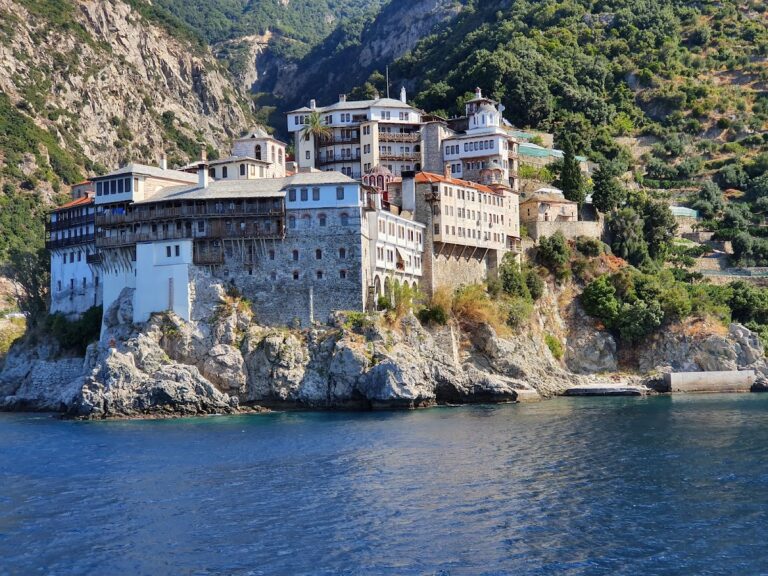
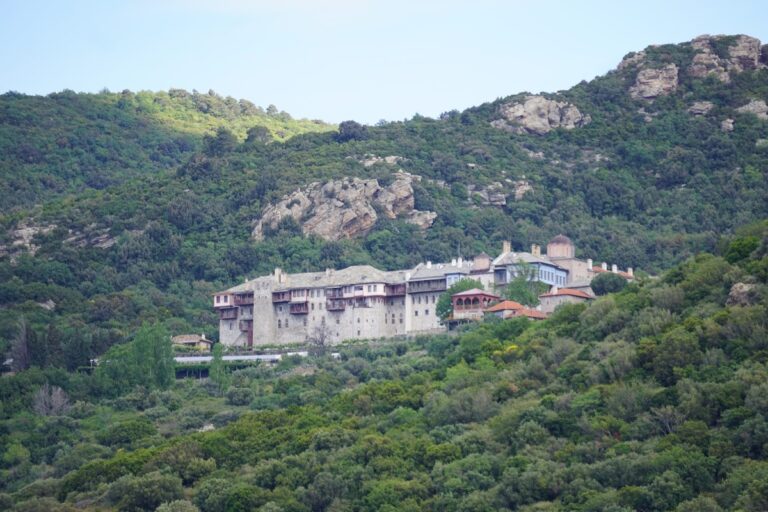
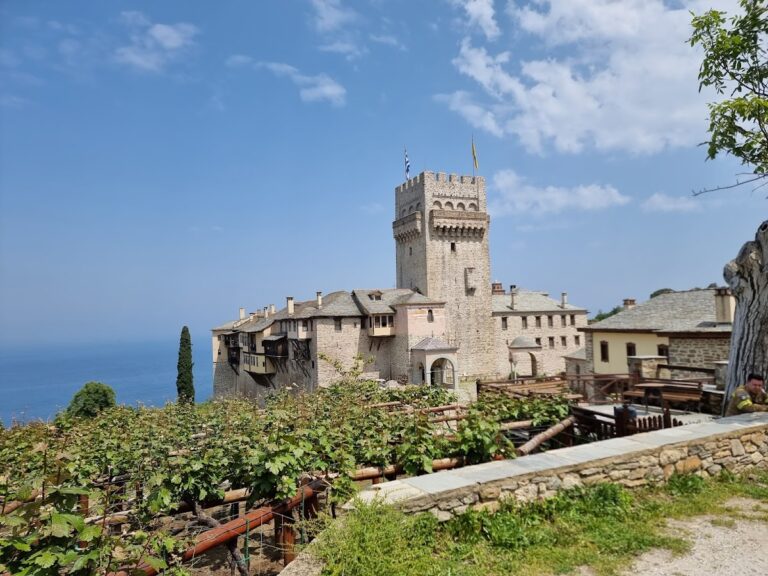
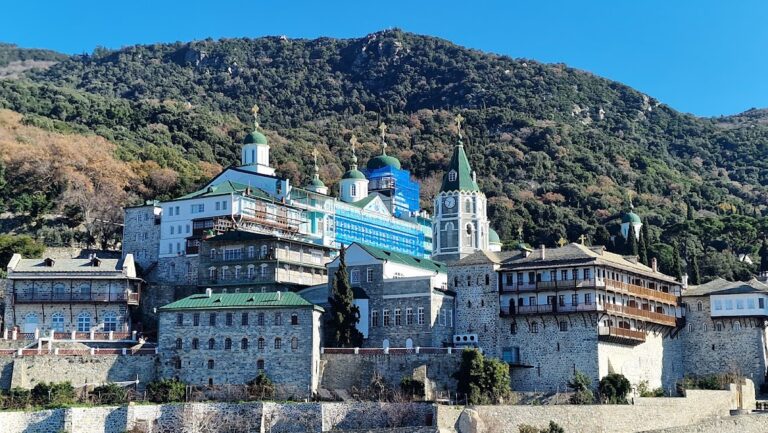
Simonopetra stands on the southern coast of the Athos peninsula, between the port of Dafni and the Monastery of Saint Gregory. The monastery occupies a massive granite rock approximately 330 metres above the sea, in an exceptionally steep and harsh setting. Its multi-storeyed, tower-like complex is traditionally described as a seven-storey building and is regarded as one of the boldest works of Byzantine engineering on Mount Athos. The underlying rock passes through the lower floors. Monks traditionally count the levels from top to bottom, making the uppermost level the first floor and the lowest the last.
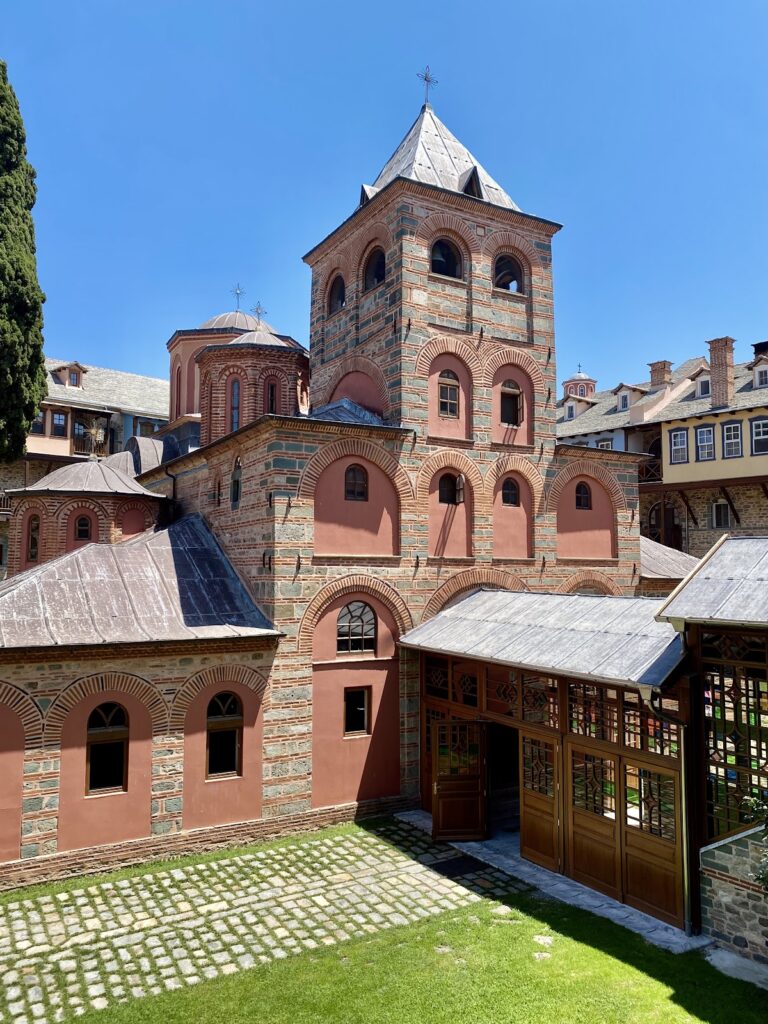
The main building occupies the site of Simon’s original foundation. Its expansion followed the major fires. The western building was erected after the sixteenth-century fire with money collected by Abbot Evgenios, while the eastern building was constructed after the fire of 1891, largely with funds raised in Russia. The katholikon, or main church, is dedicated to the Nativity of Jesus. Built approximately around 1600, it acquired its present form during the rebuilding after 1891.
Churches and Chapels
Internal Chapels
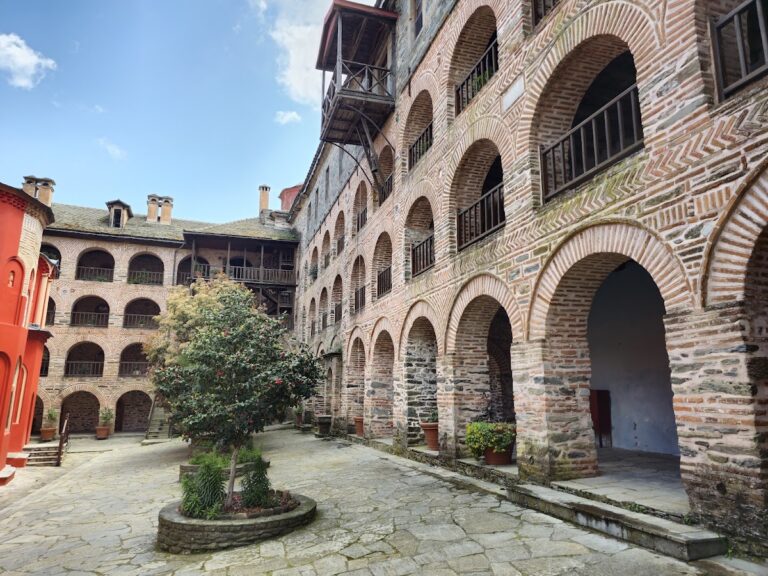
The complex contains four churches or chapels within the monastery and eight churches or chapels outside it. The Chapel of Saint Mary Magdalene occupies the first floor of the eastern wing within the abbot’s residence, while the Chapel of Saint Charalambos is on the second floor. The Chapel of Saint George lies beneath the refectory in the middle wing.
Cemetery and Fourth-Wing Chapels
Southeast of the walls, outside the main enclosure, stands the cemetery chapel dedicated to the Dormition of the Theotokos. The Chapel of Saint John the Forerunner belongs to the newer fourth wing. This wing was begun in 1996 with the approval of the Centre for Athonite Heritage and completed in 2000.
Relics and Ecclesiastical Collections
The monastery preserves a hand relic of Saint Mary Magdalene, traditionally regarded as incorrupt for many centuries and associated with her chapel. A silver reliquary taken to Russia in 1888 also contained the True Cross, a relic of Saint Anne, and a relic of Saint Panteleimon. Other ecclesiastical possessions include valuable icons, vestments, silverwork, engravings, and antiminsia, consecrated altar cloths commonly bearing an image or inscription.
Library, Archive, and Musical Tradition
Simonopetra maintains a historical library, archive, treasury, and collections of preparatory drawings and engravings. Its archive contains Greek, Turkish, and Romanian documents, chant scrolls, and printed books, while its surviving archival material is described as post-Byzantine. The monastery also has a publishing tradition involving works edited by its monks.
The monastery’s choir is known for performing and publishing Byzantine chant, the traditional liturgical music of the Eastern Orthodox Church. Its recordings and published repertory include Agni Parthene, which brought the choir and monastery broad recognition among specialists and enthusiasts of Byzantine music.
Dependencies and Related Properties
Simonopetra’s dependencies include the All Saints representative residence at Karyes, five Karyes cells, the Saint Nicholas-Dontas estate, several nearby kathismata, or small monastic residences, the forest forestry office and Saint Demetrios church, the nineteenth-century Kurtzidiko hermitage, the Kalamitsi hermitage, and the old tower and Saint Nicholas church at the arsanas. The Saint Nicholas-Dontas estate has been a monastic farm since 1368.
The Karyes building now occupied by OTE services was purchased as an ecclesiastical cell by Jovan Ugljesa in 1367 and dedicated to Simonopetra. It served as the monastery’s first representative residence until 1621, was then assigned to dependent monks until the mid-nineteenth century, and was later rented to private professionals.
External affiliated foundations include establishments in Thessaloniki, Vyronas in Attica, Sifnos, Lemnos, Pentalofos near Goumenissa, and southern France. These properties and communities form the wider network through which Simonopetra has maintained its religious presence beyond the main monastery on Mount Athos.
Nearby sites