Novo Hopovo Monastery: A Serbian Orthodox Monastic Complex near Irig


Site at a Glance
- Rating
- 4.9
- Popularity
- Medium
- Country
- Serbia
- Primary era
- Early Modern
- Eras represented
- Early Modern
- Civilizations
- Habsburg, Ottoman, Serbian
- Site type
- Religious
- Remains
- Monastery
On this page19 sections
History
Novo Hopovo monastery in Serbia, near the town of Irig, is a Serbian Orthodox monastery dedicated to Saint Nicholas, whose present church was built in 1575–1576 during the late sixteenth century. It belongs to the Srem Diocese of the Serbian Orthodox Church and is legally protected as a cultural monument of exceptional importance. Set within the historic monastic region of Fruska Gora, the monastery became an important religious, educational, artistic, and charitable institution.
Foundation and early development
Novo Hopovo was first mentioned in writing in 1451 and is traditionally regarded as a fifteenth-century monastery. Its foundation is placed in different ways between the late fifteenth and early sixteenth centuries. One tradition attributes a refoundation around 1490 to Serbian Archbishop Maksim Brankovic, a member of the Brankovic dynasty. Another tradition, drawing on the Life of Saint Angelina, dates its establishment to 1496–1502 and connects it with the Brankovic family. Stefan Brankovic has also been proposed as a founder, although the monastery’s founder remains uncertain.
Novo Hopovo and nearby Staro Hopovo existed at the same time as neighboring monasteries bearing the same name. Novo Hopovo gradually became the larger and wealthier institution. By 1753, Staro Hopovo was described as its dependency and had no permanent monastic community, receiving two monks from Novo Hopovo.
The present Church of Saint Nicholas replaced an earlier church that had been demolished. Construction in 1575–1576 was supported by Lacco and Marko Jovsic, while the patronage inscription also names Jovan Bozanic and members of his family from Upper, or Serbian, Kovin on Csepel Island in Hungary. A school was functioning at the monastery by 1578, giving Novo Hopovo an educational role that later helped establish its importance among the monasteries of Fruska Gora.
Seventeenth-century expansion and wartime losses
In 1638–1639, the monks appealed to the Russian tsar for financial assistance, describing the monastery as being in Serbian lands. They received permission to collect aid in Russia every seven or eight years. In 1641, the deputy abbot Neofit traveled across the Russian Empire to gather donations. The monastery then had about 60 monks, and part of the assistance was probably used to roof the monastic cells in the same year.
The monastery suffered severe losses during the Ottoman wars of 1684 and 1688, conflicts between the Ottoman Empire and its European opponents. The monks fled with the relics of Saint Theodore Tiro, first to Sabac and then to Radovasnica. The community numbered more than 100 people during this flight. Partial rebuilding followed, and a more complete restoration took place in 1693–1695.
Eighteenth-century prosperity and religious life
During the eighteenth century, substantial landholdings and four mills provided resources for enlarging the complex. New buildings included a refectory, a pilgrims’ house, and another monastic wing. A bell tower with a chapel was added in 1751. The monastery also became associated with important figures in Serbian religious and cultural life. Dimitrije Obradovic lived there from the summer of 1757 until the autumn of 1760, entered monastic life, and received the name Dositej. His superior was Abbot Teodor Milutinovic. Dositej Obradovic later became a prominent Serbian writer, educator, and Enlightenment intellectual.
Gerasim Radosavljevic became archimandrite, a senior Orthodox monastic priest, in 1771, while the hieromonk, or monk ordained as a priest, Gerasim Draskovic was abbot in 1809. Novo Hopovo also offered refuge to the monks of Kalenić Monastery after Ottoman forces burned their monastery in 1788. Led by their abbot Vukasinovic, they brought their valuable inventory to Novo Hopovo and stayed there until March 1795.
Estate, education, and nineteenth-century administration
The monastery’s estate included a meadow at Medjes, fields at Radinci, a house and shop in Irig, vineyards, and forests. From 1856, it also possessed a sandstone quarry called Sandstajn near Staro Hopovo. The brotherhood leased a roadside inn known as Prkos. In 1902, the estate covered 1,624 yokes and 54 square fathoms of land. In 1855, the monastery was headed by Archimandrite Sebastian Ilic, a highly educated literary worker who belonged to European agricultural societies.
Education remained part of the monastery’s work. A monastic school was formally opened in 1893, continuing the educational function already present in the sixteenth century. This role connected religious instruction with the monastery’s wider place in the cultural life of Fruska Gora.
Russian monastic community after the First World War
After the First World War, Novo Hopovo became a women’s monastery. Russian nuns and refugees from the Orthodox women’s monastery of Lesna arrived from Bessarabia in 1920–1921 after fleeing their Polish monastery in 1915. They brought the Lesna community and its boarding school to Serbia, helping revive female monasticism at Novo Hopovo.
Sixty nuns came to Serbia in 1920. They initially spent a year at Kuvezdin before moving to Novo Hopovo. The community included an orphanage for war orphans and a boarding school for Russian girls. The orphanage moved to Kuvezdin in 1921, while the boarding school remained at Novo Hopovo. The sisters continued a tradition of caring for children and providing Orthodox education. During its twenty years of operation, the orphanage raised more than 500 children.
The monastery also became a spiritual and cultural center for the Russian emigration in Serbia. Abbess Catherine Efimovska, a countess, led the nuns first and died at Novo Hopovo. She was followed by Abbess Nina Kosakovska. King Alexander I, the principal Serbian patron of the Russian community at Novo Hopovo, visited the monastery in 1923. Many Russian nuns and refugees, including Russian soldiers, were later buried there. In September 1925, the monastery hosted the Third Congress of the Russian Christian Student Movement, attended by approximately 100 participants from several European countries.
War damage and later changes
During the Second World War, the bell tower and some monastic buildings were blown up. The iconostasis was destroyed, and most of the frescoes were damaged or lost. The monastery then entered a period of neglect. The relics of Saint Theodore Tiro were kept in Irig from 1943 to 1984 for protection.
Efforts to preserve the memory of the Russian community resumed in the 1980s. In 1984, Archimandrite Dositej Milkov received permission to restore Abbess Catherine’s tombstone. Her grave was located with assistance from Abbess Maria, a former novice at Novo Hopovo, and local residents. In 1985, Archbishop Anthony Bartosevich installed a marble tombstone at the grave. In the twenty-first century, the monastery continued as a women’s monastery with three nuns, before later returning to male monastic life under Archimandrite Pavle Jovic.
Remains
Novo Hopovo stands on a gentle southern slope of Fruska Gora, a mountain range and historic monastic region in northern Serbia. The complex is organized around the Church of Saint Nicholas and surrounding residential buildings. Its architecture combines the church’s complex central plan with the later baroque appearance produced by the enlargement and restoration of the monastic buildings.
Church and bell tower
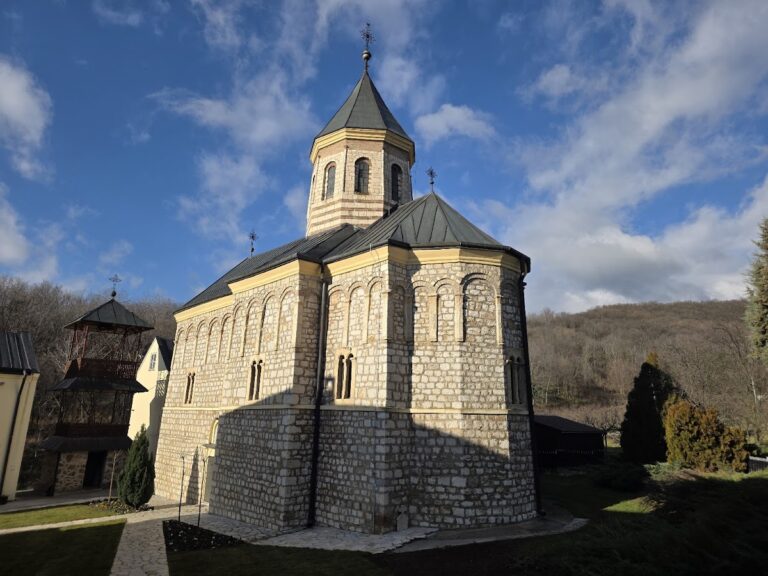
Church of Saint Nicholas
The Church of Saint Nicholas is formed from two contrasting parts: a developed main church and a large western narthex, the entrance hall before the principal worship space. The main church has an inscribed-cross plan, in which the arms of a cross are incorporated into the surrounding building, combined with a triconch arrangement of three apsidal projections. A central dome rises above the principal space.
Inside, the church has a western bay and an approximately equal eastern bay ending in altar apses. A narrow bay lies between the domed section and the altar. This additional eastern bay gives the altar area a separate architectural and structural character and is described as unique among the monasteries of Fruska Gora. The large western narthex has a simple rectangular plan, creating a clear contrast with the more intricate organization of the main church.
Bell tower chapel
The bell tower was built in 1751 and includes a small upper chapel dedicated to the Translation of the Relics of Saint Stephen. The tower formed part of the eighteenth-century expansion of the monastery and was later among the structures damaged during the Second World War.
Monastic buildings
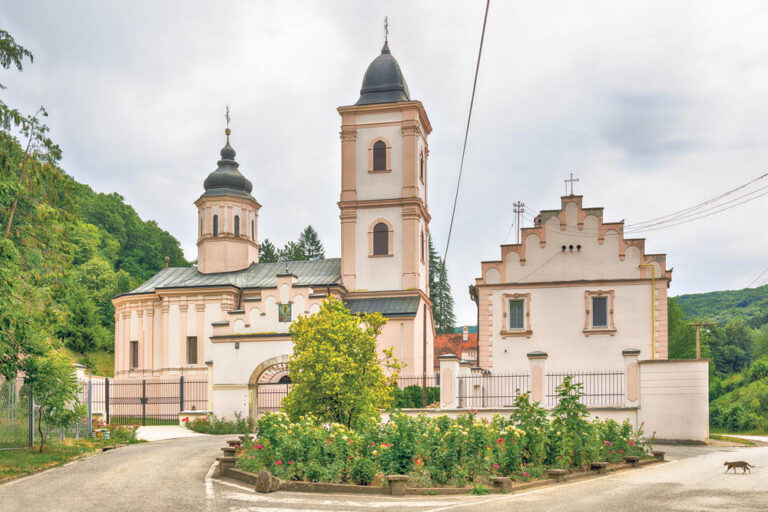
The monastic cells date from 1641 and were enlarged and restored repeatedly. By 1771, four residential buildings surrounded the monastery on all sides, creating the complex’s present baroque appearance. The eighteenth-century expansion also incorporated a new refectory, a pilgrims’ house, and an additional monastic wing, linking the residential and communal functions of the monastery around the church.
Frescoes and iconostasis
Nave, choir, and altar paintings
The frescoes in the choir and nave were completed in 1608 by painters whose names are unknown and who may have been monks from Mount Athos. Their compositions drew on the painting tradition of Athonite monasteries. The scene of the Massacre of the Innocents is described as an exact copy of a fresco in the main church of the Great Lavra. These paintings were among the works damaged or lost during the Second World War.
Narthex frescoes
A separate ensemble was painted in the narthex in 1654. Conservation lasting almost a decade identified stylistic differences between these paintings and those in the nave and altar area. The distinctions include their color schemes, use of gold, and treatment of human figures. The narthex program is arranged in zones showing warriors, kings, hierarchs, hermits, and martyrs, together with scenes of Christ’s miracles, the Akathist of the Mother of God, the sufferings of the Apostles, and an illustration of a hymn by John of Damascus.
The narthex paintings follow a more conservative manner than the newer style of the nave and altar paintings. Their original decoration probably included gold-colored compositions, much of which was later lost or removed.
Baroque iconostasis
The baroque iconostasis, the screen separating the sanctuary from the nave and carrying icons, was carved by Antun and Pavel Rizner. Teodor Krachun painted its icons in 1770, in what is regarded as his first known icon-painting commission. More than 60 small baroque icons had been installed on the screen by 1776. Another inventory lists 61 original icons, of which 19 survived the Second World War.
Relics and written heritage
Relics of Saint Theodore Tiro
The Church of Saint Nicholas houses the relics of Saint Theodore Tiro, an early Christian martyr traditionally identified as a Roman soldier, in a reliquary. In 1747, Mihailo Cokic, a wealthy resident of Becej, commissioned and donated an artistically carved walnut reliquary through the efforts of Abbot Zaharije.
Hieromonk Spiridon Jovanovic described the traditional history of the relics in 1780. According to this tradition, non-Christian Greeks cast them into the sea, and the bishop of Euchaita recovered them three centuries later. They were secretly taken to Wallachia and Sibiu, then rediscovered in the house of a deceased boyar. The Serbian carpenter Radovan Rakic obtained them from the boyar’s widow, brought them first to his home region, and later transferred them to a monastery.
Tradition further holds that the relics remained at Hodos Monastery for 25 years, where the sick came because of reputed miraculous healings. When Hungarian authorities and clergy tried to seize them, the monks fled to Fruska Gora and placed the relics at Novo Hopovo. They are mentioned at the monastery as early as 1555. During the Ottoman wars, the monks carried them with the community during its flight, and they were later kept in Irig from 1943 to 1984.
Manuscripts and the Forest Mother of God
The monastery treasury contained valuable liturgical manuscripts. An unidentified copyist completed a Panegyric, a collection of homilies and saints’ praises, on 13 May 1555 during the tenure of Abbot Kir Stefan, spiritual father Avram, and ecclesiarch Maksim. A Menaion, a service book arranged by calendar month, was copied in 1559, and an Apostolos containing readings from the Acts and Epistles was written in 1563 by the student Stanko.
In 1618, the monk Jefrem copied a Studite book containing eight canons. One Gospel was encased in silver in 1630 under Abbot Kir Stefan. A Canon to the Most Holy Mother of God was written in 1654, and a second Gospel received a silver cover in 1657 under Deputy Abbot Neofit.
The Russian nuns brought a stone wonder-working icon of the Mother of God of the Forest from the Lesna monastery. A Polish king had donated the original icon to Lesna. In 1932, the original was kept in a deposit of the Belgrade Pawn Bank to protect it from theft, while a smaller copy remained in the Church of Saint Nicholas at Novo Hopovo.
Nearby sites