Poreče Monastery: A Medieval Religious and Educational Center in North Macedonia


Site at a Glance
- Rating
- 4.8
- Popularity
- Very Low
- Country
- North Macedonia
- Primary era
- Medieval
- Eras represented
- Medieval, Modern
- Civilizations
- Byzantine, Ottoman
- Site type
- Religious
- Remains
- Monastery
On this page13 sections
History
Poreče Monastery is a medieval monastic complex in North Macedonia, situated above or beside Gorno Manastirec near Makedonski Brod in the Poreče region. Recent research places its origins in the twelfth century or earlier, revising the former view that it was founded only in the eighteenth or nineteenth century. The monastery is dedicated to the Nativity of the Virgin Mary and became an important religious, literary, and educational institution in the middle Treska basin.
Medieval origins and literary activity
The monastery’s early history is connected by local tradition with King Milutin, a medieval Serbian ruler whose reign extended Serbian political control into parts of Macedonia. According to this tradition, he founded the monastery after Poreče entered the Serbian state in 1282. The existence of the neighboring villages of Manastirec and Kalugerec in the fourteenth century has also been used as indirect evidence for the monastery’s earlier antiquity.
Poreče Monastery served as a center of religious learning and literary work during the medieval period. Learned monks copied biblical and liturgical books, translated writings by Church Fathers, and produced sermons and teachings. The monastery supplied liturgical books and other religious literature to village churches across approximately fifty Poreče villages. A local tradition recalls that forty horse-loads of books were taken from the monastery to Constantinople, although the later destination of these books is unknown.
Several manuscripts associated with the Poreče region reflect this tradition. They include a fourteenth-century festal menaion, an Orthodox liturgical book arranged around the fixed annual feasts, written by the deacon Dobre of Kalugerec between 1371 and 1395; the Poreče Four Gospels from the mid-sixteenth century; the Poreče Fifth-Tone Octoechos, a liturgical book organized according to eight musical tones, from the fifteenth or sixteenth century; and the Bence Four Gospels from the sixteenth century.
Ottoman-era destruction and rebuilding
During Ottoman rule, the monastery was burned at an unknown date. Priest Kostadin of Gresnica then took the initiative to secure its reconstruction. Priest Dimitrija traveled to Constantinople to obtain the sultan’s permission, after which local inhabitants rebuilt the monastery through voluntary labor and donations in 1846.
The rebuilt monastery soon became a regional center for education. The first school in this part of Poreče was established there, drawing pupils from several surrounding villages. Priests served as teachers, while a monastic cell school also operated during the eighteenth and nineteenth centuries, when monks taught and educated local children.
The monastery’s literary activity continued after the rebuilding. In 1868, Priest Zdrave Popkostadinov of Izhishta prepaid for a copy of Sophronius of Vratsa’s Instructional Gospel, a religious work combining biblical explanation with moral teaching. The commission provides evidence of the monastery’s continuing role in religious reading and manuscript culture.
Schools and community institutions
A Serbian national school operated at the monastery from 1873 to 1889. It reopened in 1895 under the teacher Cvetko Petrović, who taught there for two years and promoted the establishment of Serbian schools and adult literacy. In 1890, the monastery became the seat of the Poreče Serbian municipality, whose jurisdiction included thirty-six villages.
Twenty Russian monks sought refuge at the monastery in 1917 while fleeing the anti-religious regime in Soviet Russia. The last of these refugees was the hieromonk Inokentij, an ordained Orthodox monk who was also a priest. From 1947 to 1957, the monastery’s residential buildings housed an elementary school attended by more than 850 children from the Poreče region.
Modern religious life
On 22 July 2007, Archbishop Stefan of Ohrid and Macedonia consecrated a newly built residential building together with Metropolitan Timotej of Debar-Kicevo and Metropolitan Naum of Strumica. The monastery is under the Macedonian Orthodox Church–Ohrid Archbishopric and belongs to the Debar-Kicevo Eparchy, its regional diocesan subdivision, and the Brod ecclesiastical district. It remains active under its abbot, the monk Benedikt Bozinoski.
Remains
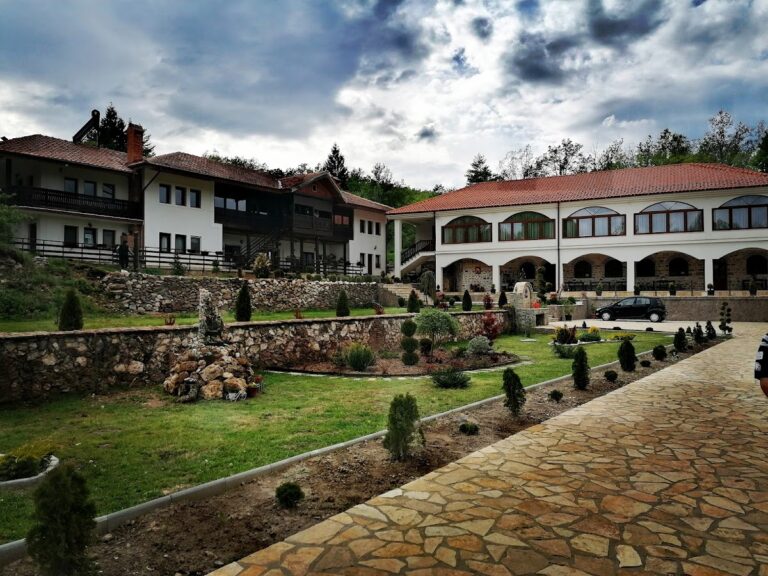
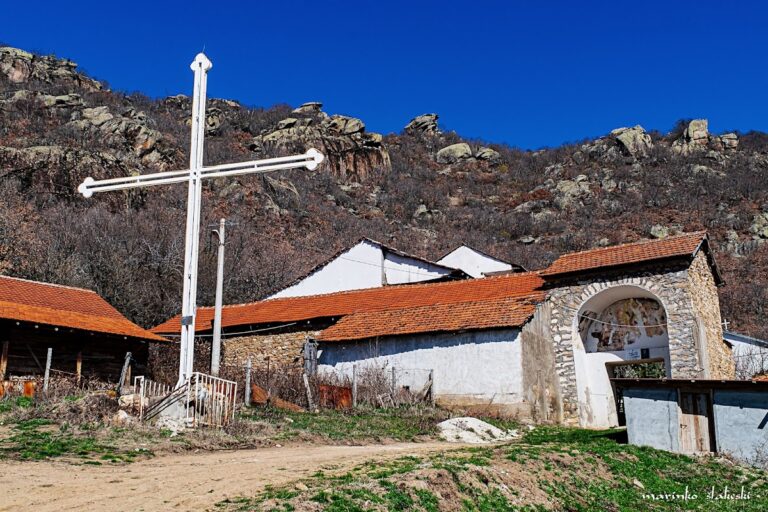
The monastery complex consists of a single church, residential buildings, and a bell tower. Its buildings represent successive periods of rebuilding and expansion, including the reconstruction of 1846, a residential addition from the beginning of the twentieth century, and a modern residence consecrated in 2007.
Church and earlier frescoes
Church of the Nativity of the Virgin Mary
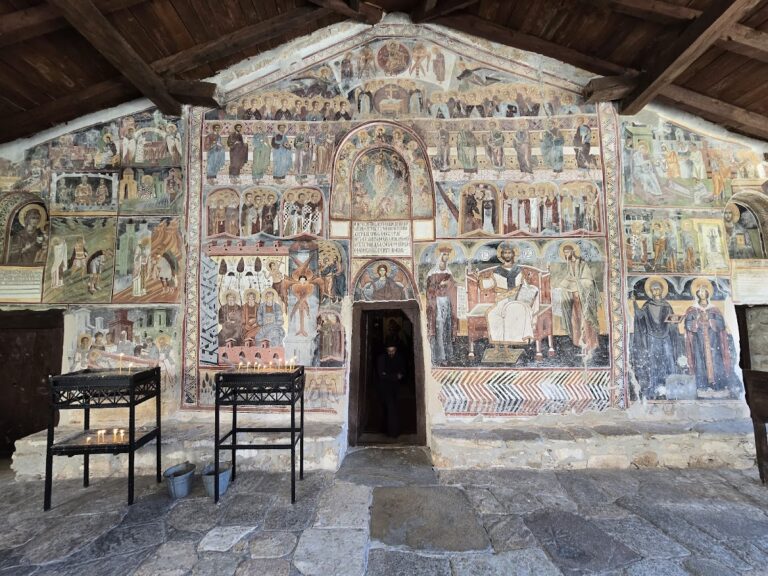
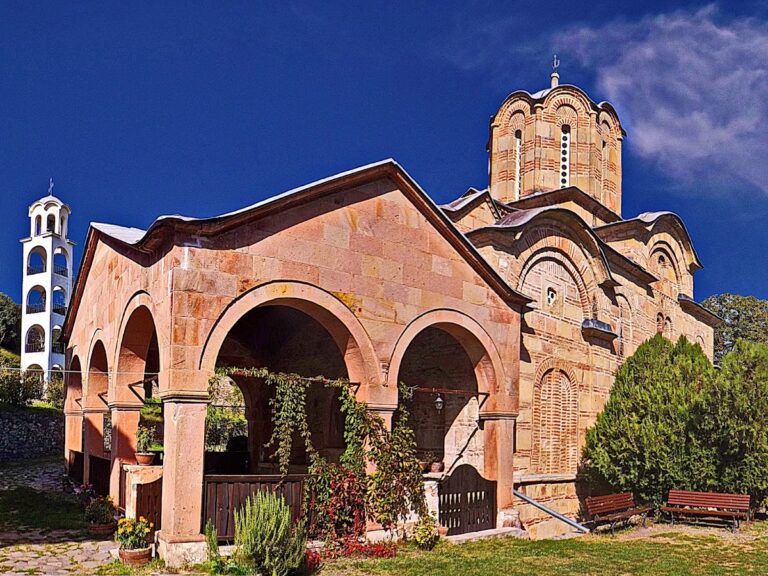
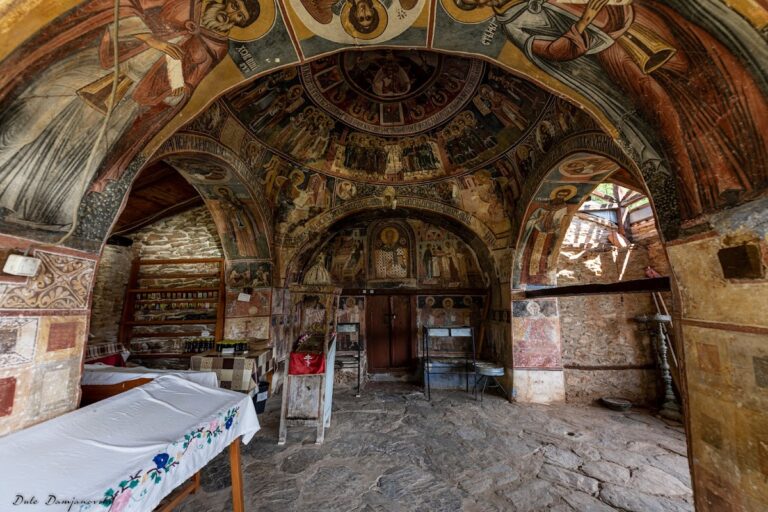
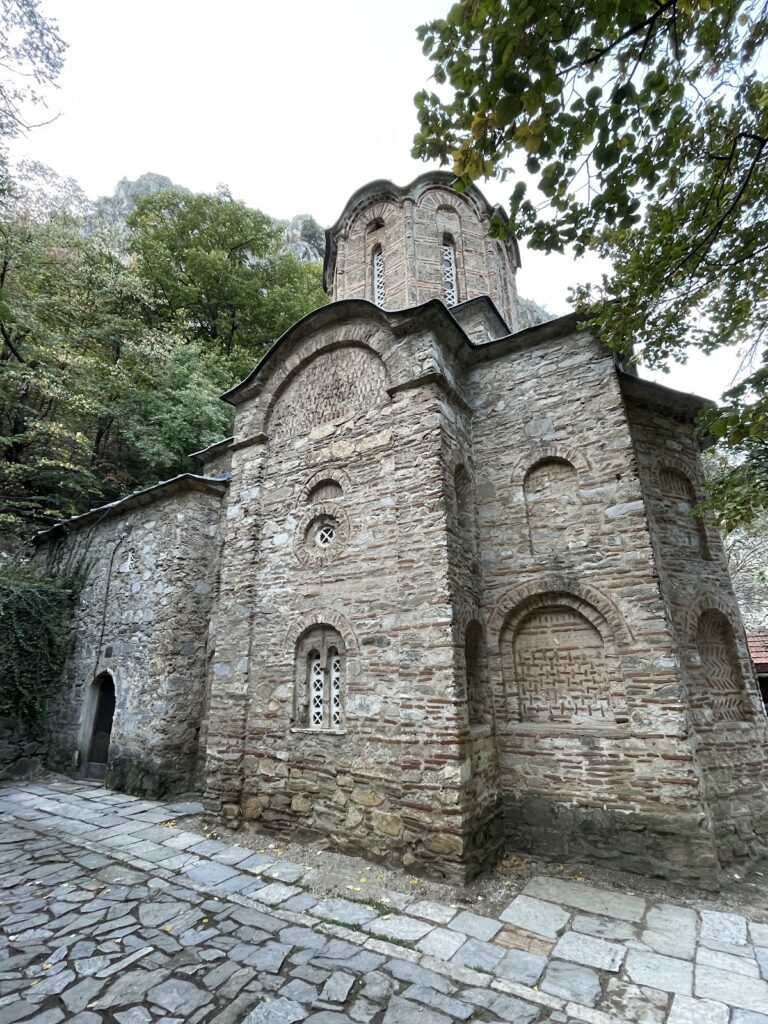
The main church is dedicated to the Nativity of the Virgin Mary. It has been described as a nineteenth-century rebuilding, and 1899 is also given as the date of its construction and fresco painting. Recent research has identified surviving frescoes dating from the eleventh to the thirteenth century. These paintings have changed the interpretation of the monastery by pointing to an earlier phase of religious activity than the nineteenth-century date alone would suggest.
Residential buildings and bell tower
Older residential building
The older residential building on the southeastern side belongs to the period of the 1846 reconstruction. It is now in a ruined condition.
Southern residential building
A separate residential building on the southern side was erected at the beginning of the twentieth century. Together with the older southeastern building, it reflects the monastery’s continued need for accommodation and institutional space after the nineteenth-century rebuilding.
Modern residence and bell tower
The newer residential building on the eastern side was constructed in modern times and consecrated in 2007. It serves as the monks’ residence and also accommodates visitors. A bell tower forms part of the wider complex alongside the church and residential buildings.
Memorial ossuary
A memorial ossuary beside the monastery commemorates local Poreče residents who were killed in the 1916 massacre at Dervishka Niva.
Nearby sites