Agia Lavra: An Historic Orthodox Monastery and Centre of the Greek Revolution


Site at a Glance
- Rating
- 4.8
- Popularity
- Medium
- Country
- Greece
- Primary era
- Medieval
- External website
- Open
- Eras represented
- Medieval
- Civilizations
- Byzantine, Greek
- Site type
- Religious
- Remains
- Monastery
On this page12 sections
History
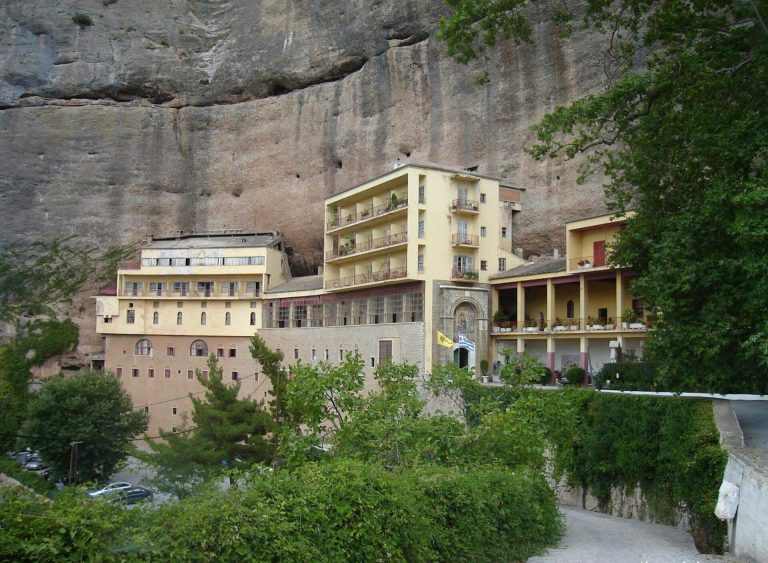
Agia Lavra is an active male monastery of the Eastern Orthodox Church in Greece, near Kalavryta in Achaea. Founded in 961, it is dedicated to the Dormition of the Mother of God, the Orthodox commemoration of the death and bodily assumption of the Virgin Mary, and is counted among the oldest monasteries in the Peloponnese.
Foundation and relocation
The monastery was founded by the monk Eugenios, who had been a fellow ascetic of Athanasius the Athonite, a major Byzantine monastic reformer and founder of the Great Lavra on Mount Athos. The first monastery stood at Paleomonastiro, about 300 metres from the present site. Its original katholikon, the principal church of an Orthodox monastery, survives at the mouth of a cave.
A fire completely destroyed the first monastery in 1585. It was rebuilt around 1600, and the painter Anthimos completed its fresco decoration in 1645. In 1689, under the abbot Eugenios, the monastery moved to its present location. A drawing made by the Russian monk Barsky after his visit in 1745 offers an early representation of the relocated foundation.
Ottoman rule and destruction
Agia Lavra experienced serious disruption in 1715 during the second Ottoman rule of the region and especially during the Orlov Revolt, an eighteenth-century Greek uprising encouraged by Russian intervention. During the Greek War of Independence, Ibrahim Pasha of Egypt led Ottoman forces campaigning in the Peloponnese. His army burned Agia Lavra in 1826, although the monks had escaped beforehand with most of the monastery’s treasures.
Reconstruction began in 1828 with the foundation of a new katholikon, the third in the monastery’s history. The building was destroyed by the earthquake of 24 July 1844 and rebuilt in 1850, after the establishment of the independent Greek state. German forces burned the monastery on 14 December 1943 during the operation that also devastated Kalavryta. Monks who had not left were executed. The monastery was restored in 1950 in its present form.
Agia Lavra and the Greek uprising
In March 1821, Agia Lavra became a meeting place for Achaean primates, prominent local lay leaders under Ottoman rule, and other figures involved in the Greek uprising. On 10 March, Germanos of Patras, a Greek Orthodox metropolitan and leading ecclesiastical figure associated with the War of Independence, met there with Andreas Lontos, Asimakis Zaimis, Asimakis Fotilas, and Prokopios of Kerniki. They had refused an Ottoman summons to travel to Tripoli. At the monastery, they decided that the uprising should begin, then dispersed through Achaea to recruit forces.
On 21 March, Sotirios Theocharopoulos, Nikolaos Soliotis, Ioannis Papadopoulos, and Nikos and Vasilis Petimezas gathered at Agia Lavra. They took a small cannon from the monastery and a gold-embroidered icon of the Virgin as a banner before attacking Kalavryta. The Ottoman forces under Arnaoutoglou surrendered immediately. Agia Lavra and Kalavryta also served as supply depots for the revolutionary camp at Omplos Monastery. A letter dated 23 March requested that the abbot and monks send animals and provisions to Omplos.
Greek tradition regards Agia Lavra as the place where the Revolution began and as a symbolic birthplace of modern Greece. The associated ceremony is historically disputed. Accounts place it on 25 March 1821, 23 March, 20 March, or 17 March, while some locate it in Patras or Vostitsa rather than at Agia Lavra. In the traditional version, Germanos conducted a doxology, a formal Christian service of praise and prayer, administered an oath to Peloponnesian fighters, and raised the revolutionary banner.
Some twentieth-century historians treated this scene as a legend because it does not appear in Germanos’s memoirs. Other historians pointed out that the memoirs are incomplete and were mishandled before publication. The tradition became widely established partly because it linked the Feast of the Annunciation with the Revolution, and it was taught in school textbooks until recently. A 1836 painting by a Bavarian artist depicts an oath-taking scene based on fighters’ accounts, but places it at Vostitsa. Agia Lavra’s historically documented contribution also included food and money, as shown by letters from military leaders to its monks and abbots.
Ecclesiastical and historical standing
At different times, Agia Lavra held patriarchal, stavropegic, and royal status. A stavropegic monastery was placed directly under patriarchal authority rather than under the ordinary jurisdiction of a local bishop. Smaller monasteries, including Agia Triada and Philokali, were attached to it during different periods. At the height of its prosperity, the monastery is stated to have had approximately 1,000 monks and to have accumulated substantial movable and immovable property.
Its association with the Greek uprising and its long religious history led to recognition as an archaeological site and a protected historic building in Greece.
Remains
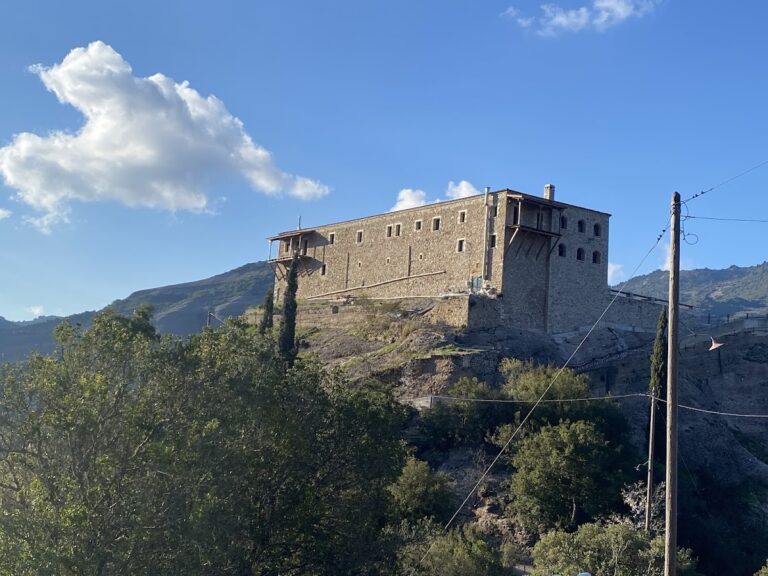
Agia Lavra stands about 4 to 5 kilometres west of Kalavryta, on a hill at the foothills of Mount Velia in the Chelmos mountain area, at roughly 950 metres above sea level. The surviving site combines the relocated monastery, its domed principal church, the earlier church at Paleomonastiro, and collections of religious, historical, and documentary objects.
Earlier and present churches
Paleomonastiro katholikon
At Paleomonastiro, the original location of the monastery, the first katholikon remains at the mouth of a cave. It is a two-aisled, cross-roofed church, meaning that its roof forms intersect, and its interior preserves two rows of frescoes. The building represents the earliest surviving physical element of Agia Lavra’s foundation.
The relocated monastery and domed basilica
The church built after the 1689 relocation was a three-apsed Athonite-type structure. This form follows the architectural tradition associated with monasteries on Mount Athos and consisted here of a single-aisled church with an unsupported dome.
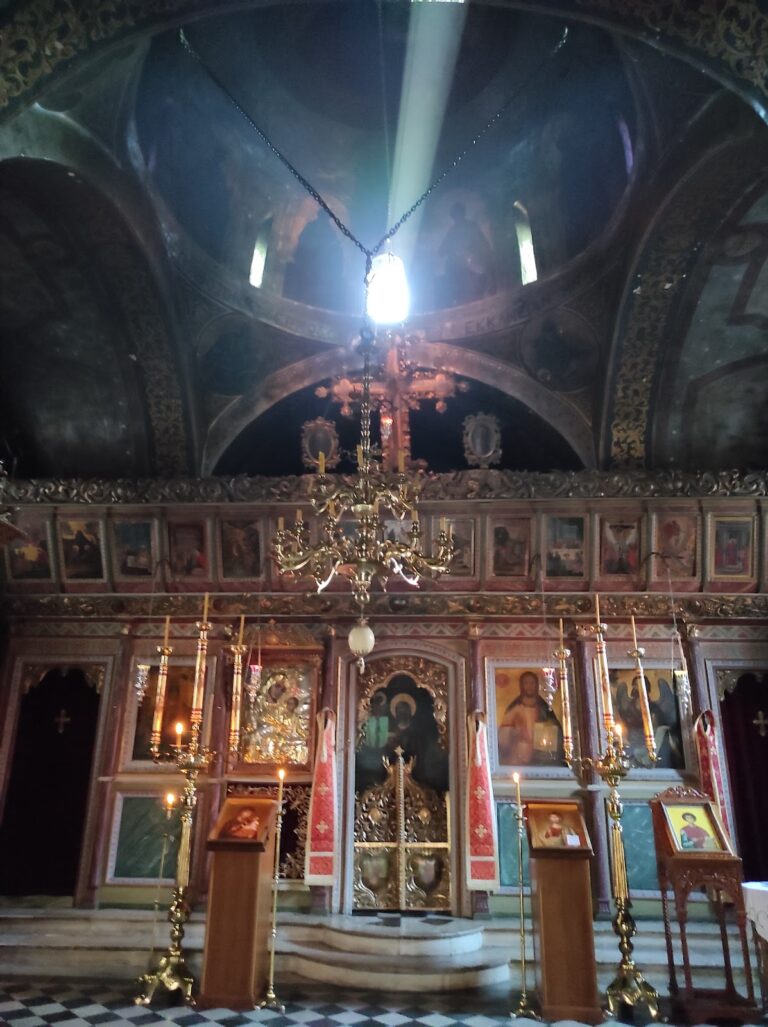
The katholikon founded in 1828 took the form of a domed basilica. After the earthquake of 24 July 1844 destroyed it, the church was rebuilt in 1850. The monastery was restored again in 1950 after the wartime burning of 1943, giving the complex its present form.
Revolutionary features and collections
Banner, weapons, and commemorative landscape
A plane tree immediately outside the monastery gate is associated with the traditional raising of the revolutionary flag by Germanos of Patras. On the hill opposite the monastery, a monument to the heroes of the 1821 Greek Revolution overlooks the complex.
The monastery museum preserves the sacred banner before which the revolutionaries are said to have sworn their oath in March 1821. The sixteenth-century banner depicts the Dormition of the Mother of God and originally served as the curtain of the Royal Doors in the church. The museum also preserves the weapons of the fighters who took part in the uprising.
Relics, textiles, and manuscripts
Among the monastery’s sacred treasures is the skull of Saint Alexios the Man of God, the patron saint of Kalavryta. Byzantine Emperor Manuel II Palaiologos donated it to Agia Lavra in 1398. Other relics include the skull of Saint Philaret the Merciful and relics of Saint Panteleimon, Saint Paraskevi, and the Holy Unmercenaries.
The collections include a 1754 epitaph embroidered in Smyrna and an image of Saint George embroidered in Constantinople by Kokona tou Rologa. They also contain valuable Gospels, including one donated by Catherine II of Russia, as well as the gold-embroidered vestments of Germanos of Patras, encolpia or religious pendants, wooden crosses, sacred chalices, documents, books, icons, and other sacred vessels.
The library contains approximately 3,000 printed books. Its oldest book is dated 1502. The collection was substantially developed with the help of Kyrillos Lavriotis in 1796 and the Kalavrytian teacher and monk Gregorios Ioannidis in 1929. The monastery’s textile holdings include pieces embroidered with gold or silver thread woven into pure silk in Smyrna and Constantinople, dating from the sixteenth century.