Mega Spilaio: A Greek Orthodox Monastery in Greece
Site at a Glance
- Rating
- 4.8
- Popularity
- Medium
- Country
- Greece
- Primary era
- Modern
- Eras represented
- Early Modern, Modern
- Civilizations
- Ottoman
- Site type
- Religious
- Remains
- Monastery
On this page17 sections
History
Mega Spilaio is a Greek Orthodox monastery in Greece, near Kalavryta, traditionally founded in 362 by the Thessalonian monk-brothers Symeon and Theodore. Formally dedicated to the Dormition of the Theotokos, the Orthodox feast commemorating Mary’s death and heavenly reception, it is regarded as one of the oldest monasteries in Greece and the Peloponnese.
Founding traditions and early history
Monastic tradition says that Symeon and Theodore travelled from Jerusalem to Achaea after receiving identical visions directing them to an icon of the Theotokos attributed to Luke the Evangelist. They were led to the cave by Euphrosyne, a local shepherdess whose flock repeatedly drank from a spring there. Euphrosyne is venerated as a saint, and the spring later became known as the Maiden’s Spring.
The cave was known in antiquity. The second-century Greek geographer and travel writer Pausanias associated it with the refuge of the daughters of Proetus, figures from Greek mythology who were said to have suffered madness in the region. Christian hermits occupied the cave during the early Christian centuries. The monastery’s medieval development under Byzantine and Latin rule is otherwise obscure until about 1354, when it became the residence of the Orthodox Metropolitan of Patras while Patras was under Latin rule.
Growth and repeated rebuilding
Mega Spilaio developed into a major Orthodox center and acquired properties in Constantinople, Smyrna, Thessaloniki, Achaea, and Elis. Its dependent estates included urban holdings and large landed properties in Achaea and Elis. Around 1801 to 1806, the Irish traveller Edward Dodwell counted approximately 450 monks at the monastery.
Fire repeatedly altered the complex. Fires are associated with the years 840, 1285, 1400, 1640, and 1934. Reconstruction after the 1285 fire is attributed to Andronikos II Palaiologos, the Byzantine emperor who ruled from 1282 to 1328. The original church survived until the fire of 1934, after which a new church was built in 1937. The monastery was rebuilt again after the Second World War.
Revolutionary resistance and refuge
In 1770, during a revolt in the Peloponnese, Metropolitan Parthenios of Patras led Greek insurgents who were besieging Kalavryta. The monastery’s abbot intervened with a cross in his hands and enabled Turkish families to leave safely. This action was credited with helping spare the monastery when the revolt was suppressed and Albanian irregulars ravaged the Peloponnese. The monastery also sheltered Greek civilians.
Before the Greek War of Independence, monks joined the Filiki Etaireia, a secret Greek society founded to prepare an uprising against Ottoman rule. The monastery’s metochia, or dependent estates and affiliated religious properties, in Constantinople and on the Princes’ Islands served as meeting places for members of the organization. In 1818, Nikolaos Skouphas selected the metochion of Saint George as a society contact point.
During the Greek War of Independence, Mega Spilaio became a center of resistance and refuge. Forty monks led by the deputy abbot Gerasimos Torolos fought at Levidion on 14 April 1821. From 7 to 19 January 1823, monks fought at Akrata alongside Gerasimos and the deputy abbot Damaskinos, who arrived with 50 monks. The monastery sheltered thousands of refugees, including more than 500 prominent Peloponnesian families. Its monks also supported the war effort by selling silver sacred vessels and melting copper objects into ammunition.
The sieges of Ibrahim Pasha
Ibrahim Pasha, the Egyptian commander leading Ottoman-Egyptian forces in the Peloponnese, attempted three times to capture the monastery. In December 1825, about 2,000 defenders strengthened its fortifications, including forces led by Kanellos Deligiannis and Andreas Londos. After a clash with an Ottoman-Egyptian reconnaissance force, Ibrahim abandoned that siege.
In May 1826, Ibrahim advanced through the Vouraikos gorge with about 7,000 soldiers and again sent an advance force against the monastery, but he decided not to assault it. In June 1827, he returned with approximately 15,000 soldiers and 2,000 men under Nenekos, a Greek military leader who collaborated with him. Ibrahim made Mega Spilaio his principal objective because it repeatedly sheltered the population of Kalavryta.
After the monks rejected his demand for surrender, about 600 fighters under N. Petmezas and 100 under Fotakos defended the monastery. Ibrahim positioned troops around the site, but on 24 June the monks and defenders attacked the besieging forces and compelled them to withdraw. The monastery was not captured during the war. In April 1829, Ioannis Kapodistrias, the first head of state of independent Greece, celebrated Easter there with monks and worshippers.
Later history and continuing religious life
A school operated at the monastery, where George Paraskevopoulos was recorded as a student in 1895. He later became Saint Gervasios of Patras. During the German occupation of Greece, Mega Spilaio was plundered and damaged in December 1943 during Operation Kalavryta. The surviving cells from the 1934 fire were burned, and monks, monastic attendants, and visitors were executed. Monastic records count 16 people killed at the monastery and nine monks killed at the chapel near Psilos Stavros. Historian Hermann Frank Meyer gives a total of 22 victims and dates the shootings at Mega Spilaio to 8 December. New buildings were erected after the war.
Mega Spilaio remains an active monastery within the Metropolis of Kalavryta and Aigialeia. Its principal feast is the Dormition of the Theotokos on 15 August. Other commemorations take place on 14 September and 18 October, the latter associated with Luke the Evangelist and the monastery’s founders.
Remains
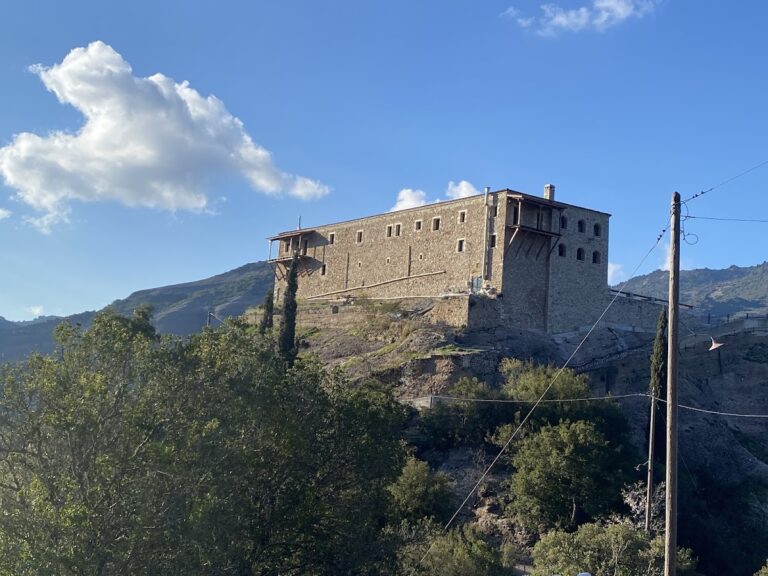
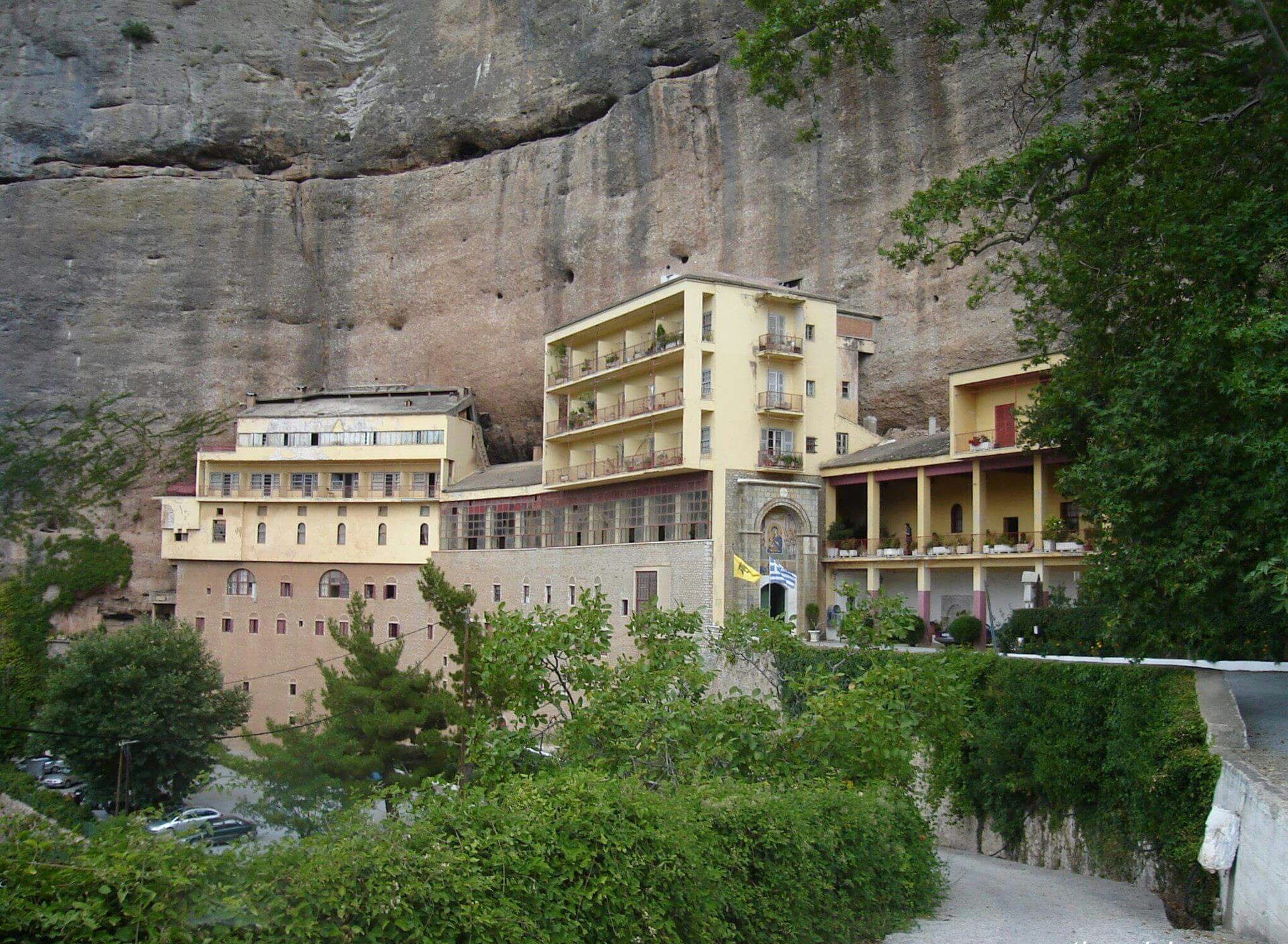
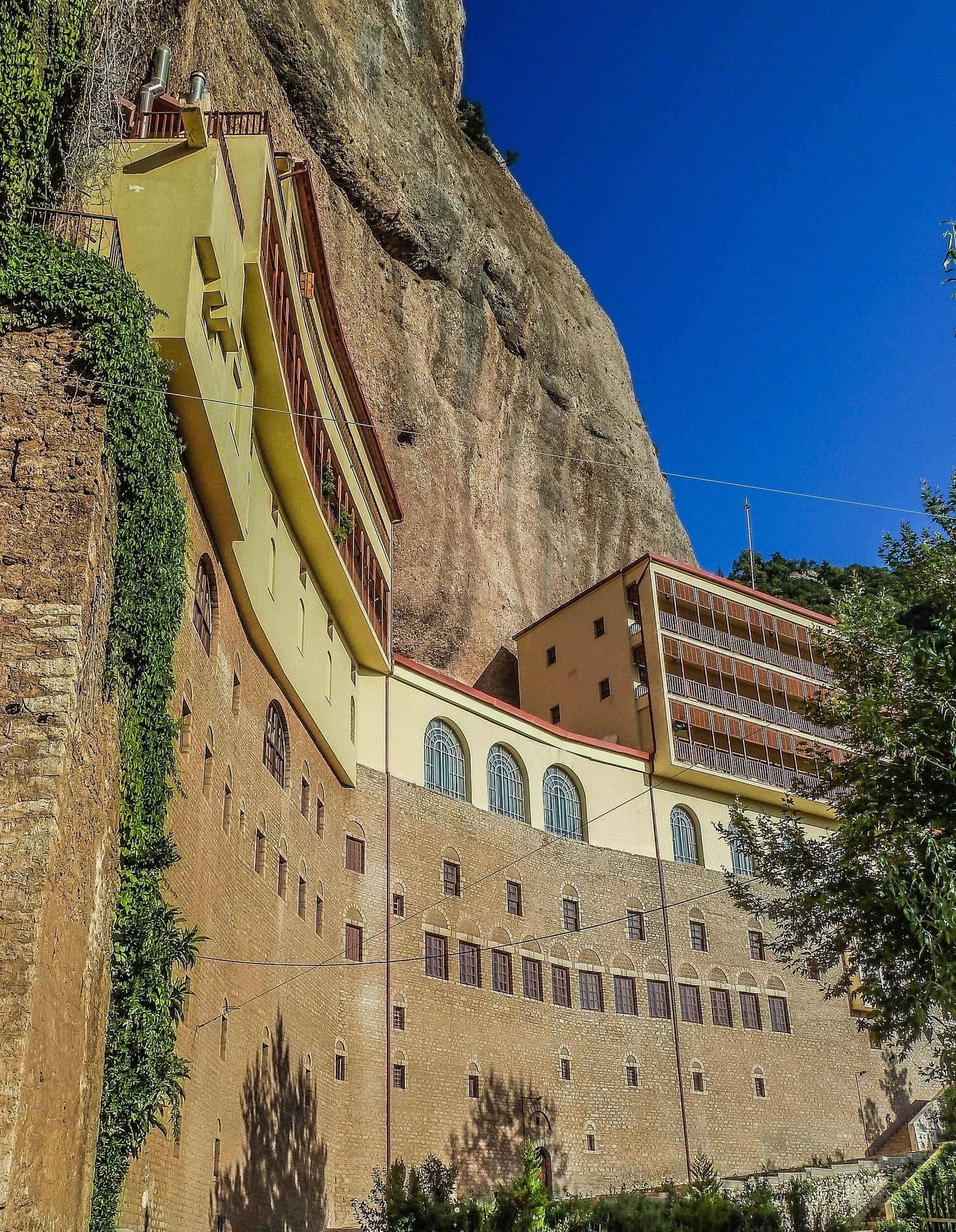
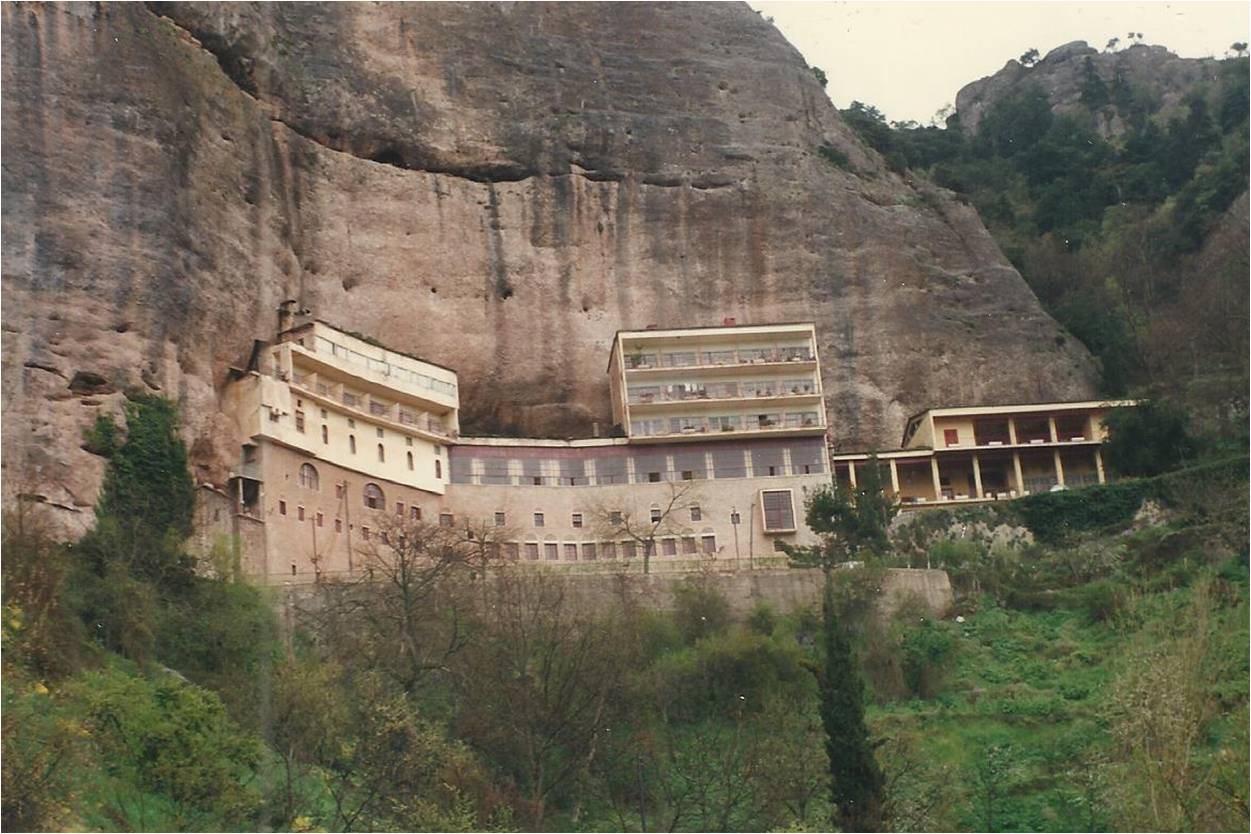
Mega Spilaio occupies the opening of a large natural cave on the western slope of Mount Chelmos, above the gorge of the Vouraikos River and near Kato Zachlorou. The monastery stands at approximately 900 to 940 metres above sea level, about 10 to 11 kilometres from Kalavryta. Its earliest buildings were inserted into the cave, while the surviving complex forms an eight-storey structure partly embedded in and partly set against an overhanging cliff approximately 120 metres high.
Cave church and chapels
The katholikon
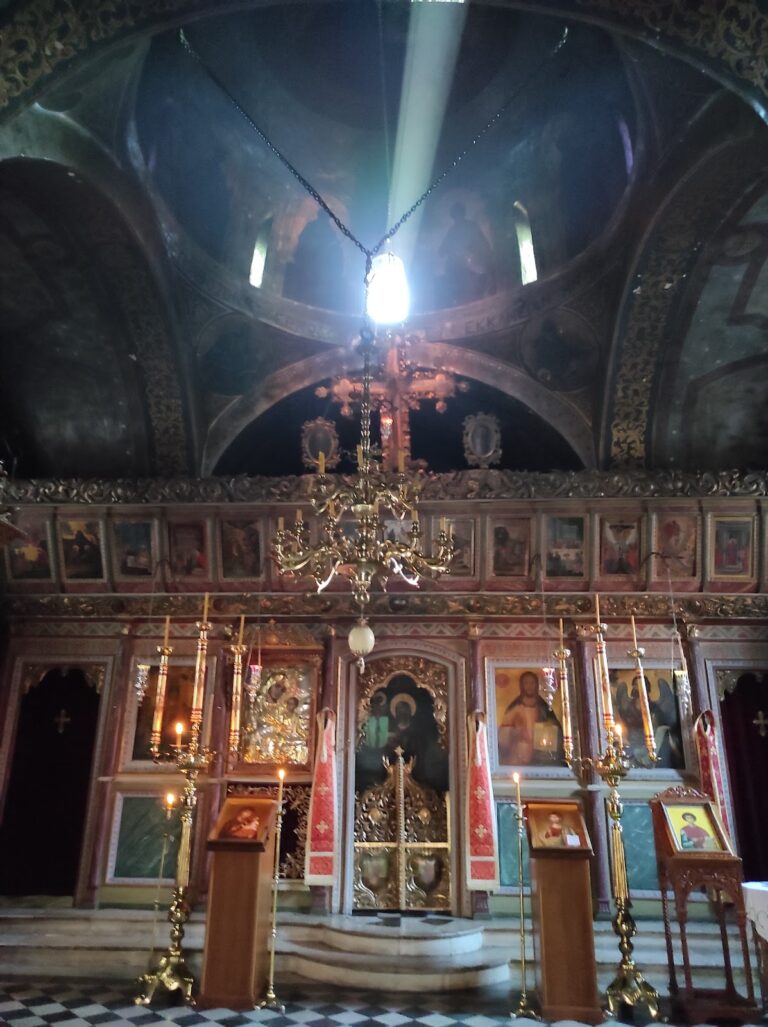
The katholikon, the principal church of an Orthodox monastery, is cut into the rock. It has a cross-shaped plan and two narthexes, entrance or vestibule areas adjoining the main church. The interior contains post-Byzantine wall paintings dated to 1653, marble floor inlay, and a carved wooden iconostasis. Further paintings in the church complex date from the early nineteenth century.
The Maiden’s Spring
The cave spring associated with Euphrosyne’s discovery of the icon was later faced with marble and became known as the Maiden’s Spring. Its water is regarded as holy, preserving the physical feature at the center of the monastery’s foundation tradition.
Founders’ chapel
The present complex includes a chapel containing the remains of Symeon and Theodore. Their association with the cave, the icon of the Theotokos, and the monastery’s foundation remains central to the religious character of the site.
Chapel near Psilos Stavros
Another chapel stands near Psilos Stavros. In December 1943, nine monks were executed there during the violence associated with the German occupation and Operation Kalavryta.
The Megaspileotissa and sacred collections
The principal icon
The monastery’s principal shrine is the relief wax icon of the Theotokos known as the Megaspileotissa. Monastic tradition attributes it to Luke the Evangelist and regards it as one of three surviving icons by him. Made from wax, mastic, and other materials, it is approximately three inches thick and has a coloured garment with gold outlines. The Theotokos faces to the right with her head inclined toward Christ and holds him in her right arm. Christ holds a Gospel in his right hand, while angels flank the image and seraphim and cherubim occupy its four corners. Repeated monastery fires blackened or darkened the icon.
The tradition surrounding the icon says that Luke brought it from Palestine to Achaea and gave it to early Christians, who hid it in the cave during persecutions until Euphrosyne discovered it. Another monastic tradition tells that a dragon guarding the icon was killed by a thunderbolt when it attacked Symeon and Theodore as they cleared vegetation from the sacred area.
The museum
The monastery museum houses relics of the Greek War of Independence, a banner depicting three Byzantine emperors, manuscripts with miniatures, engravings, portraits, rare Gospels, gold ecclesiastical embroidery, Byzantine icons, and other ecclesiastical treasures. Its collections also include sealed documents, gold crosses associated with the True Cross, parchment Gospels, the omophorion of Chrysanthos Notaras, embroidered epitaphioi, antiminsia, and reliquaries containing the bones of saints. An omophorion is a broad vestment worn by an Orthodox bishop. An epitaphios is an embroidered cloth used in services commemorating Christ’s burial, while an antiminsion is a consecrated cloth used on an Orthodox altar.
The library
The monastery library contains more than 3,000 books and numerous early printed works, preserving part of the institution’s long religious and intellectual history.
The gorge and railway setting
A road follows the Vouraikos gorge below the monastery. The 22-kilometre, 750-millimetre-gauge Diakopto to Kalavryta railway runs along the river and becomes a rack railway in places, using a toothed rail and cogwheel to climb steep gradients. The Zahlorou to Mega Spilaio station lies at the railway’s twelfth kilometre.