Makelaria Monastery: A Byzantine Monastery in Greece


Site at a Glance
- Rating
- 4.8
- Popularity
- Low
- Country
- Greece
- Primary era
- Medieval
- External website
- Open
- Eras represented
- Medieval
- Civilizations
- Byzantine
- Site type
- Religious
- Remains
- Monastery
On this page10 sections
History
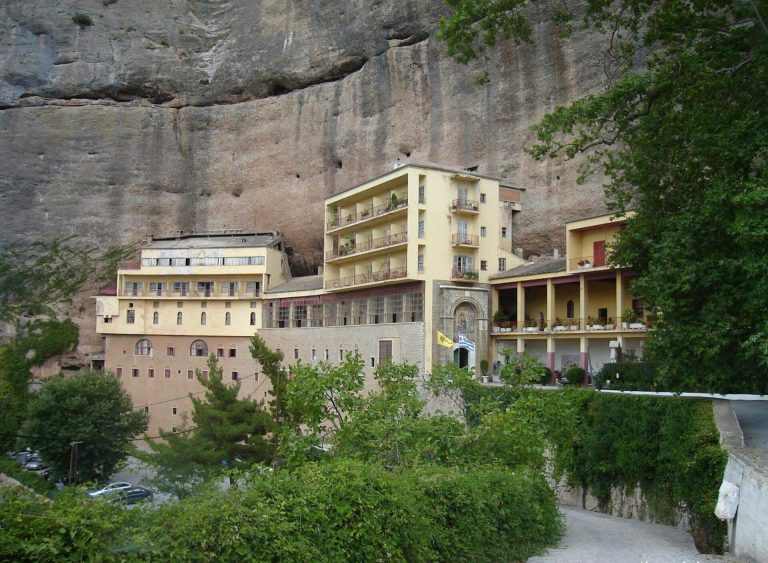
Makelaria Monastery is a sixth-century Eastern Orthodox monastery in Greece, located on a steep rock about 30 kilometres from Kalavryta in mountainous Achaea. Built during the Byzantine period, it is regarded as one of the oldest monasteries in Greece. The monastery is dedicated to the Dormition of the Theotokos, the Orthodox celebration of the death and assumption of the Virgin Mary.
Byzantine foundation
An inscription dated 1805 attributes the monastery’s foundation to Belisarius, the leading Byzantine general under Emperor Justinian, and dates its construction to 532. The inscription presents the monastery as an act of repentance for the massacre of rebels during the Nika Revolt, a major uprising in Constantinople that was violently suppressed during Justinian’s reign.
The original foundation was dedicated to the Virgin Mary and bore an earlier name connected with its rocky or stone-built setting. Its position later shaped the monastery’s role as a refuge and contributed to the traditions surrounding its name and history.
Ottoman destruction and Greek independence
Ottoman forces destroyed the monastery in 1458. Tradition holds that its exceptionally defensible location allowed inhabitants of nearby villages to shelter there. Led by the fighter Giannos, they resisted Ottoman attacks for many days before the monastery was captured. The massacre that followed is said to have filled the monks’ cells with blood and gave the monastery its present name, Makelaria, derived from the slaughter.
The monastery was renovated in 1784 by the hieromonk Neophytos, a monk ordained as a priest. During the Greek War of Independence, the struggle by Greek forces against the Ottoman Empire, several monks fought alongside the insurgents. The Battle of Kafkaria, a Greek victory over the advancing forces of Ibrahim, took place near the monastery on 26–27 August 1827.
Modern revival
Makelaria acquired its present form after the Second World War, when hieromonks Agathangelos and Anthimos carried out another renovation. Following a long period of closure, the monastery resumed operation on 1 August 2011, when the nuns Marcella and Synkletiki were installed to undertake its revival.
It is now an active women’s monastery with two nuns. Its principal feast is celebrated on 15 August for the Dormition of the Theotokos, while another feast takes place on 14 September for the Exaltation of the Holy Cross. The monastery is affiliated with the Church of Greece and the Metropolis of Kalavryta and Aigialeia, the local Orthodox diocese.
Remains
The monastery occupies a large, steep, exposed rock, and its buildings are arranged around churches and smaller sacred spaces on and below the rocky mass. The dramatic position has led to the nickname “Meteora of the Peloponnese.” Its principal churches combine the simple form of the older katholikon, the main church of an Orthodox monastery, with later Byzantine-style construction influenced by the architectural and liturgical traditions of the Byzantine Empire.
Monastery churches
Katholikon of the Dormition
The katholikon is dedicated to the Dormition of the Theotokos. It is a simple single-room church with a vaulted roof. Inside are two finely carved marble candle stands dated 1813, which belong to the surviving furnishings of the church.
Church of the Holy Trinity
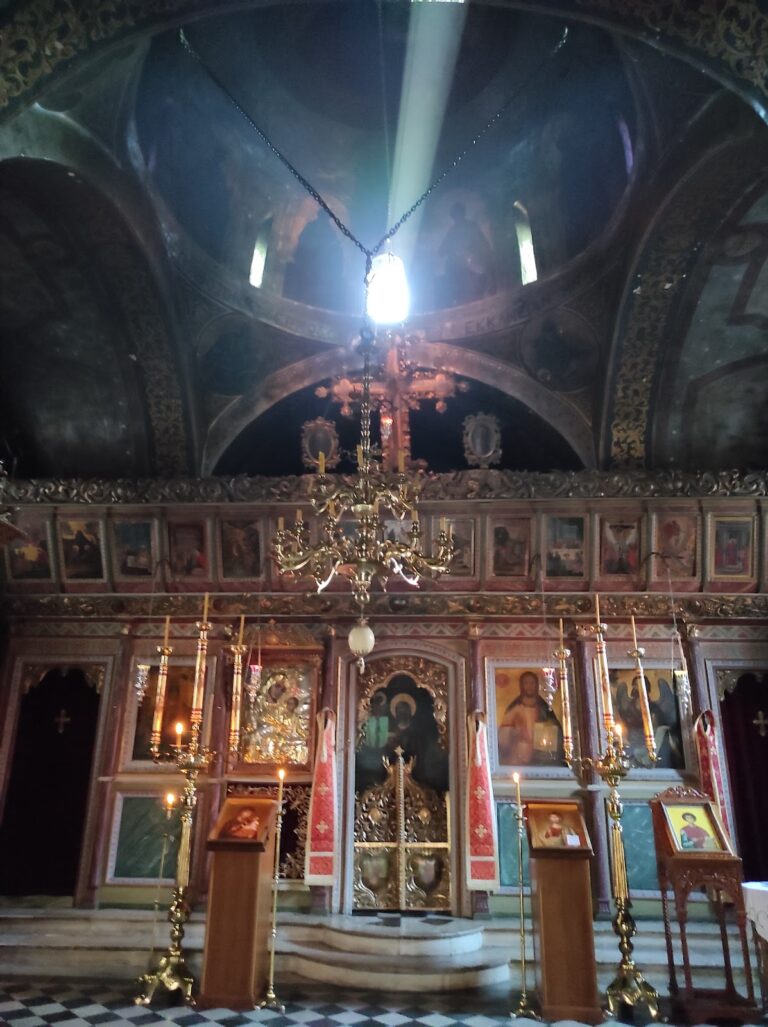
Beside the katholikon stands a later and larger church dedicated to the Holy Trinity. Built in the Byzantine style, it contains a finely carved wooden icon screen. The church also houses the monastery’s miraculous icon of the Virgin Mary, displayed on an ornate carved wooden devotional stand.
Church of the Transfiguration
A small church dedicated to the Transfiguration of the Saviour lies inside a cave somewhat below the present monastery. Water drips throughout the year from the rock above its altar, and local people attribute healing power to it.
Treasures and military objects
The monastery’s principal treasures include the miraculous icon of the Virgin Mary and a jar of miraculous oil. The jar was found inside the rock when the monastery was rebuilt after its destruction in 1458 and remains preserved there.
Gilded reliquaries, Byzantine icons, and silver-plated Gospel books were among the important treasures stolen during a robbery in September 1980. The monastery also preserves firearms, yataghans, or curved swords, and pistols associated with commanders and fighters who took part in the Battle of Kafkaria. Some uniforms belonging to fighters from the Greek War of Independence are preserved as well.