Žiče Charterhouse: A Medieval Carthusian Monastery in Slovenia


Site at a Glance
- Rating
- 4.6
- Popularity
- Low
- Country
- Slovenia
- Primary era
- Medieval
- External website
- Open
- Eras represented
- Medieval, Early Modern
- Civilizations
- Duchy of Styria, Holy Roman Empire
- Site type
- Religious
- Remains
- Fortified Monastery
On this page14 sections
History
Žiče Charterhouse is a Catholic Carthusian monastery in Slovenia, founded around 1160 in the Žičnica valley near Žiče and Špitalič by Ottokar III and Ottokar IV of Styria. The foundation belongs to the Romanesque period. It was the nineteenth monastery of the Carthusian Order, the oldest Carthusian house in Central Europe, and the first outside the order’s original French and Italian regions. The charterhouse was dedicated to Saint John the Baptist, and its principal church later gave the valley its name.
Foundation and early development
The foundation took place between 1155 and 1165, with 1165 marking the date of the surviving foundation charter. That document already names Beremund as the first prior, the superior of the charterhouse. The first monks came from the Grande Chartreuse near Grenoble. Beremund, a relative of the count of Cornwall and former prior of Durbon in Provence, led the community. A group of twelve choir monks and twice as many lay brothers is said to have arrived in 1160 and initially lived in the parish house at Konjice while the monastery was being prepared in the Saint John valley.
Aynard, a lay brother and master builder sent from the Grande Chartreuse, directed the early construction. Temporary buildings stood by at least 1165, and the community gradually developed according to Carthusian practice, which combined strict solitude in individual cells with shared worship and communal observance. Ottokar III and Ottokar IV were both buried at Žiče. Duke Leopold of Austria and his son Leopold later supported and enlarged the foundation, with the younger Leopold regarded as a second founder.
A foundation legend links the monastery with Ottokar III’s return from the Second Crusade. While hunting, he is said to have dreamed of Saint John the Baptist, who instructed him to establish a monastery in the valley. The story also offers a traditional explanation for the German name Seiz, associating it with an exclamation about a rabbit. This is a legend rather than a historical explanation of the name.
Growth and institutional influence
The monastery faced financial difficulties at first, but it prospered during the thirteenth century through privileges, donations, and exemptions granted by nobles and churchmen. Support came from Ottokar IV, Duke Leopold, Duke Ulrich III of Carinthia, the patriarchs of Aquileia, successive popes, and later the Counts of Celje. Before the end of the century, the monks of Žiče, under Prior Gotfrid, helped establish a daughter charterhouse at Lehnica in present-day Slovakia. The community also maintained close institutional links with charterhouses at Prague, Mauerbach, Gaming, and Aggersbach.
As the Carthusian Order organized itself into provinces, Žiče first belonged to the Lombard Province. In 1335 it became the seat of the German Province, and in 1355 it became the seat of the Upper German Province. Its influence reached a peak during the Great Western Schism, the late-fourteenth- and early-fifteenth-century division in Western Christianity when rival popes claimed authority from Rome and Avignon. Carthusian houses also divided in their allegiance. At the request of Pope Urban VI, the order’s general chapter moved from the Grande Chartreuse to Žiče, which served from 1391 to 1410 as the central house for the branch loyal to the pope in Rome.
Three Žiče priors became general priors of the Roman-aligned Carthusians. John of Bari held the office in 1391, Christopher served from 1391 to 1398, and Stephen Maconi of Siena led the branch from 1398 to 1410. From Žiče, they directed policy, supervised the creation of new charterhouses, and helped train future priors and choir monks. Stephen Maconi, a friend and follower of Catherine of Siena, promoted her writings and canonization and worked toward reunification. When the order was reunited in 1410, the Žiče priors had contributed to the reconciliation, and the charterhouse retained lasting prestige.
Žiče also became a centre of literary production. During the fourteenth century, Philipp of Seitz worked there and composed a Middle High German poem of 10,133 lines on the life of the Virgin Mary and Christ. A postscript identifying the “house at Seitz” connects the poem with the charterhouse.
Economic activity, decline, and dissolution
The charterhouse developed substantial economic activities alongside its religious life. It operated a glassworks at Špitalič beside the Žičnica before 1672 and another near Leskovec from about 1700 to 1764. The prospect of selling bottles in Rogaška Slatina helped motivate the later glassworks. Viticulture and winemaking were also important. In the late fifteenth century, Paolo Santonino described the monastery’s large wine cellars and exceptionally abundant production.
Ottoman incursions, peasant uprisings, and the spread of Reformation ideas weakened the monastery during the fifteenth and sixteenth centuries. On 3 March 1531, an Ottoman attack killed Prior Andrew and several monks. The raid marked the beginning of a decline in the charterhouse’s influence and wealth. In 1564 the monastery passed to commendatory priors, who held the office without necessarily serving as resident monastic superiors. In 1591 it was transferred to the Jesuits of Graz, but the Carthusians recovered it in 1593.
Religious life had ceased for three decades, from 1565 to 1595. Prior Vianni Gravelli, sent from the Grande Chartreuse, then restored the community, recovered part of its property and rights, and helped revive its prosperity. The renewed life of the monastery continued until Emperor Joseph II abolished the charterhouse in 1782 as part of the Josephine Reforms, centralizing Enlightenment measures that dissolved contemplative communities considered insufficiently useful to the state.
Fifteen choir monks were living at Žiče at the dissolution. They dispersed, returned to their home regions, or entered the secular clergy rather than moving to another charterhouse. A parish seat occupied the former monastery from 1782 until 1797, while a new parish was established at Špitalič in 1808 and continues to exist. After the dissolution, the buildings passed to the Religious Fund. In 1786, the monastic cells and parts of the complex were demolished, and their materials were sold or reused, including after a major fire in Konjice.
Prince Weriand of Windisch-Graetz bought the deteriorating ruins at auction in 1826 or 1828. His family formally owned them until the end of the Second World War, after which ownership passed to the Municipality of Slovenske Konjice. Žiče was proclaimed a cultural monument of national importance by the Government of Slovenia in 2015. Reconstruction and conservation continue under expert supervision.
Library and manuscript tradition
On 30 May 1487, Bishop Peter of Caorle visited Žiče as an envoy of the Patriarch of Aquileia. His secretary, Paolo Santonino, counted more than 2,000 volumes in the monastic library, most of them handwritten. In the mid-sixteenth century, Archduke Charles II of Styria ordered books from Žiče and other nearly deserted charterhouses to be transferred to the Jesuit college library in Graz.
About 120 medieval manuscripts and roughly 100 fragments from the Žiče corpus are known today, most outside Slovenia. They represent nearly four centuries of manuscript production within one Slovenian monastic community. The material includes works associated with Philipp of Seitz, Nicolaus Kempf, and Sifried of Swabia, as well as texts on theology, astronomy, practical sciences, and literature. The manuscripts also preserve evidence of outside scribes, probably including benefactors, and trace the development of a distinctive Žiče style of decorated initials and illumination.
Remains
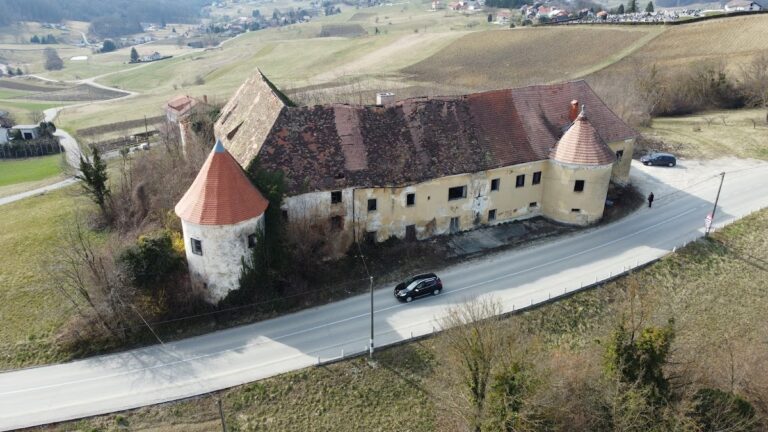
Žiče Charterhouse was organized as two separate monastic houses adapted to the valley’s terrain. The Upper House, or Domus Superior, stood at Stare Slemene for the choir monks, while the Lower House, or Domus Inferior, stood at Špitalič for the lay brothers. The Carthusian arrangement combined a monastic church, a small cloister linking communal rooms, and a great cloister connecting individual cells. The surviving upper enclosure follows the landscape in an approximately triangular plan, while the largely unbuilt area between the two houses preserves their physical separation.
Upper House
Church of Saint John the Baptist
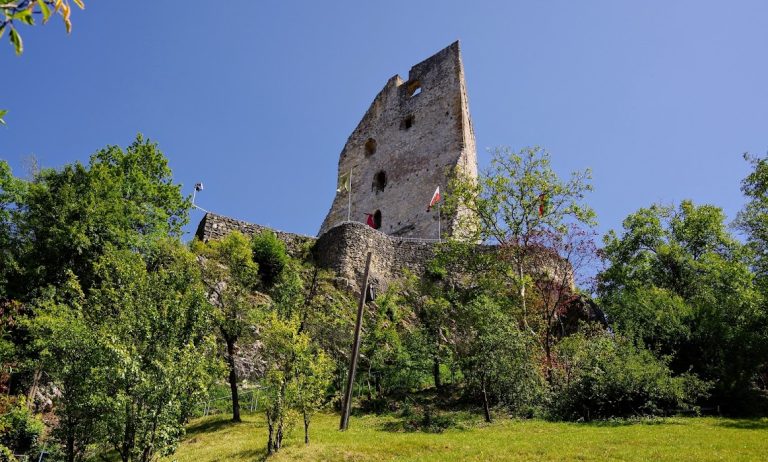
The large church of Saint John the Baptist, known as the Ecclesia Maior, was consecrated on 24 October 1190 by Patriarch Godfrey of Hohenstaufen. It is the most imposing ruin in the upper complex and gave the valley its name. The surviving remains include Gothic church windows, a side-aisle apse, and a church keystone carved with a winged ox, the traditional symbol of Saint Luke the Evangelist. The keystone is now built into a facade.
Cloisters and communal buildings
The Upper House contained twelve cells for the choir monks and a prior’s house, symbolically corresponding to the twelve apostles with Christ as their head. The small cloister connected the kitchen, chapter house, refectory, and a dormitory used by lay brothers who came from the Lower House for worship on Sundays and feast days. It also led to the church and sacristy. The chapter house had an altar and was normally connected with the prior’s house and chapel.
The great cloister linked the individual cells and enclosed the cemetery known as God’s Acre. A crucifix once stood at its centre, but it was replaced in the fifteenth century by the All Saints cemetery chapel, where priors were buried. The chapel survives. Other surviving or excavated parts of the upper complex include the refectory, cellars, kitchen, an upper-storey wing, part of the cloister, and ruins of additional cells and communal buildings.
Fortifications and garden
A wall enclosed the upper charterhouse and separated it physically from the surrounding area. The wall followed the terrain and was strengthened with towers during the fifteenth- and sixteenth-century fortification phase. A major defensive tower and sections of the fortified enclosure have been restored. The restored herb garden contains a replica of an original stone table with a bench and a replica of a monastic table dated 1656. A sundial also survives among the remains.
Lower House at Špitalič
Lay-brothers’ church
The Lower House contained sixteen cells for lay brothers, connected by a cloister. Its communal facilities probably included a kitchen, refectory, and infirmary. The former lay-brothers’ church, the Ecclesia Minor, was dedicated to the Visitation of Mary, commemorating Mary’s visit to Elizabeth. The Lower House was later abandoned and demolished, but this church remained at Špitalič as its surviving monastic building.
The church was consecrated in 1190 and was built in the French late Romanesque style. It has remained almost unchanged. Its entrance portal was moved to the west side and expresses the transition between Romanesque and Gothic architecture. Three slender columns stand on each side, ending in layered, chalice-shaped foliate capitals. The capitals differ from one side to the other, with foliate forms on the left and bud forms on the right, a variation interpreted as evidence for two sculptors. The semicircular lunette contains a relief of the mystical Lamb bearing a resurrection cross, a Christian image of Christ known as the Lamb of God.
In 1757, the Celje woodcarver Ferdinand Gallo made two side altars for the Špitalič church in a light Rococo style.
Hospice and service buildings
The Lower House also included a hospice, probably on the site of the present parish house. It supplied money, clothing, food, and medicines to people in need. Some medicines were prepared from cultivated herbs according to recipes preserved in the monastic library. Outside the charterhouse walls stands the Gastuž building, reflecting the Carthusian practice of receiving guests beyond the enclosure. It is associated with an inn documented from 1467 and has a collection that includes medieval culinary recipes.
Manuscripts and decorative remains
The surviving manuscript material includes about 120 manuscripts and 100 fragments, some with colourful painted initials and other illuminated elements. Professional or itinerant painters from southern Germany, Vienna, Prague, and northern Italy contributed to this decoration. Carthusian regulations allowed monks to draw initials with reed pens and coloured inks, while painted decoration was assigned to professional artists.
The manuscripts preserve a sequence of handwriting forms and decorated initials through which the development of the Žiče style can be traced. They include texts by authors associated with Žiče and the nearby Jurklošter Charterhouse, together with copies made by monks and external scribes. Their physical survival extends the visible remains of the monastery into the library tradition that once formed part of its communal life.
Nearby sites