Zbelovo Castle: Medieval Fortress and Lordship Seat in Slovenia
Site at a Glance
- Rating
- 4.1
- Popularity
- Very Low
- Country
- Slovenia
- Primary era
- Medieval
- Eras represented
- Medieval, Early Modern
- Civilizations
- Duchy of Styria, Habsburg, Holy Roman Empire
- Site type
- Military
- Remains
- Castle
On this page7 sections
History
Zbelovo Castle, also known as Plankenstein, is a late twelfth-century medieval fortress in Slovenia, built by the ministerial knights of Konjice. Ministerials were members of the medieval service nobility who held land while performing military or administrative duties for a ruler. The castle stood above the Dravinja River and the settlement of Zbelovo, guarding the road from the Savinja Valley towards the Drava region.
Origins and the Zbelovo Knights
The castle and its lordship had already existed when Zbelovo was first explicitly mentioned in 1428 as “Plankenstein vest.” Around 1202, the estate passed by inheritance to Albert Rogaški, a relative of the Konjice family. It later went to their relative Otto Liechtensteinski in 1296. The Liechtensteins leased the property to the Lords of Viltuš in 1312, to Ulrik der Putz in 1393, and subsequently to Viljem Safner. Around 1420, Rudolf Liechtensteinski sold Zbelovo to Viljem and Janez Metz.
Zbelovo was the seat of the local knights and the administrators of the lordship. Walter de Wlancistaine appears in 1202, followed by Ortolf de Blanchenstein in 1206. Ortolf’s sons were Rudolf, Henrik, Gotskald, and Ortolf II. Later members of the family became benefactors of Studenice Monastery. After the Counts of Celje took possession, the Zbelovo knights became their formal vassals, and the family soon died out.
Celje Control and Habsburg Administration
In 1439, during a war between the Counts of Celje and the Habsburgs, the castle was occupied by the Counts of Celje or their commander Jan Vitovec. Its position within the Counts’ connected territory between Konjice, Poljčane, and Lemberg helped explain this seizure. The Counts appointed Ulrik Grassl as administrator. After the death of Ulrik, Prince of Celje, in 1456, Zbelovo passed to the territorial prince, a ruler with sovereign authority over a territory within the medieval imperial order.
The estate was then managed by administrators and pledge-tenants, who controlled property held as security for a debt or financial agreement. Ulrik Grassl was followed by his son Anton in 1460, Gilg Prandtner in 1478, Pongrac Puchsteiner in 1489, Sebastian Mindorfer in 1493, Viljem Kalmanič in 1500, Franc Prager later that year, and Janez Svetkovič, also known as Swetkowitz, from 1509.
In 1515, rebellious peasants occupied and badly damaged the castle. Emperor Maximilian I, the Habsburg monarch who ruled the Holy Roman Empire from 1493 to 1519, then placed Zbelovo, together with the manor houses at Lemberg and Šmarje, under the administration of Janez Presinger. Presinger was the royal hunting and forestry master in Carniola, Carinthia, and Gorizia, and governed through appointed administrators. The castle administrator in 1528 was the knight Jurij Lindeški, also called Georg von Lindegg.
Janez Presinger was succeeded by his son Baltazar in 1529. By 1557 Baltazar was described as a baron and served as provincial governor of Upper Austria. His sister Gertruda Presinger followed him in 1564. The estate comprised the three administrative offices of Zbelovo, Lemberg–Nova Vas, and Pohorje according to the 1524 land register. This register recorded the lordship’s revenues, obligations, and organization, including wine dues collected from vineyards at Poljčane, Lemberg, and Lipoglav.
Decline and Later Ownership
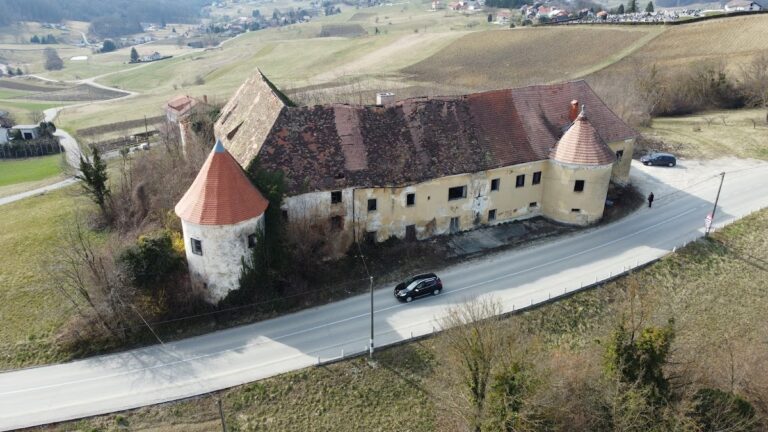
Janez Presinger considered the hilltop castle unsuitable for habitation and built a small manor house beside the Dravinja at the northern foot of the hill. The new building served administrative purposes rather than replacing the castle as a residence. The castle and lordship were sold in 1580 by Archduke Charles II, a Habsburg ruler of Inner Austria, to Baron Jošt Janez Thurn. The Thurn family, later raised to the rank of counts, retained the property until 1870.
The Thurns abandoned the castle by the end of the sixteenth century. In 1586 it was already unoccupied and unfurnished, and it was left to decay. A depiction by Vischer, a seventeenth-century topographer and engraver of regional settlements and buildings, shows Zbelovo as completely ruined by the second half of that century. Count Gustav Thurn sold the lordship in 1870 to Janez Walland, a townsman from Konjice.
The castle’s strategic role also shaped the administration of the lordship. A toll station stood in the narrow valley below it on the road between the Savinja Valley and the Drava region. Zbelovo was the seat of the lordship’s territorial and local courts from before 1524 until the middle of 1849. The site is listed in Slovenia’s Register of Cultural Heritage as an immovable monument of local importance in the Municipality of Slovenske Konjice, a designation proclaimed on 18 July 1998.
Remains
Hilltop Castle
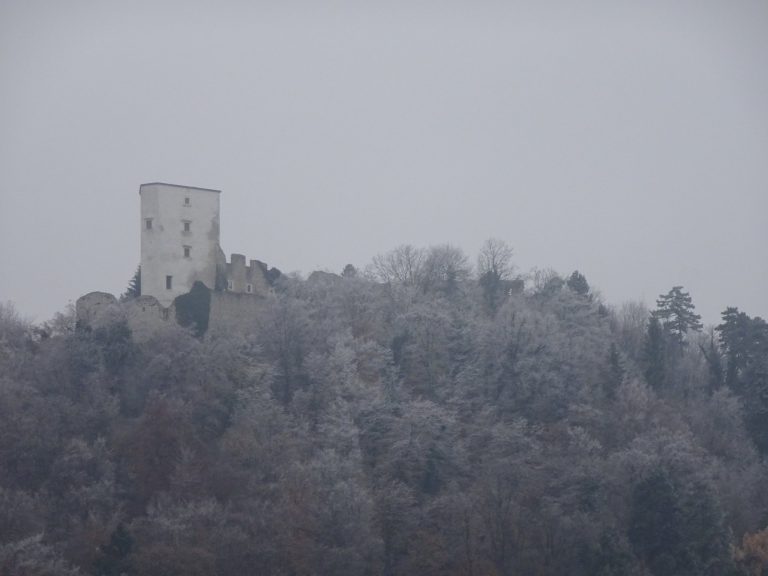
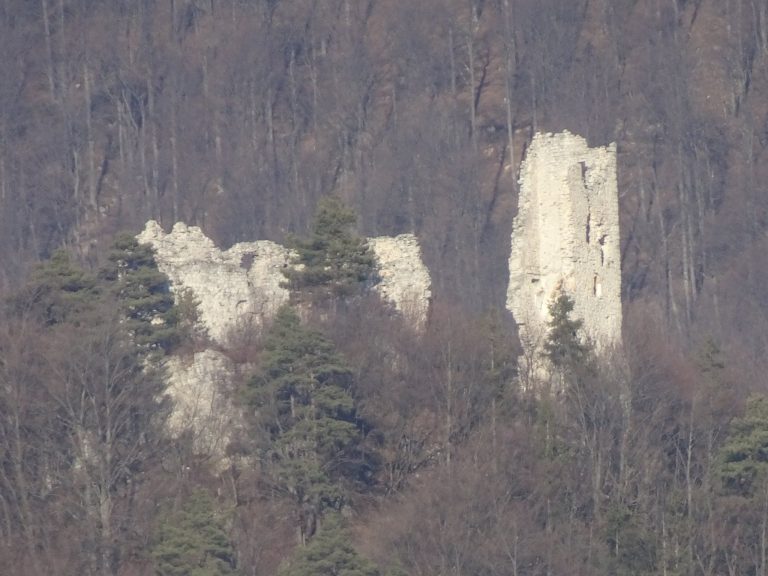
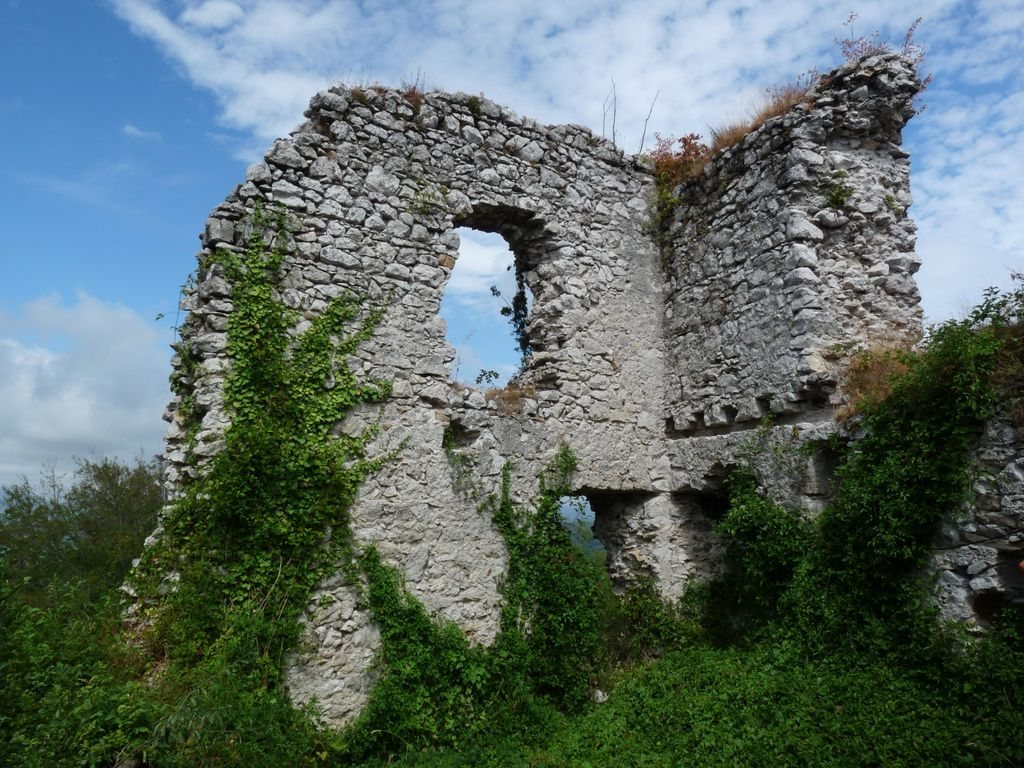
The castle occupied a steep hill on Zbelovska Gora above the Dravinja River and the settlement of Zbelovo, southwest of Poljčane. Its surviving fabric consists of slight ruins from a fortress built at the end of the twelfth century. The hilltop position placed the castle above the road corridor linking the Savinja Valley with the Drava region. The ruinous state visible today reflects the abandonment that began in the late sixteenth century and the complete ruin shown in Vischer’s engraving from the second half of the seventeenth century.
Manor House and Valley Toll Station
After the main castle became unsuitable for residence, a small manor house was built at the northern foot of the hill beside the Dravinja. It functioned as an administrative building and appears in Vischer’s depiction of the site. Below the castle, the narrow valley contained a toll station along the road connecting the Savinja Valley and the Drava region. Together, these surviving site elements reflect the administrative and transport functions associated with the former lordship.