Panagia Eikosifinissa: An Orthodox Monastery in Greece


Site at a Glance
- Rating
- 4.9
- Popularity
- Medium
- Country
- Greece
- Primary era
- Medieval
- External website
- Open
- Eras represented
- Medieval, Early Modern, Modern
- Civilizations
- Byzantine, Greek, Ottoman
- Site type
- Religious
- Remains
- Fortified Monastery
On this page15 sections
History
Panagia Eikosifinissa is a historic Eastern Orthodox monastery in Greece, located near Amphipolis on the northern slope of Mount Pangaion. The present monastery was essentially founded in the eighth century by Saint Germanos, although traditions place an earlier Christian settlement at nearby Vigla. It became an important center of Orthodox religious life, Greek education, and Greek political and cultural activity in Eastern Macedonia.
Early Foundations and the Eighth-Century Monastery
The earliest history of the site is uncertain. One tradition attributes a church and monastic settlement at Vigla to Sozon, bishop of Philippi, whose episcopate included participation in the Council of Chalcedon in 451, an important Christian council concerned with doctrine and ecclesiastical authority. Sozon is said to have established the settlement around 450, after which it was abandoned. Another tradition places the foundation of the monastery in 518.
The foundation tradition for the present monastery begins with Saint Germanos, an Orthodox monk regarded as its principal founder. He is traditionally said to have arrived at Vigla around 718 after leaving the Monastery of Saint John the Baptist on the Jordan River. Finding the ruins associated with Sozon, he began building a new monastery.
Constantinopolitan officials named Nikolaos and Neophytos are also commemorated as associated founders. According to tradition, they encountered the wounded Germanos while travelling to Serbia as envoys of Emperor Basil I. They paid the craftsmen whom Germanos could not afford and secured his release from custody. They later sold their property and entered the monastery.
The name Panagia Eikosifinissa does not derive from the apparent Greek meaning “twenty palms.” It is linked instead to the older place-name Kosinitsa, which is related to a Slavic word for “beehive.” Other traditions connect the name with a miraculous icon of the Virgin that emitted a reddish light, or with an oasis of twenty palms near the Monastery of Saint John the Baptist in Palestine.
Byzantine and Patriarchal Development
Archaeological evidence indicates that the monastery’s principal church, known as the katholikon, was rebuilt in the eleventh century. The monastery later became stavropegic, meaning that it was placed directly under patriarchal authority rather than the ordinary jurisdiction of a local bishop. Patriarchal decrees issued by Symeon I and Maximos III placed it under the Ecumenical Patriarchate, the senior patriarchal institution of the Eastern Orthodox communion, based in Constantinople, now Istanbul.
A new period of prosperity began in 1472, when the former Ecumenical Patriarch Dionysios I settled at the monastery. Through his activity and personal resources, he revitalized the community and became known as its second founder. He remained there until 1488, returned after resigning again in 1490, and died at the monastery in 1492. He was later recognized as a saint.
Further patriarchal support came through decrees issued by Jeremias I in 1544, Metrophanes III in 1567, and Jeremias II in 1573. In 1610, Matthew, Metropolitan of Myra, visited the monastery and composed the Supplicatory Canon of the Virgin of the Acheiropoietos. Gregory V, who later became Ecumenical Patriarch and was venerated as a national martyr and saint, stayed at Panagia Eikosifinissa in exile after his first patriarchate in 1798.
Ottoman Rule, Education, and Destruction
During the Ottoman period, Panagia Eikosifinissa served as a major center for Eastern Orthodoxy and Greek education in Eastern Macedonia. On 25 August 1507, Ottoman forces killed 202 people at the monastery: 24 hieromonks, meaning monks who were also ordained priests, three deacons, 145 monks, and 30 pilgrims. Ten monks from Vatopedi Monastery on Mount Athos arrived in 1510 to re-establish the community.
The monastery remained an important spiritual and national center during the Greek Revolution, the war of independence against Ottoman rule that began in 1821. Its abbots maintained close ties with the revolutionary leaders Nikotsaras and Emmanouil Pappas. A school called the School of Common Letters, or Greek School, operated there until 1843. The future Ecumenical Patriarch Neophytos VIII studied at the monastery from 1839.
The complex was seriously damaged by an earthquake in 1829 and burned in 1854. A plague epidemic in 1864 caused the deaths of much of the brotherhood. During the tenure of Chrysostomos, Metropolitan of Drama, Philippi, and Zichna, a farming school operated at the monastery from 1902 to 1910 with three agronomists.
In 1898, Prokopios, Bishop of Amphipolis and later Metropolitan of Iconium, arrived as an exarch, an ecclesiastical representative of a senior church authority, appointed by the Ecumenical Patriarchate to restore unity and peace within the brotherhood. He later died as a martyr in Asia Minor in 1923.
Bulgarian Occupations and the Loss of the Collections
During the Second Bulgarian Occupation of Eastern Macedonia, Bulgarian forces murdered Makarios, an elderly former abbot, on 3 October 1916. On 27 March 1917, Bulgarian troops and irregulars led by Todor Panitsa assaulted the monastery, abused the monks, and seized most of its relics and cultural treasures. The monks were taken hostage in June 1917. Survivors returned on 10 October 1918, after the defeat and withdrawal of the Bulgarian and German forces.
The seized holdings included 907 sacred liturgical objects, 430 manuscript codices, 467 other manuscripts, and additional materials. In 1923, Georgios Sotiriou, a professor of Byzantine archaeology and director of the Byzantine Museum in Athens, sought their return in Sofia, but only seven objects were returned. Many items remain in Sofia, including at the National Historical Museum and the Ivan Dujev Centre for Slavic-Byzantine Studies, while others entered European and American institutional and private collections.
The Greek government pursued restitution under the Treaty of Neuilly of 1919. The Ecumenical Patriarchate, diocesan authorities, and local government bodies have also continued to demand the return of the seized cultural property.
During the Second World War, Bulgarian occupying forces again entered the monastery, confined Abbot Gregory and twelve monks, and burned the complex on 12 July 1943. The church was reported to have remained undamaged. After the war, Abbot Gregory Katsivakis built an abbot’s residence and a small guesthouse through his own labor and assistance from the faithful. He was the last abbot of the male monastery and remained in office until his death in 1956.
Revival as a Women’s Monastery
Panagia Eikosifinissa was revived after 1965 through the efforts of Dionysios Kyratsos, Metropolitan of Drama. The monastery was then largely abandoned and deserted. A women’s sisterhood was installed, and extensive conservation and construction restored monastic life. Kyratsos was buried at the monastery in 2005 and is regarded as its third founder.
Panagia Eikosifinissa is now a women’s monastery. It had 24 resident nuns in the 2011 census and currently has 23. Its principal commemorations are those of Saint Germanos and Nikolaos and Neophytos on 22 November, Saint Dionysios on 23 November, the Dormition of the Virgin on 15 August, the Exaltation of the Holy Cross on 14 September, and the Presentation of the Virgin on 21 November.
The recovery of displaced objects has continued. In 2011, part of the relic of Saint Dionysios was returned from Bulgaria. In 2016, a 674-page ninth-century handwritten New Testament stolen in 1917 was recovered from the Lutheran School of Theology in Chicago. It is described as the world’s oldest complete manuscript of the New Testament. In October 2023, three sixteenth-century manuscripts were returned through the Ecumenical Patriarchate and the Archdiocese of America. Their study revealed the names and precise composition of the 202 people killed at the monastery in 1507.
Remains
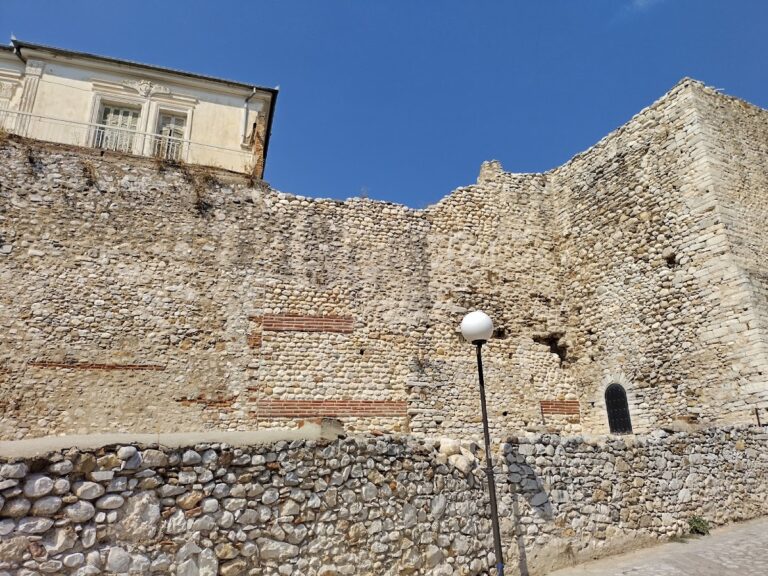
The monastery stands in a gorge on the northern slopes of Mount Pangaion, at an elevation of 753 meters. A high wall encloses the complex, which is divided into a principal section and a secondary group of buildings. The central katholikon, the principal church of an Orthodox monastery, occupies the middle of the enclosure and is the oldest surviving building in the complex.
Enclosure and Monastic Buildings
Principal Section
The principal section contains the katholikon, the abbot’s residence, the nuns’ cells, a guest reception building, the chapel of Saint Barbara, the museum, the refectory, and workshops for embroidery and icon painting. The chapel of Saint Barbara includes a holy-water spring. These buildings form the main institutional and residential group within the walled monastery.
Secondary Section
The secondary section contains three guesthouse buildings, a presbytery for the monastery priest, and the chapel of the Life-Giving Spring. Together with the principal section, these structures make up the divided arrangement of the monastic complex.
Katholikon
Plan and Entrance
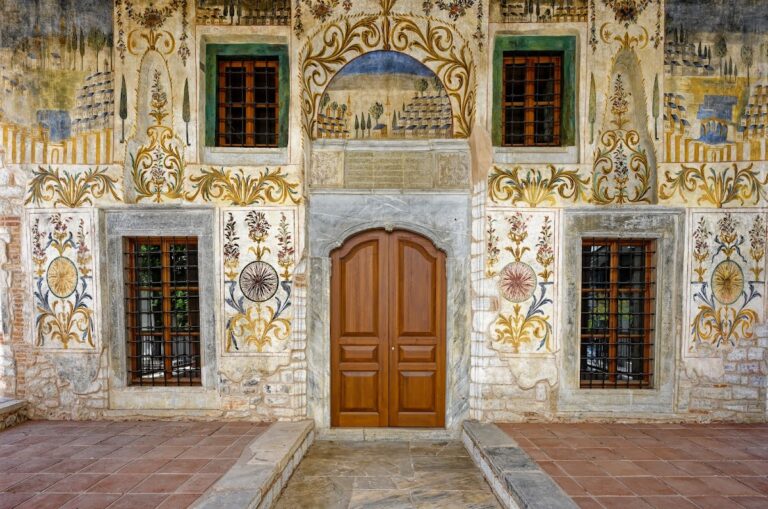
The katholikon has a composite, four-column, domed cross-in-square plan. It consists of an outer narthex, an inner narthex, and the main church. A narthex is the entrance or vestibule area of a church, while the domes rest on four marble columns. The principal entrance is elaborately carved in stone and dates to 1838.
Paintings and Woodwork
The outer narthex is completely covered with wall paintings showing the monastery’s founders at full length. The church was painted between 1858 and 1864 by Matthaios Ioannou of Corinth and his assistant, the monk Ananias. Inside, a richly carved wooden iconostasis separates the sanctuary from the main worship space. Craftsmen from Chios worked on it for 22 years, from 1781 to 1803. The Marian shrine and the bishop’s throne are also carved in wood. The iconostasis has been attributed to the woodcarver Petre Filipovski, known as Garka, although that attribution remains uncertain.
Relics and Memorial
A display case on the right side of the katholikon contains silver reliquaries holding dozens of sacred relics. A reliquary is a container used to preserve sacred remains. In front of the monastery complex stands a monument to the 172 monks killed in 1507.
Treasury and Manuscripts
The monastery’s treasury formerly held numerous valuable ecclesiastical treasures, and its library contained 1,300 volumes in 1917, including 400 manuscripts written on parchment. Most of these holdings were removed during the Bulgarian seizure that year. Identified displaced objects include an icon of the Virgin Hodegetria, reliquaries associated with Saint Dionysios dating from the late eighteenth century, an eighteenth-century silver vessel for storing offerings, and other sacred objects now held in Sofia.
The returned manuscripts provide important surviving evidence of the monastery’s former library. The New Testament recovered in 2016 consists of 674 handwritten pages and dates from the ninth century. The three manuscripts returned in 2023 date from the sixteenth century. Their study also clarified the names and precise composition of the people killed in the 1507 massacre.
Nearby sites