Tazouda Castle: A Mountain Fortress in Morocco


Site at a Glance
- Rating
- 4.7
- Popularity
- Very Low
- Country
- Morocco
- Primary era
- Medieval
- Eras represented
- Medieval
- Civilizations
- Marinid
- Site type
- Military
- Remains
- Fort
On this page8 sections
History
Tazouda Castle is a medieval fortress in Morocco, occupying a naturally defended summit in the Rif region of Nador Province. Its recorded history reaches from the tenth century through the medieval period and includes repeated destruction, rebuilding, and reinforcement. The fortress belonged to the territory of the Kingdom of Nekor, a medieval polity in the Rif, and its position remained useful for defense into the period of the Spanish Protectorate.
The Tenth-Century Fortress
The fortress identified as Tazouda was probably destroyed in the tenth century by Maisour, a eunuch serving the Fatimid caliphate. Andalusians rebuilt it for Musa ibn Abi al-Afiya, a tenth-century ruler in the Maghreb, but the army of Jawhar al-Siqilli later destroyed it during the same century. Jawhar was a military commander and statesman who served the Fatimid caliphate.
The geographer al-Bakri described Tazouda, probably referring to this fortress, as an impregnable stronghold on a high and inaccessible mountain. The description reflects the defensive value of its summit location, where steep natural edges made approach difficult.
Rebuilding under the Hammudids
Tazouda was rebuilt during the eleventh century after Muhammad ibn Idris, the last ruler of the Hammudids of Malaga, was summoned to oppose the advance of the Almoravids. The Hammudids were a medieval Muslim dynasty that ruled parts of Iberia and North Africa, while the Almoravids were a Berber-led Islamic dynasty whose expansion created the military threat associated with this rebuilding.
The fortress was occupied in the eleventh century by the Ait Ourtdi tribe, whom Ibn Hawqal identified with the Beni Boutouya. Ibn Hawqal was a geographical writer whose description helps connect the settlement with the wider territory of Nekor.
Marinid and Late Medieval Phases
Tazouda remained active during the fourteenth-century Marinid period. The Marinids were a medieval Berber dynasty that ruled Morocco and parts of the western Maghreb from the thirteenth to the fifteenth century. Leo Africanus considered it possible that they had originally built the fortress, although it was later destroyed and fell into ruin.
According to Leo Africanus, a commander from Granada rebuilt the settlement under the Kingdom of Fez after the Spanish occupation of Melilla. The walls were strengthened, and the governor concluded treaties and truces with the Catholic Monarchs until 1493. The Catholic Monarchs were Isabella I of Castile and Ferdinand II of Aragon, the joint rulers associated with the Spanish monarchy in this period.
Hassan al-Fikiki proposed that the Marinids encountered an older fortress and renewed its principal interior buildings while constructing the outer walls. This interpretation distinguishes the earlier core from later defensive additions and helps explain the repeated rebuilding of Tazouda.
Remains
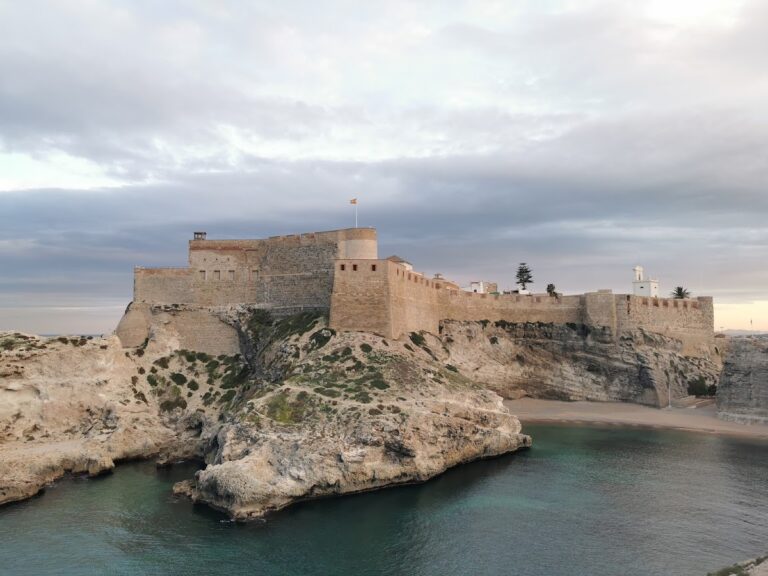
Mountain Setting and Natural Defenses
Tazouda occupies a mountain summit at about 600 metres above sea level, on the northern edge of the crater of an ancient volcano in Morocco’s Rif region. The summit lies on a granite plateau, a relatively level elevated surface underlain by granite rock. A volcanic crater is a bowl-shaped depression formed around a volcano’s opening.
Only one route reaches the site, approaching from the east. Sheer edges protect the western, northern, and southern sides, giving the fortress a naturally defensive position and making it difficult to approach. This terrain formed part of the site’s military character alongside its built fortifications.
Walls and Interior Buildings
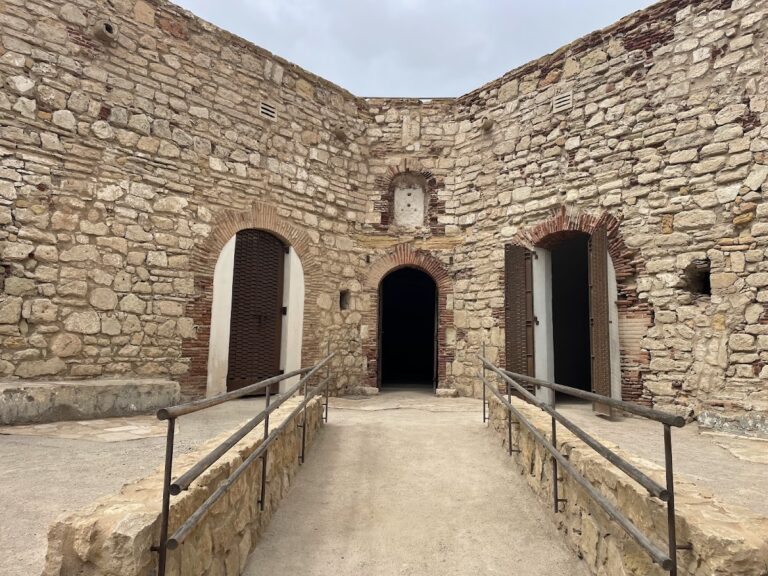
The fortress consisted of outer walls and prominent buildings within them. The outer defenses were strengthened during a later rebuilding, while the principal interior buildings were renewed in the interpretation attributed to Hassan al-Fikiki. These works formed successive layers in the fortress’s changing defensive arrangement.
The Tazouda Name
The name Tazouda derives from the Amazigh plural of Thazatta, pronounced Thizotha, a thorny sidr plant. The plant was used as a defensive hedge to hinder enemies attempting to climb the fortress. The name therefore preserves a direct association between the surrounding vegetation and the site’s natural and artificial defenses.