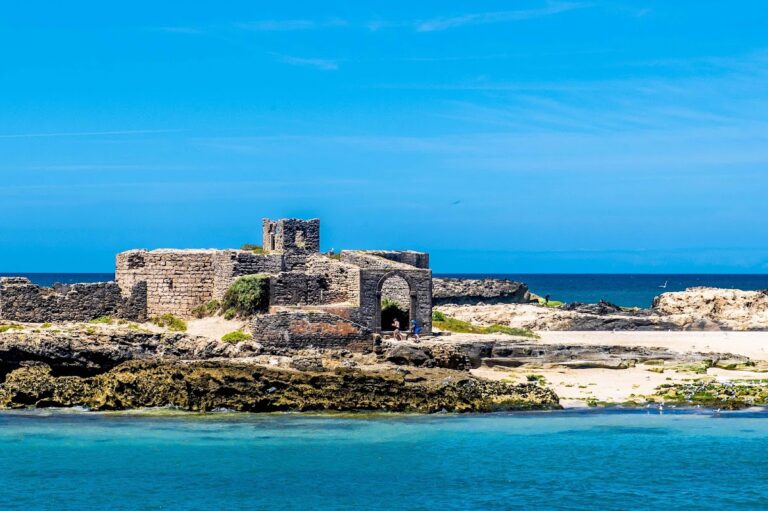
Sqala of Kasbah: An Eighteenth-Century Artillery Platform in Essaouira


Site at a Glance
- Rating
- 4.6
- Popularity
- Medium
- Country
- Morocco
- Primary era
- Early Modern
- Eras represented
- Early Modern
- Civilizations
- Alaouite
- Site type
- Military
- Remains
- Fort
On this page4 sections
History
The Sqala of Kasbah is an eighteenth-century artillery platform in Essaouira, Morocco, built in the Vauban style under Sultan Mohammed III of the Alaouite dynasty. Constructed in 1765 on the sultan’s orders, it formed one of the principal fortifications protecting the city from naval bombardment.
Construction under Mohammed III
Mohammed III, also known as Mohammed Ben Abdellah, was an Alaouite sultan of Morocco. The sqala was established as part of Essaouira’s coastal defenses, with its design following the fortified military system associated with the French engineer Sébastien Le Prestre de Vauban. A French architect influenced by Vauban’s work produced the fortification.
Defense and heritage status
The Sqala of Kasbah took part in the defense of the city during the French bombardment of Mogador in 1844, an attack carried out during the Franco-Moroccan War. A Moroccan dahir, or royal decree, dated 30 August 1924 classified the sqala as a historic monument. It now forms part of Essaouira’s UNESCO World Heritage site, designated in 2001.
Remains
The fortification stands at the northwestern corner of Essaouira’s old city, within the kasbah along the Atlantic coast. Built entirely of cut stone, it extends for several hundred metres beside the shoreline and forms part of the city’s fortified enclosure. Its rectangular courtyard is arranged on two levels. The underground level served as storage for military equipment, while the upper level included a watchtower surmounted by another tower.
The fortification is dominated by the North Borj, a borj being a fortified tower or defensive structure. Several dozen Spanish bronze cannons remain within the sqala. Cast in Seville and Barcelona between 1743 and 1782, the guns measure 3.25 metres in length and have a 150-millimetre calibre. Their external breech sections measure 450 millimetres, and they were designed to fire projectiles weighing approximately 5 kilograms to a distance of about 1,500 metres.