Reichenstein Castle Ruins: A Medieval Hilltop Fortress in Germany


Site at a Glance
- Rating
- 4.2
- Popularity
- Very Low
- Country
- Germany
- Primary era
- Medieval
- Eras represented
- Medieval
- Civilizations
- Holy Roman Empire, Kingdom of Bohemia
- Site type
- Military
- Remains
- Castle
On this page7 sections
History
Reichenstein Castle Ruins stand above Stadlern in Germany, in the Upper Palatinate Forest of Bavaria. The fortress was probably developed during the twelfth or thirteenth century from an early settlement centre, although its builders and exact origins remain unknown. Its position belonged to a region crossed by medieval routes toward the east and exposed to incursions reaching the newly settled areas of the Bavarian Nordgau.
Medieval Lords and Bohemian Authority
During the thirteenth century, Reichenstein belonged to the Bohemian lords of Hostau. The castle was acquired by the Landgraves of Leuchtenberg in 1333. A landgrave was a high-ranking territorial ruler whose authority was comparable to that of a prince. On 29 May 1350, the Landgraves of Leuchtenberg placed their lordships of Pleystein and Reichenstein under King Charles IV as Bohemian fiefs. Charles IV was king of Bohemia and later Holy Roman Emperor, while a Bohemian fief was a lordship held from the Bohemian crown in return for feudal allegiance.
On 28 January 1366, Reichenstein passed together with Schönsee to Landgrave Johann of Leuchtenberg. The castle and its associated lordship remained part of a changing network of territorial possessions in the border region.
Conflict and Changing Ownership
Reichenstein and Schönsee were sold to the knight Tobias von Waldau on 23 April 1416. Hussite forces captured Reichenstein in 1431. The Hussites were followers of the religious reformer Jan Hus, and their armies were active across Central Europe during the fifteenth century. Duke Johann of Neunburg secured the castle’s return after a siege that ended on 14 September 1432.
In 1514, Jobst Schlüsselfelder, Hans Reich, and Hieronymus Holfelder bought Reichenstein Castle and the town of Schönsee from Ulrich, Jörgen, and Sebastian von Waldau for 3,900 Rhenish gulden. Because the full purchase price had not yet been paid, the sellers retained Reichenstein and Schönsee as a pledge. Heinrich von Plauen, Count of Hartenstein, later became an owner. Soon afterward, the lordship of Reichenstein-Schönsee passed to the knight Thomas Fuchs of Wallburg, who also held Schneeberg, Tiefenbach, Frauenstein, and Winklarn.
Administrative Union and Protection
Reichenstein-Schönsee and Frauenstein-Winklarn remained joined until the nineteenth century. Administration was conducted from Winklarn Castle, which was newly built in the sixteenth century. The ruins are protected in Bavaria both as an archaeological monument, covering archaeological features and finds in the area of the medieval castle, and as a listed architectural monument of Stadlern.
Remains
Hilltop Fortress
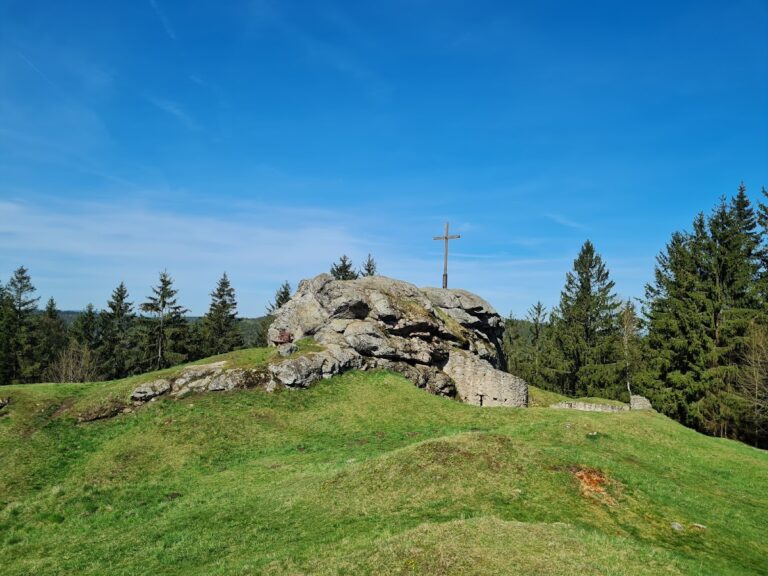
Reichenstein occupies the summit of the Reichenstein, a hill in the Upper Palatinate Forest at approximately 874 metres above sea level. The site is a ruined aristocratic hilltop fortress. Its surviving fabric is limited to slight wall remains and the stump of a round keep.
Round Keep
The fragmentary round Bergfried, or principal defensive tower, is the most clearly identifiable surviving element. In a medieval German castle, the Bergfried served chiefly for defence and as a place of refuge rather than as the lord’s ordinary residence. At Reichenstein, only the tower stump and limited masonry remain, conveying the fragmentary condition of the castle today.
Nearby sites