Patriarchate of Peć: Traditional Seat of the Serbian Patriarchs


Site at a Glance
- Rating
- 4.9
- Popularity
- Medium
- Country
- Serbia
- Primary era
- Medieval
- External website
- Open
- Eras represented
- Medieval, Early Modern, Modern
- Civilizations
- Ottoman, Serbian
- Site type
- Religious
- Remains
- Monastery
On this page15 sections
History
The Patriarchate of Peć is a medieval Serbian Orthodox complex in Serbia, built and expanded between the thirteenth and fourteenth centuries in the Serbo-Byzantine tradition, which combines Byzantine church planning and decoration with regional Serbian forms. Its churches became the centre of the Serbian Church and, from 1346, the seat of the Serbian Patriarchate and the traditional place of enthronement for Serbian patriarchs.
From Žiča to Peć
The precise foundation date of the complex is unknown. During the lifetime of Archbishop Sava, the site was probably a metochion, a dependent monastic estate administered by a larger monastery, belonging to Žiča, then the seat of the Serbian Archbishopric. Archbishop Arsenije I later selected Peć for a new church because the location was regarded as more secure and closer to the centre of the Serbian state than Žiča.
Arsenije established the Church of the Holy Apostles in the first third of the thirteenth century. The seat of the Serbian Church moved from Žiča to Peć in 1253, returned briefly to Žiča in 1285, and was transferred back to Peć in 1291. This final move established the monastery as the enduring ecclesiastical centre of the Serbian Church.
Further construction followed in the fourteenth century. Archbishop Nikodim I founded the Church of St. Demetrius around 1320 on the north side of the Church of the Holy Apostles. His successor, Archbishop Danilo II, built the Church of the Virgin Hodegetria and the Church of St. Nicholas around 1330 on the southern side. Danilo II also added a monumental narthex, an entrance and transitional hall attached to the churches, together with a tower.
The Serbian Patriarchate
In 1346, Serbian Emperor Stefan Dušan elevated the Serbian Archbishopric to patriarchal status. The monastery consequently became the seat of the Serbian Patriarchate of Peć. Serbian archbishops and patriarchs were buried in its churches from the thirteenth through the fifteenth centuries and again in the seventeenth century, making the complex the principal mausoleum of Serbian religious dignitaries.
After the Ottoman conquest, activity at Peć declined for a period, while the Ohrid Archbishopric exercised authority over the former Serbian ecclesiastical territories. The Serbian Church organization and the Patriarchate of Peć were restored in 1557 under Sultan Suleiman the Magnificent after the intervention of Grand Vizier Sokollu Mehmed Pasha. The restoration brought renewed activity. The narthex was extensively repainted in 1565, the icon screens, or iconostases, were renewed, and the treasury was replenished.
Seventeenth-century renewal and Ottoman-era hardship
Patriarch Pajsije I initiated a major renewal during the seventeenth century. The churches were reroofed with lead plates, the Church of St. Demetrius was structurally strengthened, and its frescoes were renewed in 1620 and 1621. The old refectory was painted and reroofed, while the western part of the Church of the Holy Apostles was repainted in 1633 and 1634.
During the middle of the seventeenth century, the monastery established contacts with the Russian Empire. Through its abbots it received money, printed books, and liturgical objects. Under Patriarch Maksim Skopljanac, the complex was enclosed in 1672 and 1673. The Church of St. Nicholas was painted in 1673 and 1674, and a new iconostasis was made for it in 1677.
The Great Turkish War brought further disruption. In 1688, Ottoman forces discovered and looted the treasury after it had been hidden in a dome of Gračanica Monastery. When Patriarch Arsenije III Crnojević went to Austria in 1689, Mahmud Begović, the pasha of Peć, looted the remaining accumulated possessions of the Patriarchate.
Patriarch Mojsije Rajović later recovered confiscated monastic land and built an enclosure around the monastery buildings in 1720. The Church of the Holy Apostles received a new iconostasis in 1722. The Austro-Turkish War of 1737 to 1739 caused additional hardship. During the Serbian migration of 1739, Patriarch Arsenije IV Jovanović Šakabenta transferred accumulated valuables to Sremski Karlovci.
Abolition and restoration of the patriarchal seat
Economic difficulties restricted major artistic activity during the later eighteenth and nineteenth centuries, although the monastery continued to be maintained. A new iconostasis was made for the Church of St. Demetrius in 1803, and additional icons were produced for the Patriarchate in 1806. Arslan Pasha of Bosnia looted the complex again in 1831. New monastic buildings and boundary walls were added or renewed during the nineteenth and early twentieth centuries, including a watermill in 1847, a residential building in 1850, an eastern enclosure wall in 1889, a large residential building in 1895, and a southern wall in 1912.
The Patriarchate was abolished in September 1766 after the Serbian ecclesiastical hierarchy came under increasing pressure from the Phanariotes and the Ecumenical Patriarchate of Constantinople. Ottoman rule in the region ended in 1912. During the First Balkan War, Montenegrin forces entered Peć, and the Treaty of London of 1913 assigned the region to Montenegro. The monastery then again became an episcopal seat.
Bishop Gavrilo Dožić of Peć began work on the complex, but the First World War and the subsequent Austro-Hungarian occupation of Montenegro, including Peć, halted these projects. In 1920, the structural unity of the Serbian Orthodox Church was restored and the Serbian Patriarchate was renewed. Peć retained its traditional primatial seat, and Patriarch Dimitrije was enthroned there in 1924. All subsequent Serbian patriarchs have traditionally been enthroned at the monastery.
Conservation and present ecclesiastical role
Major reconstruction and conservation took place in 1931 and 1932 under the direction of architect Đurđe Bošković, partially restoring the complex’s earlier appearance. Further conservation campaigns and archaeological investigations followed in several phases after the Second World War. Monastic residences were damaged by fire during an attack on 16 March 1981, and a new residential building was constructed west of the narthex that year.
The monastery was threatened during the ethnic violence in Kosovo in March 2004 but avoided destruction. International peacekeeping forces subsequently increased its protection. Responsibility was transferred progressively from the NATO-led Kosovo Force to the Kosovo Police, which assumed primary responsibility in 2013.
The Patriarchate was placed on Serbia’s list of Monuments of Culture of Exceptional Importance in 1947. In 2006 it was added to the UNESCO World Heritage property Medieval Monuments in Kosovo, together with Visoki Dečani, Gračanica, and the Church of the Virgin of Ljeviša. The property was placed at the same time on the List of World Heritage in Danger. Conservation between June and November 2006 addressed weather protection, interior wall repairs, and the renewal of the complex’s exterior appearance. It also revealed two previously unknown frescoes on the north facade of the Church of St. Demetrius, showing a Serbian queen and a nobleman. In 2008, the church facades were painted red in reference to Žiča Monastery, an intervention that drew both criticism and support from specialists.
The monastery has special stavropegial status, meaning that it falls under the direct jurisdiction of a patriarch or another senior church authority rather than ordinary diocesan administration. Although territorially administered within the Eparchy of Raška and Prizren, it remains under the direct jurisdiction of the Serbian Patriarch and continues to serve as the traditional setting for the enthronement of Serbian patriarchs. The Serbian patriarch traditionally also bears the title Archbishop of Peć, preserving the monastery’s historical place in the organization of the Serbian Orthodox Church.
Remains
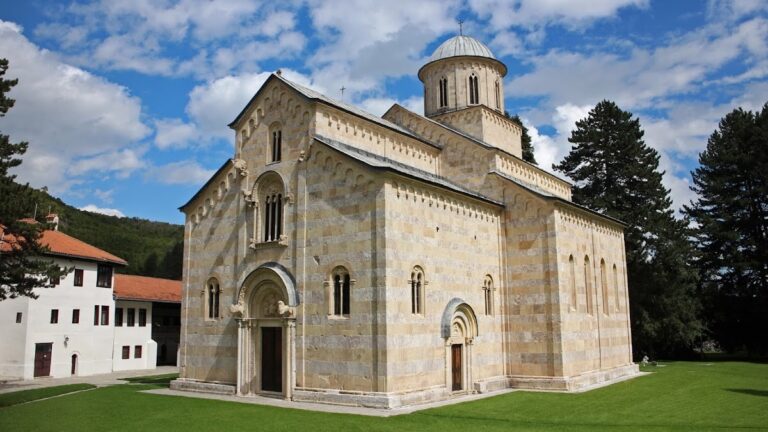
The complex stands at the entrance to the Rugova Canyon beside the Peć Bistrica, west of Peć. Its four interconnected churches form a single architectural group created and enlarged between the thirteenth and fourteenth centuries. The three principal churches have domes and are joined by a common monumental narthex, while the smaller Church of St. Nicholas stands beside the Church of the Virgin Hodegetria and has no dome. The compound also includes a monastic enclosure, residential buildings, a former watermill, boundary walls, and a later residential building west of the narthex.
The four churches
Church of the Holy Apostles
The Church of the Holy Apostles is the oldest principal church in the complex. Archbishop Arsenije I built it in the first third of the thirteenth century, and it was decorated on his order around 1250 to 1260. Fourteenth-century alterations were followed by the repainting of some sections. The church was decorated again around 1300, around 1350, and around 1375, and it received two further campaigns in the seventeenth century. In 1633 and 1634, the western section was given new wall paintings where earlier frescoes had suffered substantial damage.
Church of St. Demetrius
Archbishop Nikodim I built the Church of St. Demetrius around 1320 on the north side of the Church of the Holy Apostles. It was first frescoed around 1345 during the time of Archbishop Joanikije II. Painter Georgije Mitrofanović created a new layer of frescoes in 1619 and 1620, after the church had been structurally strengthened. The 2006 conservation work revealed images of a Serbian queen and a nobleman on the north facade.
Church of the Virgin Hodegetria
Archbishop Danilo II built the Church of the Virgin Hodegetria around 1330 on the south side of the Church of the Holy Apostles. Its interior was frescoed before 1337, while its narthex received paintings in the fourteenth and sixteenth centuries. A painting above the entrance shows Danilo II with St. Nicholas paying homage to the Virgin, who is represented as the Fountain of Life.
Church of St. Nicholas
Danilo II built the Church of St. Nicholas beside the Church of the Virgin Hodegetria. Painter Radul decorated it with frescoes in 1673 and 1674, and a new iconostasis was installed in 1677. The church forms the smaller, domeless element of the interconnected group.
The monumental narthex
Danilo II’s narthex links three churches and serves as both a ceremonial and pictorial space. It originally formed an open porch on three sides. Two columns and three pillars support its vault. After structural deterioration, an exterior arch was enclosed in 1560, and the surviving frescoes are now concentrated largely on interior wall surfaces. The narthex remains in good condition, while the tower that once stood before it is represented by a surviving foundation.
Near the eastern wall, beside the Church of the Holy Apostles, stands the marble Throne of St. Sava. Serbian archbishops and patriarchs used it when presiding over ecclesiastical assemblies held in the narthex. Above the throne, on a pilaster near the entrance to the Church of the Holy Apostles, is a painting of St. Sava dated 1375. It portrays him in ceremonial clothing and an ornate mitre.
The narthex also contains the tomb of Patriarch Makarije. On the eastern wall, a fresco shows Makarije praying to the Virgin and Christ, whose figures occupy adjacent pilasters. Fourteenth-century paintings are especially concentrated in the southeast corner and along the eastern wall. Among them is the Tree of the Nemanjić Dynasty, arranged in four horizontal rows and presenting members of the medieval Serbian ruling house from Stefan Nemanja to the then-living Stefan Dušan.
Fresco cycles and liturgical furnishings
The narthex preserves a long sequence of wall painting from different periods. The cycle painted in 1565 includes saints and monks, scenes from Christ’s teachings and parables, a calendar containing 365 figures and scenes, and representations of the first seven ecumenical councils. It also includes portraits of Serbian archbishops and patriarchs. The work is associated with Andreja and with the Serbian monk and painter Zograf Longin. The earlier fourteenth-century paintings are generally regarded as artistically superior, while the later cycle is also considered a major achievement of regional painting.
Two paintings dated 1875, showing Angelina of Serbia and the Archangel Michael, decorate the west wall near the main entrance to the narthex. They replaced earlier paintings regarded as inferior in quality. The complex therefore preserves a continuous sequence of Serbian wall painting extending from the thirteenth through the nineteenth centuries, alongside renewed iconostases and other liturgical furnishings from later periods.
Burials, relics, and the monastic enclosure
The churches contain burials and relics associated with Serbian archbishops and patriarchs, including Arsenije, Sava II, Jevstatije I, Nikodim I, Danilo II, Joanikije II, Jefrem, Spiridon, and Maksim I. The relics of Saint Jevstatije are kept in one of the churches, while those of Patriarch Spiridon are preserved in the Church of St. Demetrius.
The monastic compound reflects successive periods of enclosure and rebuilding. It was enclosed during the seventeenth century and received additional walls in the eighteenth, nineteenth, and early twentieth centuries. Its surviving elements include the former watermill, residential structures, boundary walls, and the building added west of the narthex in 1981.
A black mulberry approximately 750 years old is preserved in the courtyard. Known as Šam-dud, it is traditionally associated with Archbishop Sava II and is said to have been planted between 1263 and 1272. Together with the churches, burials, relics, furnishings, and layered frescoes, it forms part of the material setting through which the long history of the Patriarchate of Peć is preserved.
Nearby sites