Château de Latour: A Fifteenth-Century Castle in France


Site at a Glance
- Rating
- 4.6
- Popularity
- Low
- Country
- France
- Primary era
- Medieval
- External website
- Open
- Eras represented
- Medieval, Early Modern
- Civilizations
- French
- Site type
- Military
- Remains
- Castle
On this page9 sections
History
Château de Latour is a fifteenth-century castle in Latour-sur-Sorgues, France, built on the site of an older seigneurial estate. Its history is linked to successive noble families, including the La Tours, the Roquefeuil-Versols, and the Bonalds.
Medieval origins and the La Tour family
In 957, Sénégonde transferred part of the seigneurial estate to Frotaire, bishop of Cahors, and his brother Bernard Aton II, viscount of Albi and Nîmes. The fief later came into the possession of the La Tour family, whose members appear in records across the medieval period.
Gago de La Tour, married to Adélaïs, was followed by his son Gago, who was married to Guillelme. In 1133, Gago transferred land to the religious community of Sylvanès as penance for his father’s sins. Arnaud de La Tour, married to Anglésie, donated property to Pétronille, abbess of Nonenque, in 1205. Mérode is recorded in 1300, while Guilbert de La Tour appears in 1302 as co-seigneur of Rebourguil, one of several joint lords of that estate.
Bernard de La Tour is mentioned in 1375 and 1391 as a damoiseau, a young or minor nobleman in medieval France. Flottard de La Tour appears in 1396, when the fief was held from the county of Rodez.
The Roquefeuil and Bonald periods
During the fifteenth century, a branch of the Roquefeuil-Versols family acquired the fief. Jean, son of Pierre de Roquefeuil and Isabelle Pelet, is recorded in 1426 and 1439. His son Sicard de Roquefeuil was followed by another Jean, who married Hélix de Lauzières. Their son François de Roquefeuil is recorded in 1535.
In 1601, Louis de Roquefeuil transferred all his lands to his first cousin, François de Roquefeuil, who was also lord of Londres and Viols. The later succession included Fulcrand de Roquefeuil, married to Marguerite d’Aquillon in 1609, and Blaise de Roquefeuil, who married Jeanne de Soubiran d’Arifut in 1656. Both were also associated with the barony of Londres, while Blaise held the additional title of viscount of La Rode.
The estate passed to the Bonald family in the middle of the seventeenth century. The Bonalds retained it until the French Revolution.
Communal ownership and protection
Since 1991, Château de Latour has belonged to the commune of Marnhagues-et-Latour. The Association of Friends of the Château de Latour organizes activities and visits and has undertaken restoration work at the castle.
An order dated 14 February 2024 listed the Château de Latour, the ruins known as “the icehouse,” and the façades and roofs of the dependency called “the citadel” as historic monuments. This designation identifies heritage features whose architectural or historical importance warrants formal legal protection and conservation.
Remains
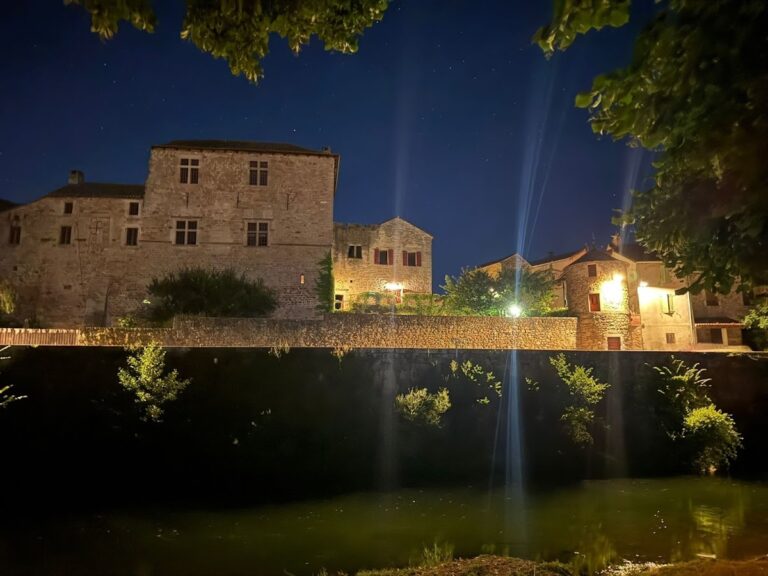
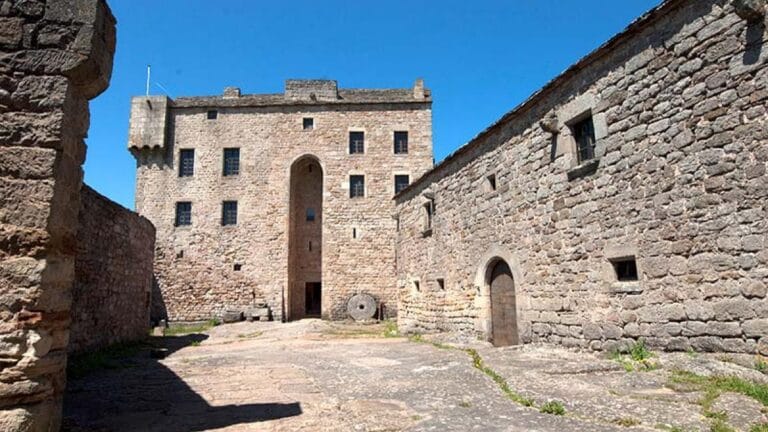
The castle stands on a rocky promontory above the Sorgues River. Its surviving complex combines residential buildings arranged around a defensive structure with associated buildings known as “the icehouse” and “the citadel.”
Castle complex
Residential buildings and defenses
The eastern and southern sides consist of two residential buildings arranged in an L-shape. Their outer ends are joined by a section that follows part of a circular arc. The complex also retains a keep, the fortified principal tower, together with a wall-walk, a defended passage along a fortification, and polygonal projecting turrets that extend from the walls for observation or defense.
The icehouse and the citadel
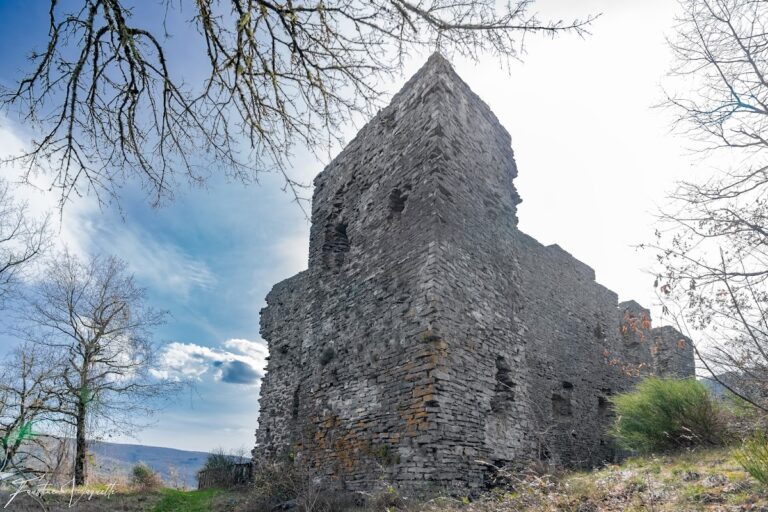
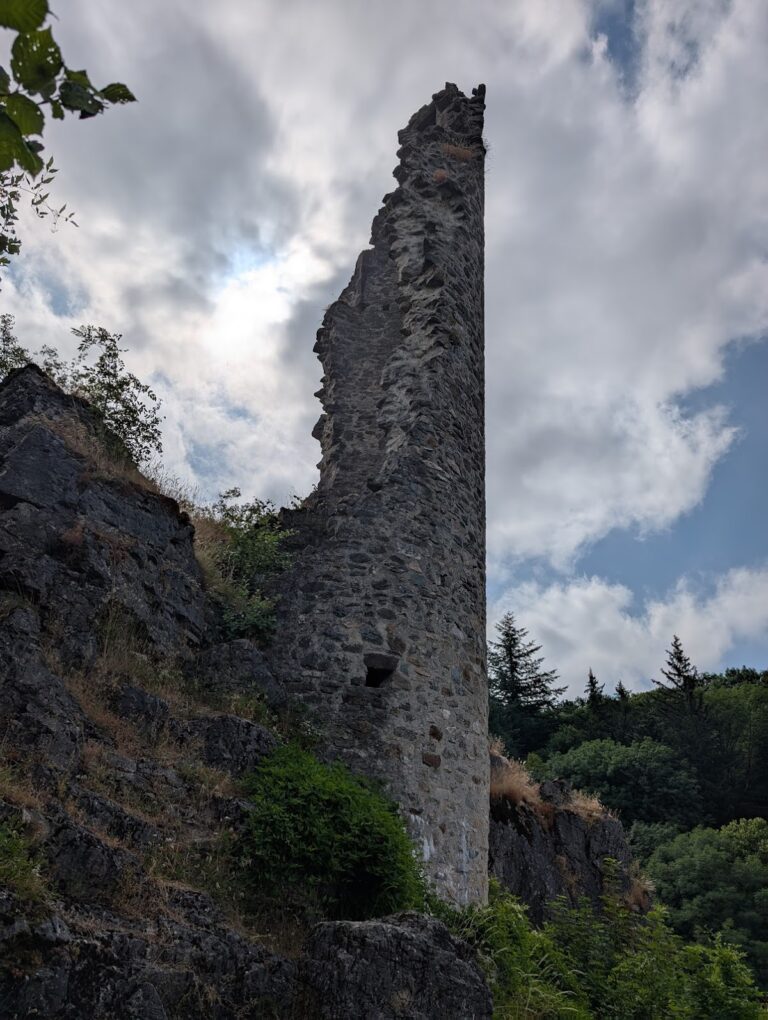
The grounds include the ruins of a building known as “the icehouse.” They also contain a dependency called “the citadel,” whose façades and roofs form part of the protected castle complex.
Interior features
Inside the castle are twin arcaded windows and a painted ceiling dating from the sixteenth century. One room contains a reconstruction of a cloistered nun’s cell, representing the enclosed living space of a woman belonging to a religious community organized around restricted contact with the outside world. Some rooms have been converted into furnished accommodation.
Nearby sites