Castle of Vecchiano: Medieval Fortress and Sanctuary

Site at a Glance
- Rating
- 4.6
- Popularity
- Very Low
- Country
- Italy
- Primary era
- Medieval
- Eras represented
- Medieval
- Civilizations
- Republic of Pisa
- Site type
- Military
- Remains
- Castle
On this page11 sections
History
The Castle of Vecchiano is a medieval fortification in Vecchiano, Italy, conventionally dated to the tenth century, although its precise origins may be older. Its position above the Serchio River gave it a role in defending the bridge and the frontier facing Lucca. The site also includes the church of Santa Maria in Castello, which later became a sanctuary and remains in liturgical use.
Early records and medieval lordship
The castle’s earliest recorded mention appears in a statute issued in 1092 by Daiberto, the bishop of Pisa. The statute ordered Pisan Lombard families, including the Orlandi and Gaetani, to take urgent measures to defend the territory. The site may have had Byzantine origins, and some research connects it with an earlier fief of the Viking-Norman Pagano Embriaci family of Vecchiano, also called the Verchionesi.
The documented history of the castle continues in 1120, when Guido di Ungarello of the Pisan San Casciano family donated his entire share of the castle and the hill of Velano, the medieval name for Vecchiano, to Azzone II, archbishop of Pisa. A document from 1134 records the church of Santa Maria at Velano as an inheritance left by Pietro da Parlascio, son of Ugo I di Pagano, to his nephews, the sons of his brother Ugo II, known as the Eburiaco.
From 1276 to 1397, the castle belonged to the Pisan Lanfranchi dei Chiccoli family. The Lanfranchi opposed Pope Boniface VIII, who was pontiff from 1294 to 1303, and were associated with Nicholas V, an antipope supported by opponents of papal authority in the early fourteenth century. During this period, the castle church depended on the pieve, or rural parish church with authority over subsidiary churches, at Rigoli and Corliano.
Conflicts between Pisa, Florence, and Lucca
In October 1397, Giovanni Colonna seized the castle from the Lanfranchi with 1,000 cavalrymen and 170 Lucchese lancers. Gian Galeazzo Visconti, the ruler of Milan, bought it from the Appiani in 1399, when it formed part of the territory of the Republic of Pisa. In 1405, Visconti’s son Gabriele Maria sold the castle to the commune of Florence. Its frontier position and control of the bridge over the Serchio made it part of the military geography of the boundary with Lucca.
The castle changed hands again during the wars of the fifteenth century. In October 1436, the Gaetani, Counts of Terriccio and d’Oriseo, recaptured it with assistance from Milanese and Aragonese forces. Florentine and Angevin forces, associated with the Angevin dynastic house, took it back on 1 May 1437.
Patronage, landholding, and religious use
Galeazzo Visconti’s will of 8 September 1473 assigned the patronage of the castle to the Pisan patrician Bocca Gaetani. The Gaetani retained possession until 1595. The property then passed by inheritance to Pietro di Niccolao della Seta and, in 1801, to Cosimo Agostini Venerosi della Seta.
A contract dated 24 September 1579 granted the castle’s feudal lords a benefit called a posta, meaning a right connected with specified land and property holdings, in Vecchiano and Nodica. The estate covered 198 staiora, 2 pertiche, and 23 braccia, historical Italian measures whose values varied by locality. In return, the holders owed an annual payment of 13 staia of clean, marketable grain and 9 Tuscan lire. A notarial act of 14 December 1715 confirmed the arrangement, which is preserved in the historical archive of the Agostini Venerosi della Seta family.
After the Pisan territory became part of the Grand Duchy of Tuscany, the castle lost its military importance from the end of the sixteenth century. Santa Maria instead drew increasing numbers of worshippers for the Feast of the Nativity of Mary on 8 September and became a place of prayer for hermits. Cesare Del Chiocca of Rigoli was the last rector to live in the hermitage, and he was resident there in 1858.
Modern damage and continuing ownership
Leonardo da Vinci, the Italian Renaissance artist, engineer, scientist, and cartographer, depicted and identified Santa Maria in Castello on map RLW 12683. He also mentioned the church in the Atlantic Codex, folio 305r, using it as a reference point in the Serchio Valley on the river’s right bank above the rocky spur overlooking Vecchiano.
The church suffered damage in 1944 and 1945 during the passage of the Gothic Line, a German defensive position across northern Italy during the Second World War. It was restored through the initiative of parish priest Gino Barzacchini and a citizens’ committee, with further work undertaken by the Vecchiano Archaeological Group in 1991. The castle and Santa Maria, which became a sanctuary during the 2000 Jubilee, are now owned by the Agostini family. Liturgical use remains reserved for the parish priest of Vecchiano, Renato Melani.
Remains
Fortification and setting
Rocky spur and river crossing
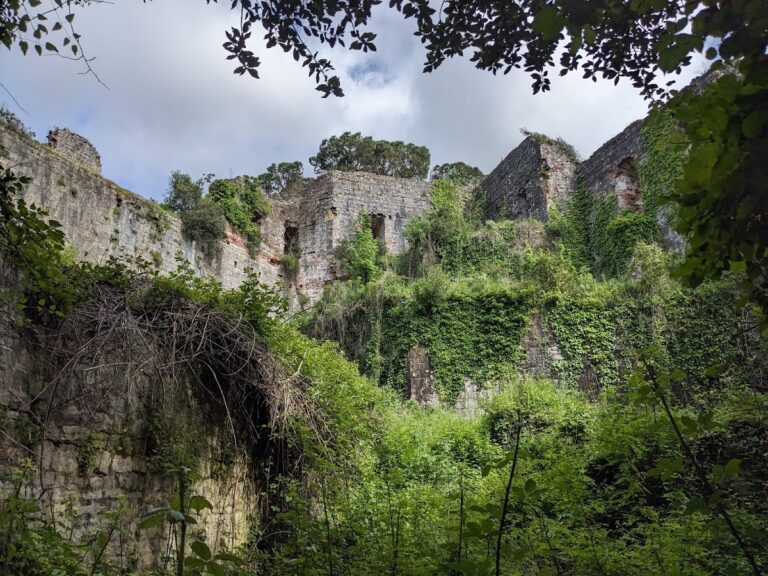
The castle occupies a rocky spur above Vecchiano on the right bank of the Serchio River. Its elevated position was associated with the defense of the bridge over the river and with the frontier facing Lucca. The surviving site is therefore understood through its relationship to the river crossing and the raised ground that supported the medieval fortification.
Santa Maria in Castello
The church of Santa Maria in Castello forms part of the castle complex. Medieval documents also call it Santa Maria at Velano. The church was damaged during the passage of the Gothic Line in 1944 and 1945 and subsequently restored, with additional work in 1991. It became a sanctuary during the 2000 Jubilee and continues to serve a liturgical function.
Associated landholding
Feudal agricultural estate
The castle’s associated holdings included agricultural plots and properties in Vecchiano and Nodica. Their recorded extent was 198 staiora, 2 pertiche, and 23 braccia. These lands were held under the feudal arrangement known as a posta, linking the physical site to a wider estate whose holders owed grain and cash payments.