Vitturi Castle: A Renaissance Palace and Fortress in Croatia


Site at a Glance
- Rating
- 4.7
- Popularity
- Low
- Country
- Croatia
- Primary era
- Early Modern
- External website
- Open
- Eras represented
- Medieval, Early Modern
- Civilizations
- Venetian
- Site type
- Military
- Remains
- Castle
On this page7 sections
History
Construction and Renaissance Transformation
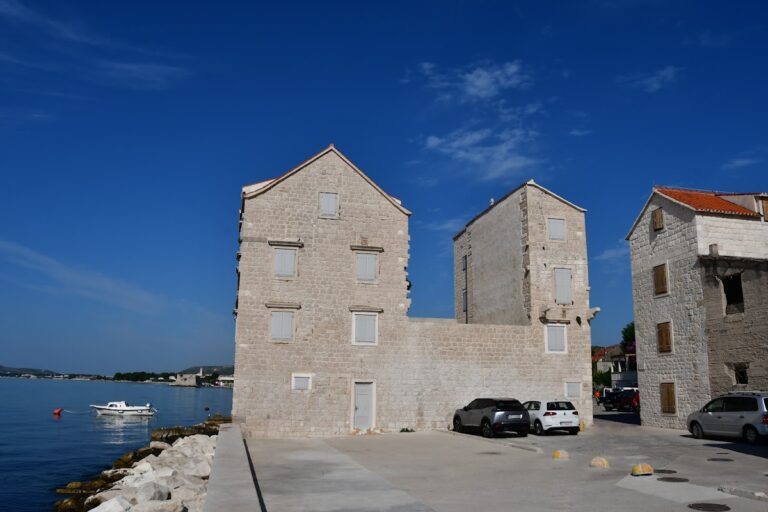
Vitturi Castle is a fifteenth-century castle in Kaštel Lukšić, Croatia, begun by the aristocratic Vitturi family of Trogir at the end of the fifteenth century. Nikola and Jerolim Vitturi built it to protect their family and the inhabitants of the nearby village of Ostrog. Conceived as a luxurious Renaissance palace, a style inspired by the forms and proportions of classical Greek and Roman architecture, it also incorporated defensive elements. Construction was completed in 1564.
Later Changes and Cultural Use
During the eighteenth century, the castle’s drawbridge, a bridge that could be raised or lowered to control access, was replaced by a stone bridge. In the second half of the same century, the Vitturi family designed a formally organized classicist park beside the castle. The park was designated a monument of park architecture in 1968.
After renovation, Vitturi Castle became the cultural centre of Kaštel Lukšić. Its former residential section now accommodates the town museum and other cultural institutions, while exhibitions, concerts, and theatrical performances take place in the castle.
The Legend of Miljenko and Dobrila
Vitturi Castle is associated with the legend of Miljenko and Dobrila, a tragic love story set in the second half of the seventeenth century. Dobrila Vitturi, the daughter of the Vitturi family, fell in love with Miljenko, son of the Rušinić family, while their families were engaged in a long-standing feud.
The lovers concealed their relationship until their parents discovered it and separated them. Miljenko was sent to Venice, while Dobrila’s father arranged her marriage to a much older nobleman from Trogir. Miljenko returned to prevent the wedding and was banished from Kaštel Lukšić. Dobrila was sent to a convent, but escaped to reunite with him and marry him secretly.
When Dobrila’s father learned of her escape, he sent a messenger to tell the couple that he no longer opposed the marriage. They returned to Kaštel Lukšić and married, but Dobrila’s father killed Miljenko after the wedding celebration. Dobrila died of grief several months later. Their grave is in the Church of St. John in Kaštel Lukšić and carries the inscription, “Rest in peace, lovers.” The story, often compared with Shakespeare’s Romeo and Juliet, has inspired novels, operas, and plays.
Remains
Castle Buildings and Approach
Vitturi Castle is formed by a residential building and two defensive towers, combining the functions of a Renaissance palace with those of a fortified residence. The complex was linked to the mainland by a drawbridge, whose later replacement by a stone bridge altered the approach to the castle in the eighteenth century. The residential section survives as the part occupied by the town museum and other cultural institutions.
Classicist Park
A classicist park lies beside the castle. Designed by the Vitturi family in the second half of the eighteenth century, it follows a formally organized landscape tradition influenced by classical ideals of order and symmetry. The park remains an associated element of the castle complex and was recognized as a monument of park architecture in 1968.
Nearby sites