London Mithraeum: A Roman Sanctuary of Mithras in London



Site at a Glance
- Rating
- 4.5
- Popularity
- Medium
- Country
- United Kingdom
- Primary era
- Classical
- External website
- Open
- Eras represented
- Classical
- Civilizations
- Roman
- Site type
- Religious
- Remains
- Mithraeum
On this page14 sections
History
The London Mithraeum, also known as the Temple of Mithras, is a Roman sanctuary in the United Kingdom, built in Londinium during the first half or middle of the third century AD, probably around AD 240 to 250. Associated with Mithraism, a Roman mystery cult centered on Mithras, it stood beside the Walbrook, a tributary of the Thames and an important freshwater source. Its partly underground form recalled the cave linked with Mithras and created an enclosed setting for confidential initiation rites and communal worship.
Foundation and Roman use
A Roman citizen from Londinium probably commissioned the sanctuary, perhaps placing it in the rear garden of a private house. The building was constructed beside the eastern bank of the Walbrook and remained a place of worship through later changes to its fabric and religious associations.
The sanctuary collapsed in the early fourth century and was apparently not rebuilt immediately. It was later restored and rededicated, probably to Bacchus, the Roman god associated with wine, festivity, and ecstatic religious practice. Worship continued until the late fourth century, when the building was abandoned, probably between AD 367 and 400.
Burial and rediscovery
After abandonment, much of the building material was taken away. Rubbish and successive layers of soil then covered the remains, raising the street level by almost seven metres above the Roman road surface. Roman objects found during nineteenth-century Victorian construction hinted at the importance of the area. In 1889, discoveries included fragments representing a water deity and a genius figure, along with a marble relief of Mithras killing the bull, the central image of Mithraic ritual iconography.
German bombing heavily damaged the Walbrook district on 11 May 1941. The sanctuary itself came to light in 1954 during excavations associated with construction of Bucklersbury House. W. F. Grimes and Audrey Williams directed the principal excavation. The building was initially interpreted as an early Christian church, but sculptures of Mithras established that it was a Mithraeum, a sanctuary dedicated to the god.
The discovery attracted approximately 30,000 people within a few days, making the excavation an influential example of public archaeology. It also demonstrated the importance of archaeological investigation during major urban redevelopment. Excavation recovered domestic and ritual objects, including five fragments of marble sculpture and the marble head of Mithras found on 18 September 1954. These artefacts were placed in the Museum of London.
Relocation and reconstruction
Construction of Bucklersbury House required the ancient remains to be dismantled, stored, and reassembled about 90 to 100 metres away beside Queen Victoria Street at Temple Court. The reconstructed foundations were set at street level in an open-air display accessible from 1962. The work used modern materials and was inaccurate in several respects. Archaeologists had not been consulted, and the reconstruction attracted criticism. It received heritage designation in 2007 and remained at Temple Court until its dismantling in 2011.
Plans for a Walbrook Square redevelopment received approval in 2006, but the project was later put on hold. Bloomberg acquired it in 2010 and incorporated the restoration and relocation of the sanctuary into its European headquarters. Archaeological work led by Museum of London Archaeology during the 2010s exposed additional original foundations and made a more accurate reconstruction possible. The sanctuary was shifted slightly west of its original position so that unexcavated wall remains, considered too fragile for display, could be preserved.
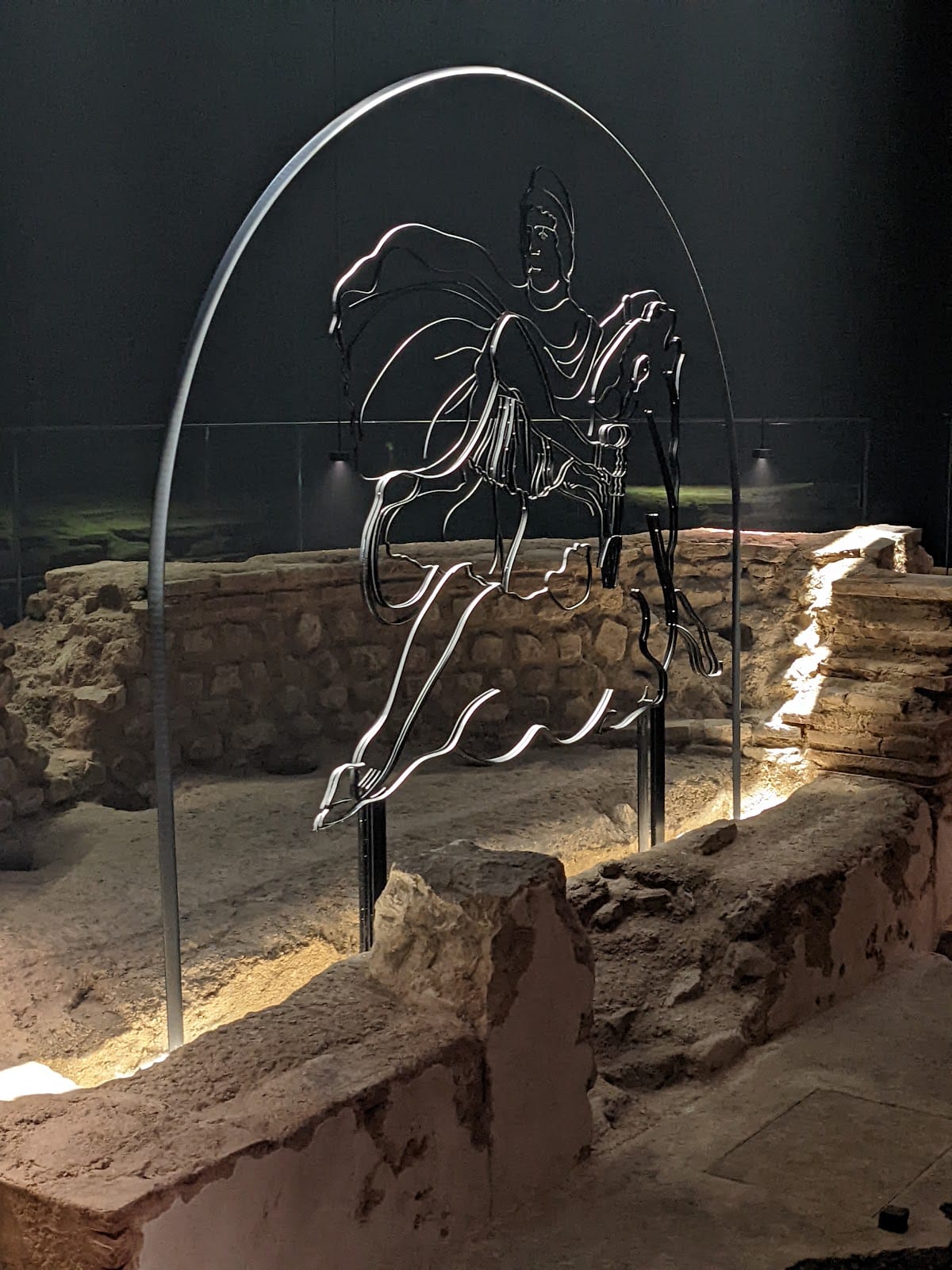
The reconstructed London Mithraeum opened on 14 November 2017 within the Bloomberg Space exhibition area beneath Bloomberg’s London headquarters, approximately seven metres below the modern street level. It represents the first building phase of around AD 240 and preserves the archaeological and historical interpretation developed through the successive excavations.
Remains
The sanctuary structure
The Mithraeum was a low, rectangular, cave-like building beside the Walbrook. It measured about 18 metres in length and 8 metres in width, making room for approximately 30 people. Dressed stone, brick, roof tile, and timber formed the structure. The eastern end contained a narthex, or entrance vestibule, while the western end ended in an apse, a semicircular space at the sanctuary’s rear.
The reconstructed building stands slightly west of its original position. About 15 percent of the ancient structure survives, principally sections of the perimeter walls. The present reconstruction follows the condition recorded at the end of the October 1954 excavation and represents the sanctuary’s first phase, without later Roman additions.
The interior was organized around a sunken central nave divided into three spaces by two rows of seven cylindrical stone columns. The number seven may have represented the seven grades of Mithraic initiation. Raised timber seating ran along the outer sides of the column rows, where worshippers probably sat during ceremonies and took part in the agape, a communal ritual meal. Wooden boards covered the central floor.
An altar stood before the apse. A statue or relief showing the tauroctony, Mithras killing the bull, probably stood behind it, while a statue of Mithras occupied a platform in the apse. A ritual well stood beside the altar. The building’s lighting probably came from torches. Its original roof was probably made of timber and tile with two sloping sides, although the presence of a ritual skylight or grille above the altar remains uncertain.
Most of the stones and bricks incorporated into the reconstruction are original. Modern timber, wall render, and lime mortar replace lost materials, with the mortar based on samples from contemporary Roman buildings in London. The floor is a hand-painted resin surface made with genuine Roman soil, laid and compacted by archaeologists to reproduce the appearance of the ancient floor.
Sculpture and religious imagery
Marble sculpture
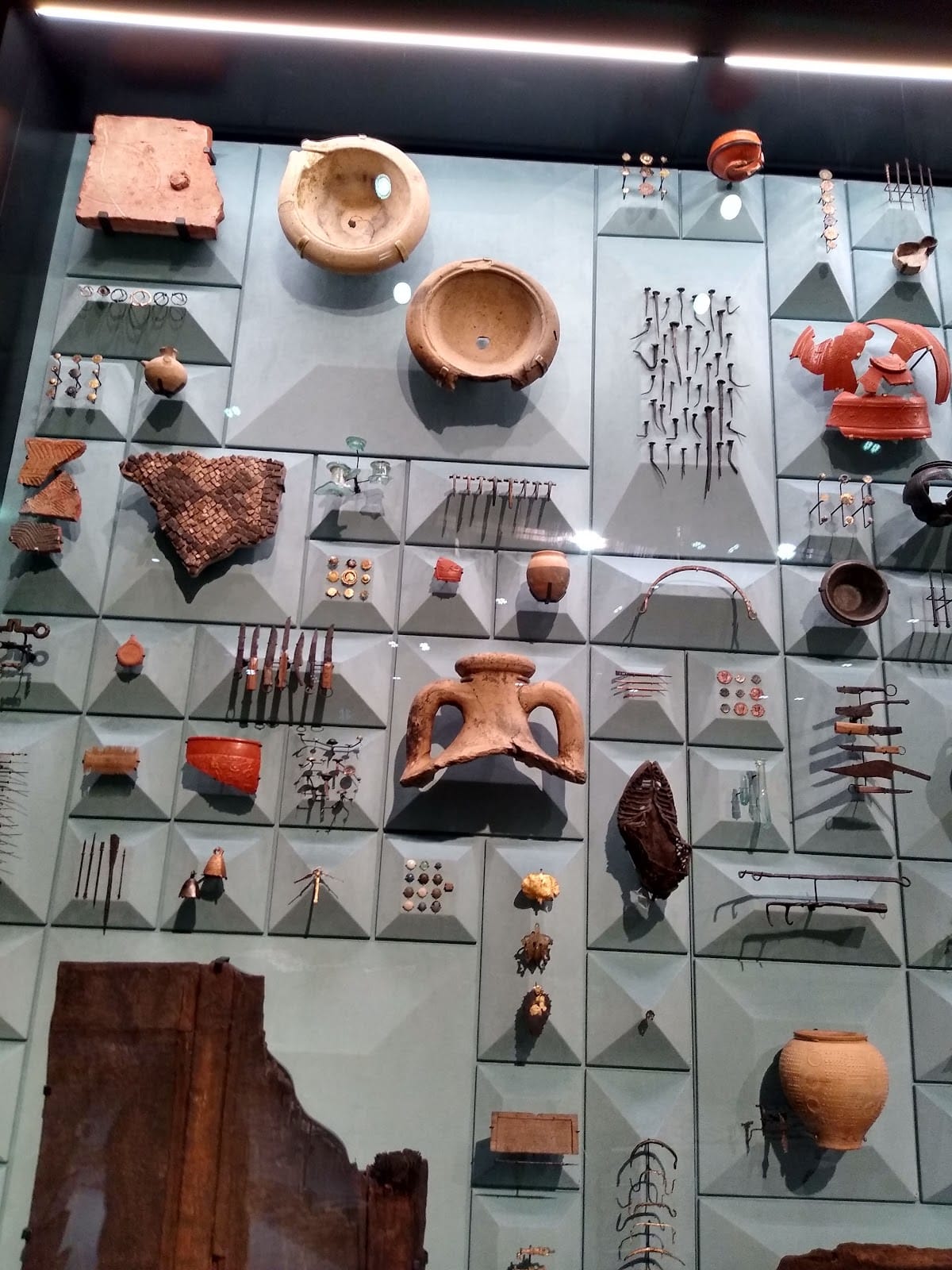
The sanctuary is displayed with objects recovered from the site, including a selection of 600 items from nearly 14,000 Roman finds. Coins, sandals, brooches, jewellery, tools, keys, combs, writing tablets, pottery fragments, amphorae, oil lamps, and sculpture fragments place the building within both religious and domestic activity at Roman London.
Finely detailed white-marble sculpture of the third century was imported from Italy. The surviving representations and fragments relate to Minerva, Mercury, Mithras, and Serapis. Minerva was associated with wisdom and crafts, Mercury with communication and guidance of the dead, and Serapis was a deity combining elements of different religious traditions in the Roman world. A marble head of Mithras is identified by its Phrygian cap and was made to fit a torso that did not survive. Locally produced clay figurines showed Venus combing her hair.
Tauroctony relief
The marble tauroctony relief discovered in 1889 is about 0.53 metres high. It shows Mithras killing the bull within a zodiacal wheel, accompanied by the torch-bearing figures Cautes and Cautopates. Sol-Helios appears above on the left and Luna on the right, while the wind gods Boreas and Zephyros occupy the lower corners. An inscription records a vow by Ulpius Silvanus, a veteran of the Second Augustan Legion.
Bacchic sculpture
Fragments representing Bacchus and other Roman deities were associated with the sanctuary. Together with the sculpture and later history of the building, these finds support the interpretation that it was rededicated to Bacchus, also known in Roman religious usage as Liber Pater.
Inscriptions and archaeological deposits
Tetrarchic inscription
An inscription dating approximately to AD 307 to 310 invokes Mithras as the Invincible Sun and refers to the four emperors and the Caesar. It connects the sanctuary with the religious and political language of the Tetrarchy, the late Roman system of rule by four emperors established by Diocletian.
Curse tablet and waterlogged finds
A small square sheet of lead from the former Walbrook streambed bears a name written backwards and was apparently deposited as a ritual curse. Such a defixion, or curse tablet, was a written magical appeal placed in a location associated with supernatural power. The waterlogged ground also preserved timber and leather exceptionally well.
Writing tablets and early London
Deposits around the sanctuary preserved successive Roman timber buildings and fences, as well as shoes, clothing, personal possessions, and documents. More than 400 wooden writing tablets were recovered. One dated 8 January AD 57 records a financial transaction and is regarded as London’s earliest financial document. Tablets from AD 62 and AD 70 contain the earliest recorded mentions of London.
Several inscribed wooden tablets dating from the first to the fifth century AD preserve the place-name Londino. That form contributed to the development of the name Londinium and connects the archaeological deposits around the sanctuary with the changing written record of Roman London.