New Castle in Kostelec nad Orlicí: An Empire-Style Kinsky Residence


Site at a Glance
- Rating
- 4.7
- Popularity
- Medium
- Country
- Czechia
- Primary era
- Modern
- External website
- Open
- Eras represented
- Modern
- Civilizations
- Habsburg
- Site type
- Domestic
- Remains
- Castle
On this page7 sections
History
New Castle in Kostelec nad Orlicí is a Neoclassical Empire-style residence in Kostelec nad Orlicí, Czechia, built between 1829 and 1833 for Count Josef Kinsky. The early nineteenth-century Empire style drew on Neoclassicism through monumental symmetry, classical columns, projecting porches, and pediments. The residence stood at the edge of the town beside the Wild Eagle River and was called New Castle to distinguish it from the older Baroque castle in Kostelec.
The Kinsky Residence
The Kostelec estate and a nearby farm passed to a branch of the Kinsky family in 1812. Josef Kinsky then commissioned the new residence, which was designed by the Viennese architect Jindřich Koch, also known as Heinrich Koch. The building became one of the principal residences of the Kinsky family and remained in their possession until it was confiscated by the Czechoslovak government during the communist period.
After 1948, the castle was used by a research institute for pig breeding. In 1979, responsibility for the building passed to the Pardubice District Centre for State Monument Preservation and Nature Conservation. Following the end of the communist period, the property was restituted to the Kinsky family. Its exterior and interiors were then extensively reconstructed, and surviving Empire furniture and other objects once owned by the family were progressively restored.
Restitution and Present Use
Since 2012, the castle has served as an exhibition venue. The representative rooms contain the Life in Biedermeier exhibition, which presents restored interiors, furniture, paintings, and domestic objects associated with Biedermeier, a nineteenth-century Central European style of comfortable and restrained household life.
The castle complex has been protected as a Czech national cultural monument since 1978. The protected property comprises the main castle, its courtyard, and the castle park. In 1995, a large part of the park was declared the Kostelec Castle Park Nature Reserve because of the ecological value of ecosystems that developed over approximately two centuries around introduced foreign trees.
Remains
Main Castle
The castle is a monumental rectangular building set on ground that slopes gently westward. It has a semi-basement, a raised main floor, and an upper floor. The principal and rear façades are each organized into eleven window axes, while the side façades have five. A central projecting section, or risalit, contains three window axes on each side. This outward-projecting section is incorporated into the central composition of the façades.
Porticos, which are roofed entrances supported by columns, project from the central façade sections. The principal portico rests on four tall Ionic columns, and the rear portico also has four columns. A large classical pediment, the triangular element above the entrance composition, crowns the centre of the principal façade.
Interior Rooms and Exhibitions
The raised main floor contains the representative rooms and library, while the upper floor was arranged for residential use. The semi-basement includes the castle chapel. The restored Biedermeier exhibition occupies the raised ground floor together with the representative rooms, and the Mirror Hall is used for concerts and ceremonies because of its excellent acoustics.
Ground-level rooms house a permanent municipal museum exhibition. Its displays include a model of the town’s medieval settlement with its covered church and parsonage, historical documents relating to guilds, trades, and associations, small archaeological finds, photographs, maps, explanatory texts, diagrams, and drawings. The exhibits came from the Museum and Gallery of the Orlické Mountains and the Museum of Eastern Bohemia.
Castle Park
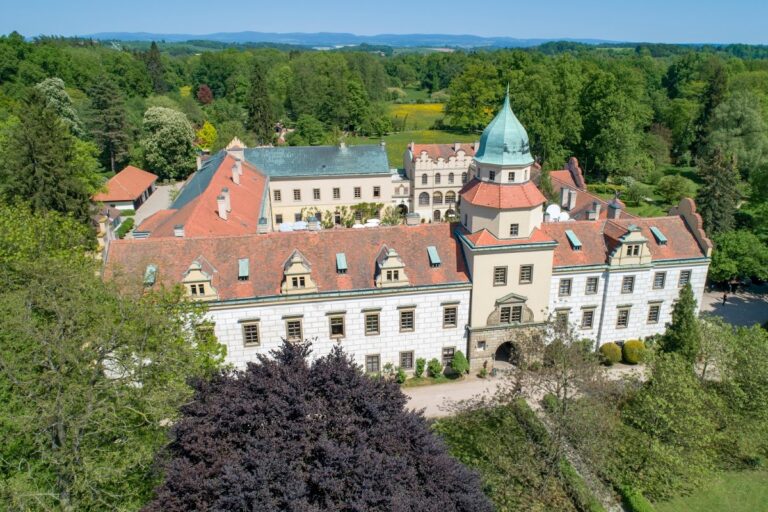
The estate includes approximately 42 hectares arranged as an English landscape park with an extensive alpine garden. The park extends around the castle and contains exotic and foreign trees, including tulip trees, trumpet trees, plane trees, red oaks, American maples, and Canadian hemlocks. Its protected ecosystems developed in conjunction with the introduced trees over roughly 200 years.
Nearby sites