Maxilly Castle: A Medieval Castle in Lugrin, France

Site at a Glance
- Rating
- 4.3
- Popularity
- Very Low
- Country
- France
- Primary era
- Medieval
- Eras represented
- Medieval
- Civilizations
- Duchy of Savoy, Holy Roman Empire
- Site type
- Military
- Remains
- Castle
On this page6 sections
History
The Blonay Family and the Medieval Castle
Maxilly Castle, also known as Château de Blonay, is a medieval castle in Lugrin, France, dating from the late thirteenth century. Located in the historic Chablais region around the southern shore of Lake Geneva, it became associated with the Blonay family toward the end of that century, when Raoul de Blonay married the heiress of Maxilly. Through this marriage, the castle and the lordship of Maxilly, a territorial domain governed by a lord, entered the family’s possession.
Under the Blonays, the castle became an annex, or dependent property, of their Château de Saint-Paul. Alice, also called Alix, de Blonay, the wife of Baron Raoul, is connected with a local legend. The castle remained tied to the changing fortunes of the Blonay lineage until it was sold to the dukes of Savoy in 1514. The family bought it back in 1528.
Religious and Political Change
In 1536, the northern part of the Duchy of Savoy was occupied by Reformed troops from Valais, Protestant forces from a region now in Switzerland. Their occupation formed part of the religious and political conflicts of the Reformation. During this period, Maxilly Castle became the property of the Graffenried family of Bern. Maxilly was the only parish in the surrounding area to be occupied and became a Protestant enclave within this part of Chablais.
On 19 March 1562, the Graffenried family sold the castle and part of the lordship to the Melchiton family. The remaining part of the lordship returned to the Blonays. Several families disputed the Melchiton inheritance, but Paul-Aimé de Melchiton retained ownership in 1615. After his widow remarried a nobleman of Chatillon, the castle passed back to the Blonay family in 1625.
Decline and Later Works
The castle gradually fell into ruin, and the Blonay family built a new house nearby. In 1880, J.-C. Gerecke acquired the estate and carried out a number of works there. These later interventions followed the castle’s long period of decline and form part of its modern history.
Remains
Castle Layout and Surviving Structure
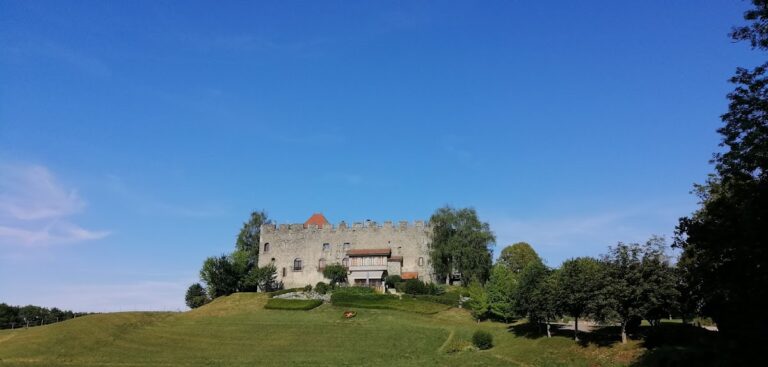
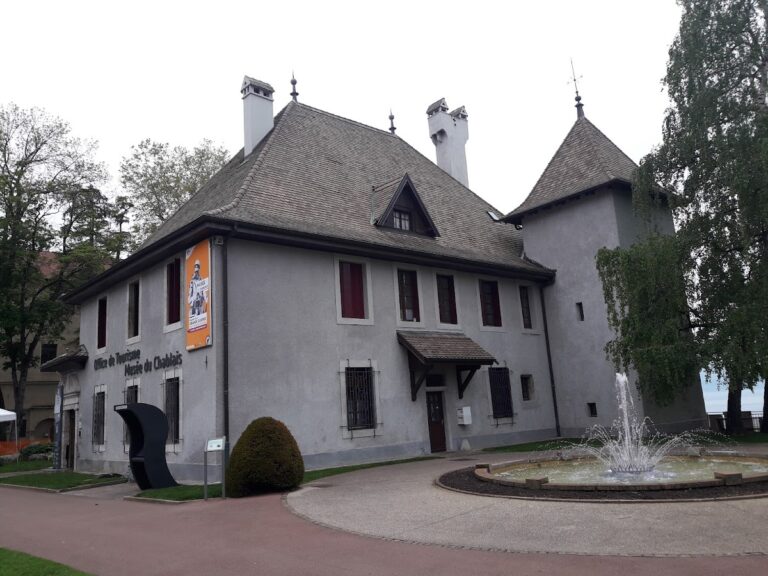
Maxilly Castle stands north of the village center of Maxilly-sur-Léman, in the Gavot area, overlooking the Coupy stream and Lake Geneva. Its plan is rectangular, measuring approximately 10 by 25 meters. This compact layout defines the surviving remains of the medieval castle.
A square tower occupies the southwestern corner of the building. It measures approximately 4.20 by 4 meters and forms the clearest separately identified defensive element in the plan. The eastern part of the castle was described as ruined in the 1950s, reflecting the deterioration that followed the building’s gradual decline.
Nearby sites