Palazzo Montecitorio: Seat of Italy’s Chamber of Deputies

Site at a Glance
- Rating
- 4.3
- Popularity
- Low
- Country
- Italy
- Primary era
- Early Modern
- External website
- Open
- Eras represented
- Early Modern, Modern
- Civilizations
- Italian, Papal States
- Site type
- Civic
- Remains
- Palace
On this page16 sections
History
Palazzo Montecitorio is a historic building in Rome, Italy, that houses the Chamber of Deputies of the Italian Republic and the Parliament in joint session. Its present form began as a seventeenth-century Baroque residence designed by Gian Lorenzo Bernini for the Ludovisi family and later developed into a papal administrative center before becoming the seat of Italy’s lower house after national unification.
Early residences and the Ludovisi project
The site already contained a palace when Cardinal Niccolò Gaddi built a residence there in the 1540s. Cardinal Pierdonato Cesi acquired it in 1571, and the property subsequently passed through Cardinal Giulio Antonio Santorio and the Somascans of San Biagio. Cardinal Luigi Capponi purchased it in 1649.
In 1653, Pope Innocent X commissioned Gian Lorenzo Bernini, a leading interpreter of Roman Baroque architecture, to create a residence for the Ludovisi family. The family acquired neighboring houses, allowing the new project to incorporate the existing urban fabric rather than replace it entirely. The name Montecitorio has been connected either with Roman electoral assemblies once held on the hill or with earth and rubble deposited during the reclamation of the nearby Campus Martius, the ancient district in which this part of Rome developed. Neither explanation is certain.
Construction slowed sharply in 1654 during a diplomatic dispute between Innocent X and Prince Niccolò Ludovisi, who had married Costanza Pamphili, a relative of the pope. After Ludovisi died in 1664, work stopped. It resumed about twenty years later under Carlo Fontana, a later Roman Baroque architect who adapted Bernini’s project.
Papal administration and civic government
Fontana persuaded Pope Innocent XII to convert the palace into premises for the Papal Curia, the central apparatus of papal government, and the customs office. Their revenues were intended to support the Apostolic Hospice for Poor Invalids, known as San Michele. The building’s connection with the hospice was commemorated by a relief of the Savior and an inscription. The Curia opened in 1696, and the palace also housed papal courts, the Governorship of Rome, and the police administration.
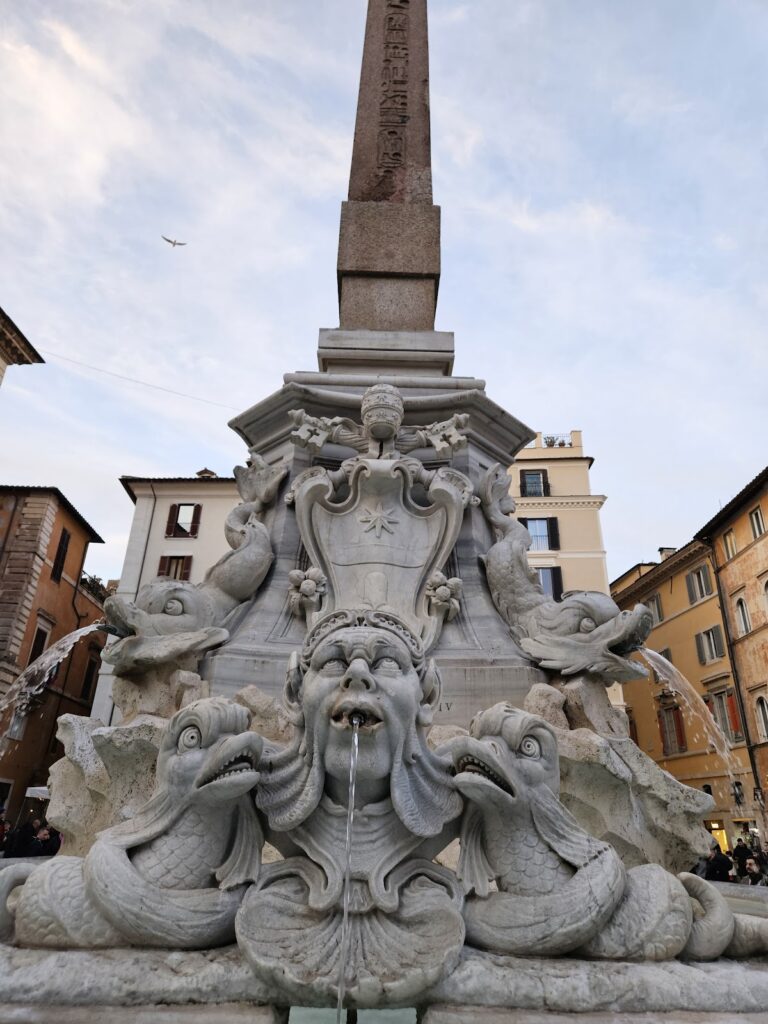
The square around the palace was reorganized according to plans by Ferdinando Fuga from about 1735, and an Egyptian obelisk was erected there in 1792. These changes formed part of the setting in which the palace continued to serve Rome’s papal administrative institutions.
Parliament after Italian unification
After Italian unification, the Kingdom of Italy expropriated Palazzo Montecitorio and selected it as the seat of the Chamber of Deputies. Palazzo Venezia and the Capitoline Hill had also been considered for this purpose, but Montecitorio was chosen instead.
Paolo Comotto built a temporary semicircular parliamentary chamber in the courtyard. It opened on 27 November 1871, but poor acoustics, severe seasonal temperatures, and serious water infiltration made it unsuitable. The chamber was declared dangerous and closed in 1900. An attempt to create a new parliament building on Via Nazionale did not succeed, so a temporary chamber was established on Via della Missione. The definitive chamber at Montecitorio opened in 1918.
Modern political history
Ernesto Basile directed a major enlargement and modernization in the early twentieth century. He retained Bernini’s facade but reduced the courtyard and demolished the original wings and rear section, replacing them with a new parliamentary block. The new interiors were completed in 1927.
Palazzo Montecitorio has remained a major center of Italian political life. The result of the institutional referendum of 2 June 1946, which determined the country’s move from monarchy to republic, was proclaimed in the Sala della Lupa. In 1943, a building official displayed cracks in the walls, an action said to have helped prevent German troops from occupying the parliamentary chamber.
Several episodes associated with the palace reflect the conflicts of modern Italian politics. On 10 December 1892, Maffeo Pantaleoni and Napoleone Colajanni met in its corridors to discuss the Banca Romana scandal. After Giacomo Matteotti denounced fascist electoral fraud in Parliament on 30 May 1924, Benito Mussolini made threatening remarks. Deputy Palmiro Togliatti was shot near the Via della Missione entrance on 14 July 1948. On 25 June 1969, General Giorgio Manes died at Montecitorio while due to testify before a parliamentary commission investigating the Solo Plan.
Remains
Bernini’s Baroque facade
The original building was a Baroque project adapted to the pre-existing street pattern. Its facade follows the curve of the road in a five-part polygonal composition. The roughly worked stone and projecting leaves and broken branches were intended to suggest a structure carved from living rock.
Carlo Fontana preserved the facade’s characteristic convex form, added a bell gable, and altered the entrance with two doors beside the main doorway. The relief of the Savior bearing the inscription Hospitii apostolici pauperum invalidorum was moved from the courtyard to the right-hand corner of the facade.
Main portal and central elevation
The main portal has four Tuscan-order columns framing three doors, with the central opening higher than the two lateral ones. Circular reliefs representing Charity and Justice stand above the side entrances. A balcony with a balustrade, a high attic, a large clock face, two bells, and a winged hourglass surmounted by a cross complete the central elevation.
Basile’s parliamentary complex
The rear parliamentary block faces Piazza del Parlamento. Its four corner towers are clad in red brick and travertine, and its design combines elements derived from ancient Roman and Baroque architecture with Italian Art Nouveau and early twentieth-century classicizing motifs. Basile, who was born in Palermo and became a major figure in Italian Art Nouveau, also worked with Leonardo Bistolfi, Giuseppe Mannajuolo, Gioacchino Luigi Mellucci, and Domenico Trentacoste on the rear facade and its marble groups.
Parliamentary chamber
The parliamentary chamber occupies all three floors of the block. Its seating follows an amphitheater-like arrangement, while oak paneling lines the interior. Overhead light enters through Giovanni Beltrami’s fan-shaped stained-glass skylight, known as the Velario, a large glazed roof opening.
Aristide Sartorio’s pictorial frieze runs around the upper part of the chamber beneath the Velario. It presents the history of the Italian people in 50 paintings containing approximately 260 figures. Sartorio executed the work in encaustic, a technique that binds pigments with heated wax, between 1908 and 1912. The scenes include men and women, some nude, together with horses.
Behind the presiding officer’s seat is Davide Calandra’s bronze panel, The Glorification of the Savoy Dynasty, cast in Pistoia. The Savoy dynasty ruled the Kingdom of Italy from unification in 1861 until the establishment of the republic in 1946.
Parliamentary rooms and circulation spaces
The first floor contains the entrance to the chamber, the Transatlantico, several press rooms, the Ministers’ Room, the Casellario for sorting deputies’ mail, the Green Room for reading periodicals, the Courtyard of Honor, the Legislative Archive, and the seat of the elections committee. The Transatlantico is a long hall extending along the diameter of the parliamentary hemicycle. Its Sicilian marble floor and furnishings recalling early twentieth-century ocean liners gave it its name, and it became an informal meeting place in parliamentary life.
The second floor contains the principal representative rooms and the offices of the president, the secretary general, and members of the presidency office. A monumental staircase leads to the corridor of busts, where about thirty bronze and marble busts of notable deputies and presidents of the Chamber are displayed.
Bernini wing and representative rooms
Sala della Lupa
The Sala della Lupa is the largest room in the Bernini wing. It takes its name from a bronze Capitoline Wolf, the traditional symbol of Rome depicting the she-wolf associated with Romulus and Remus. The President’s Library stands to its left, while the Aldo Moro Room lies to its right.
Aldo Moro Room
The Aldo Moro Room contains a representation of the Marriage at Cana by Paolo and Benedetto Caliari, together with Rococo furniture from the Royal Palace of Caserta. It was formerly called the Yellow Room because of its upholstery. The room was officially dedicated to Aldo Moro on 13 May 2008, thirty years after his death. Moro was a prominent Italian statesman and Christian Democratic politician who was killed in 1978. The room adjoins the Cavalier Room.
Sala delle Donne
The Sala delle Donne was established on the initiative of Laura Boldrini to commemorate women who played important roles in forming the Italian Republic. Its subjects include the 21 women members of the Constituent Assembly, the first women mayors, and the first woman regional president.
Collections and parliamentary memory
Palazzo Montecitorio contains more than 1,000 paintings and sculptures dating from the sixteenth to the twentieth century, as well as several thousand prints and engravings, archaeological finds, clocks, period furniture, tapestries, and busts. Some works belong to Italian superintendencies and were held temporarily by the Chamber. Modern and contemporary works were acquired directly from the 1930s onward, while others entered the collection through donations.
Works still associated with the palace include Pacecco De Rosa’s 1630 Adoration of the Shepherds and Maria Lai’s Traces of Laws in the new parliamentary groups room. The Gallery of Presidents, designed by Basile, contains portraits and effigies that document Italian parliamentary history, including representatives of the states that existed before unification. The palace also has an archaeological collection and associated artistic furnishings, linking its working institutional spaces with successive layers of Italian political and cultural history.