Palazzo Chigi: Seat of the Italian Government in Rome
Site at a Glance
- Rating
- 4.4
- Popularity
- Very Low
- Country
- Italy
- Primary era
- Early Modern
- External website
- Open
- Eras represented
- Early Modern, Modern
- Civilizations
- Italian, Papal States
- Site type
- Civic
- Remains
- Palace
On this page19 sections
History
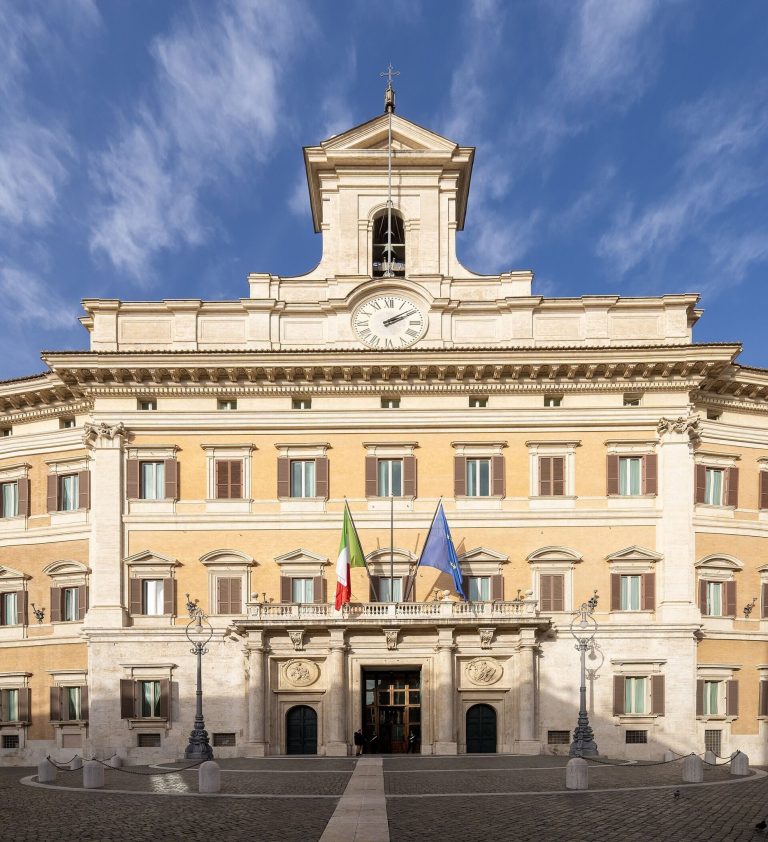
Palazzo Chigi is a historic palace in Rome, Italy, located between Piazza Colonna and Via del Corso beside Palazzo Montecitorio. Its development began with the gradual unification of buildings owned by several Roman noble families, and its main construction and transformation took place during the sixteenth and seventeenth centuries. Associated first with Giacomo della Porta and completed around 1580 by Carlo Maderno, the complex became a monumental aristocratic residence before eventually serving as the official seat and principal workplace of Italy’s prime minister.
The Aldobrandini and Chigi residences
The Aldobrandini acquired the property on 28 January 1578 and pursued its enlargement. Their acquisitions formed part of a wider effort to establish a prestigious residence close to the papal court, cardinalatial palaces, Curial institutions, and Rome’s principal roads. Pietro Aldobrandini the Younger later sold the property to Paolo Fossano, who continued the building works. The complex progressively took the form of a large aristocratic residence during the late sixteenth and early seventeenth centuries.
The Aldobrandini were a powerful Roman family whose influence grew after the election of Clement VIII, the pope whose pontificate helped raise the family to a dominant position in Rome. In 1659 Agostino Chigi, the first Prince of Farnese, acquired the palace. The Chigi, originally a banking family from Siena, had risen to particular prominence after the election of Pope Alexander VII, a member of the family. Palazzo Chigi became one of their principal Roman residences.
Further rebuilding took place under Felice della Greca and Giovanni Battista Contini. During the seventeenth and eighteenth centuries the palace hosted aristocratic receptions, diplomatic meetings, ceremonies, and other events connected with Roman noble and papal-court life. On 20 April 1770 Wolfgang Amadeus Mozart gave a concert there in the presence of Charles Edward Stuart, the Jacobite claimant who sought to restore the Stuart dynasty to the British throne.
Diplomatic residence and political change
During the eighteenth and nineteenth centuries Palazzo Chigi provided accommodation for foreign diplomatic representatives to the Holy See and later to the Kingdom of Italy. Its occupants included representatives of Belgium, Spain, the Kingdom of Sardinia, and Austria-Hungary. The palace housed the Spanish embassy in the late eighteenth century, and in 1878 it became the residence of the Austro-Hungarian ambassador to the Kingdom of Italy.
Its association with Austria-Hungary gave the building the derisive nickname “Austro-Vatican mole.” Diplomatic use continued into the early twentieth century, when Italian irredentist movements protested the palace’s connection with Austria-Hungary during disputes over Trento and Trieste. After the capture of Rome in 1870 and the transfer of the Italian capital there, the area around Piazza Colonna grew increasingly important as a political and administrative center of the unified Italian state.
The Italian state definitively acquired Palazzo Chigi in 1916 by exercising the right of pre-emption established by the 1909 law protecting property of major artistic and historical importance. The palace first became the seat of the Ministry of the Colonies and later housed the Ministry of Foreign Affairs.
Fascist and republican government
From 1922 Benito Mussolini used Palazzo Chigi as the seat of the Ministry of Foreign Affairs. Mussolini, the Fascist dictator of Italy, served simultaneously as prime minister and foreign minister. He established his office in the Deti Gallery and delivered some early public speeches from the corner balcony overlooking Piazza Colonna and Via del Corso. The balcony was later nicknamed the “Prow of Italy,” although political communication was subsequently transferred to the balcony of Palazzo Venezia.
The palace hosted diplomatic meetings and political negotiations connected with Fascist foreign policy. On 4 November 1925 an attempt was planned to assassinate Mussolini while he appeared on the palace balcony, but the plot failed after Tito Zaniboni was arrested in advance. On 22 June 1941 Italy declared war on the Soviet Union at Palazzo Chigi.
Palazzo Chigi became the official seat of the Presidency of the Council of Ministers on 29 March 1961, replacing the Palazzo del Viminale. The Presidency of the Council of Ministers is the central coordinating institution of the Italian executive, led by the prime minister, while the Council of Ministers is the cabinet. The Ministry of Foreign Affairs later moved to the Palazzo della Farnesina.
At first, Palazzo Chigi was used mainly for ceremonial and representative purposes. Under the government of Aldo Moro, an Italian statesman who served as prime minister in the 1960s, it became the stable operational center of the executive from 1963. During the First Republic, the palace hosted Council of Ministers meetings, governing-coalition summits, political consultations, international diplomatic meetings, and other major events in republican political history. The name “Palazzo Chigi” consequently became a metonym for the Italian government and executive power.
Restoration and continuing institutional role
A major restoration and conservation campaign during the 1990s treated the façades, reception rooms, interior decorative systems, and the prime minister’s study. Completed on 7 November 1999, the work recovered historically important painted decoration that had been obscured or altered by interventions in the 1960s.
In the twenty-first century Palazzo Chigi has continued to serve as the principal operational center of the Italian executive. It hosts international summits, diplomatic meetings, Council of Ministers sessions, political consultations, and press conferences. On 28 April 2013, during the swearing-in of the Letta government at the Quirinal Palace, a shooting took place in the area in front of Palazzo Chigi. Luigi Preiti seriously wounded the Carabinieri officers Giuseppe Giangrande and Francesco Negri, as well as a passer-by. The palace remains the official residence and principal workplace of the Italian prime minister and the seat of the Italian government.
Remains
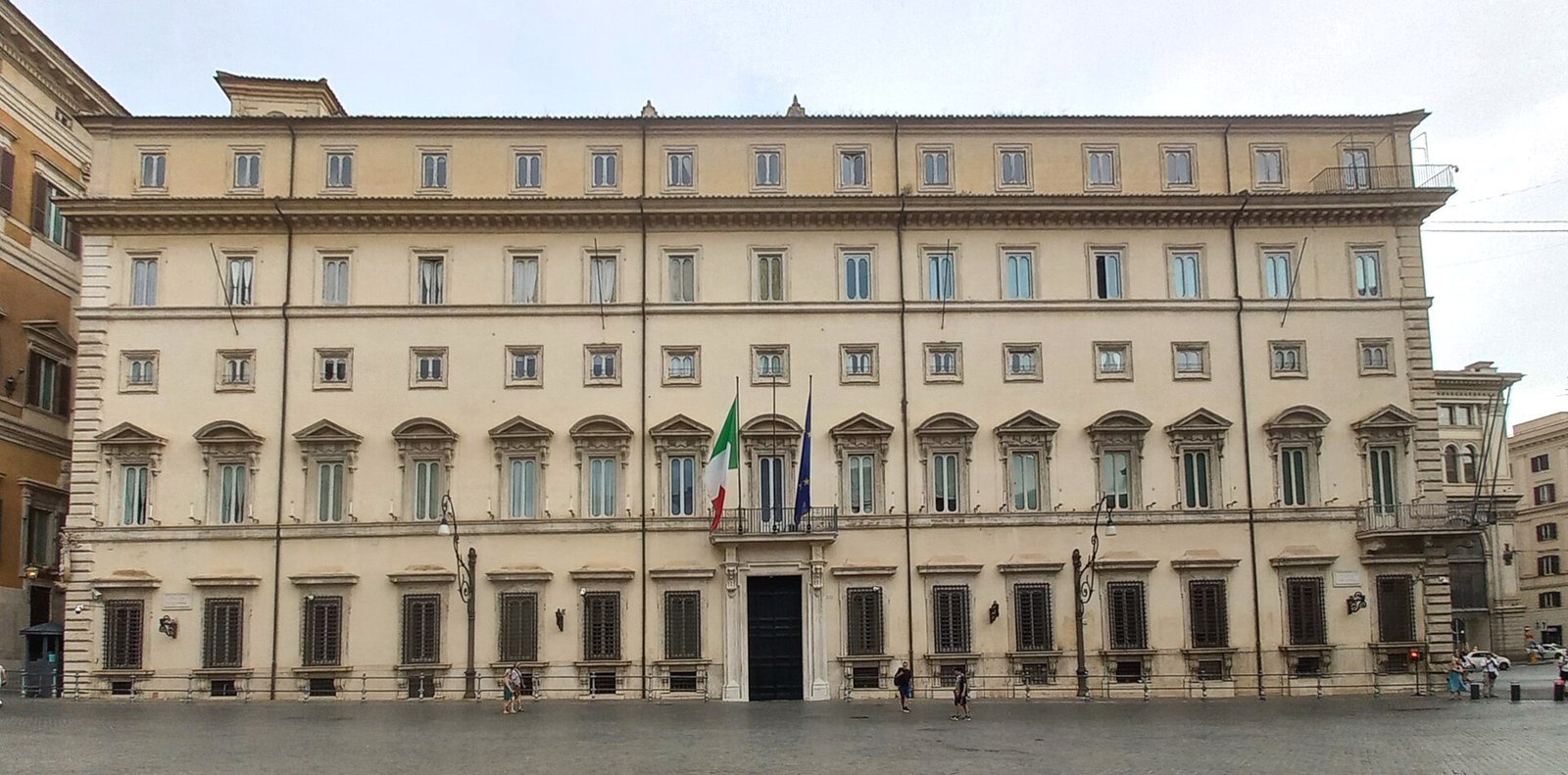
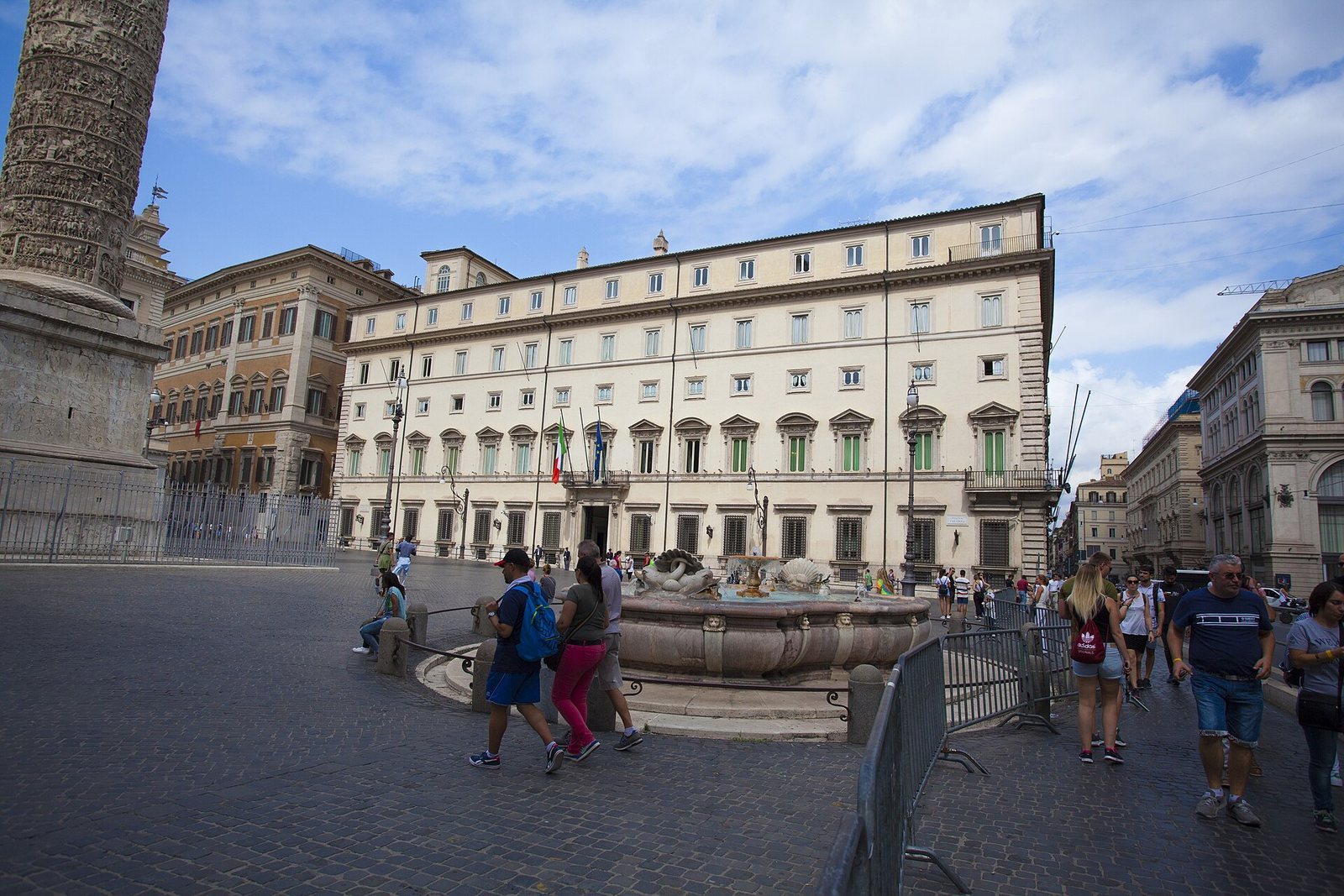
Palazzo Chigi occupies a substantially rectangular historic-city block extending along the axis between Via del Corso and Piazza Colonna. Its five floors contain monumental reception rooms, residential rooms, offices, and interior spaces altered, enlarged, and redecorated by successive owners and by the Italian state. The building combines Mannerist, Renaissance, and Baroque characteristics. Its severe, monumental treatment relies on regular composition and controlled surfaces rather than exuberant decoration.
Entrances, courtyard, and ceremonial staircase
Façades and access
The principal entrance is on Via del Corso, while the best-known and most symbolically important façade faces Piazza Colonna. A monumental access from Piazza Colonna was established in 1740, strengthening the palace’s representative relationship with the urban space. The exterior reflects the sixteenth- and seventeenth-century transformations promoted first by the Aldobrandini and later by the Chigi.
Cortile d’onore
The entrance leads to the cortile d’onore, a large internal courtyard with a portico designed by Felice della Greca. Repeated arches rest on square piers, which are topped by a frieze decorated with trophies of arms and musical instruments in a sixteenth-century manner. At the center stands an eighteenth-century travertine fountain bearing the Chigi coat of arms. The fountain forms part of the ceremonial route used for official receptions.
Scalone d’Onore
The Scalone d’Onore, or ceremonial staircase, was built for the Chigi in the second half of the seventeenth century and designed by Felice della Greca. Positioned to the left of the Via del Corso entrance, which was the principal entrance during the Chigi period, it rises from the courtyard toward the piano nobile, the palace’s principal ceremonial or residential floor. The staircase is decorated with the Chigi arms, ancient sculptures, Roman sarcophagi, and large seventeenth-century bronze lanterns. Its ascent has both a practical and ceremonial function and remains part of the protocol for official visits and receptions.
Representative rooms and government chambers
Sala delle Galere
The Sala delle Galere, also called the Sala dei Galeoni, contains five white-stucco bas-reliefs of ships in motion, installed above the doors in 1917 when the palace became the Ministry of the Colonies. Its cornice includes seventy-two different female faces conceived as allegories of the world’s populations. A large Murano-glass chandelier in a modern eighteenth-century style hangs in the room, alongside two canvases by Giovan Battista Pace reproducing scenes based on frescoes by the Cavalier d’Arpino in the Palazzo dei Conservatori. Eighteenth-century terracottas titled Il Giorno and La Notte by Bartolomeo Cavaceppi, together with a copy of Raphael’s Meeting of Leo the Great with Attila, also form part of the interior. The room is used for official statements and press meetings.
Sala dei Mappamondi
The Sala dei Mappamondi, also called the Sala delle Quattro Stagioni, is an antechamber to the Sala del Consiglio dei Ministri and belongs to the palace’s first Aldobrandini-built wing. A terrestrial globe dated 1632 and a celestial globe dated 1636 stand on either side of the entrance to the Council chamber. The room was decorated in 1857 with Neoclassical allegories of the four seasons and other symbolic figures on its walls and vault. Its eighteenth-century doors have mirrors and gilded carving. Spring and summer appear on the eastern side of the vault, while autumn and winter appear on the western side, with Chigi and Sain-Wittgenstein heraldry at the center.
Anticamera del Presidente and the prime minister’s study
The Anticamera del Presidente faces Piazza Colonna and is one of the principal representative rooms on the piano nobile. A painted frieze on its walls depicts episodes from the life of Cardinal Pietro Aldobrandini. The room also contains an eighteenth-century fireplace, a large mirror, eighteenth-century Roman furnishings, and a sixteenth-century Flemish tapestry from Brussels.
The prime minister’s study lies immediately beyond the antechamber. Its decoration is relatively restrained, with simple seventeenth-century friezes and a copy of Domenichino’s Saint Agnes, derived from an original by Titian now in the Prado Museum in Madrid. Above the entrance to the Deti Gallery, a seventeenth-century depiction of Jonah and the whale was discovered during the late twentieth-century restoration after being concealed by twentieth-century decorative interventions.
Sala del Consiglio dei Ministri
The Sala del Consiglio dei Ministri is the principal institutional room and meeting place of the Italian cabinet. It faces the central balcony overlooking Via del Corso. Four tapestries associated with the school of Peter Paul Rubens, a sixteenth-century wooden choir from the former Chigi chapel, and a late eighteenth-century white-marble fireplace form part of its furnishings. The wooden ceiling has a frieze made in 1665 by Giovanni Paolo Schor, while the room’s formal institutional arrangement was adapted from the palace’s earlier aristocratic interiors.
Galleries, library, and second piano nobile
Galleria Deti
The Galleria Deti takes its name from Cardinal Giovanni Battista Deti, who promoted the room at the beginning of the seventeenth century. Flaminio Allegrini decorated it between 1616 and 1625 with gilded stucco, biblical subjects, and heraldic motifs associated with its aristocratic commission.
Sala delle Marine and Salone d’Oro
The Sala delle Marine lies on the second piano nobile beside the Salone d’Oro, together forming part of the apartment used by the prime minister. Its name derives from marine views and related ornament, including coastal landscapes and allegorical references to navigation and maritime commerce. Late eighteenth-century and Neoclassical elements remain in the room. The decoration is related stylistically to that of the Salone d’Oro, but is lighter and more focused on landscape themes. Twentieth-century adaptation for the Presidency of the Council left much of this historical decoration in place.
The Salone d’Oro overlooks Piazza Colonna and is one of the palace’s most richly decorated rooms. Its gilded walls and ceiling were created between 1765 and 1767 for the marriage of Sigismondo Chigi and Maria Flaminia Odescalchi. Under the direction of Raffaele Stern, Tommaso Righi made bas-reliefs of putti, griffins, and allegorical figures, while Andrea Mimmi executed the inlaid floor. Giovanni Angeloni created the ceiling coffers and frieze, whose center contains Giovan Battista Gaulli’s 1668 painting Diana Spying on the Sleep of Endymion. Luigi Valadier produced the gilded metal decoration framing the mirrors and lamps.
Chigi Library and Tapestry Rooms
Agostino Chigi commissioned a library hall in the late seventeenth century for Cardinal Flavio Chigi’s extensive collection. Giovanni Battista Contini designed the room. The Chigi Library, or Chigiana, contained thousands of valuable manuscripts, many of them originating in the personal library of Pope Alexander VII.
Two rooms known as the Tapestry Rooms connect with the Sala dei Mappamondi. The first serves as a meeting room and contains two seventeenth-century Brussels tapestries depicting the story of Noah, together with two nineteenth-century paintings on Risorgimento subjects. The second functions as a waiting room for the secretary-general of the Presidency of the Council and contains eighteenth-century gilded wooden furniture and three tapestries from a series on Alexander the Great. Their vaulted ceilings have decorated stucco cornices, and the rooms form an architectural sequence with the Sala dei Mappamondi.