Guadix Cathedral: A Historic Cathedral of the Incarnation in Spain



Site at a Glance
- Rating
- 4.6
- Popularity
- Medium
- Country
- Spain
- Primary era
- Early Modern
- External website
- Open
- Eras represented
- Early Modern, Modern
- Civilizations
- Crown of Castile, Spanish
- Site type
- Religious
- Remains
- Cathedral
On this page17 sections
History
Guadix Cathedral, also called the Cathedral of the Incarnation, is a Roman Catholic cathedral in Guadix, Spain, built by Christian communities between the sixteenth and eighteenth centuries in Late Gothic, Renaissance, and Baroque styles. It occupies the site of the city’s former principal mosque and became the seat of the Diocese of Guadix after the Christian conquest.
Early Christian and Islamic phases
Tradition associates the first Christian community and bishopric at Acci, the ancient name of Guadix, with Saint Torquatus in the first century AD. Saint Torquatus is traditionally counted among the seven apostolic men who spread Christianity in the Iberian Peninsula. By the tenth century, a Hispano-Visigothic church occupied the site, and it was later adapted into a mosque during the Islamic period.
Christian forces conquered Guadix in 1489 during the Reconquista, the centuries-long Christian conquest of territories ruled by Muslim states in the Iberian Peninsula. The bishopric was restored, and the former mosque became the Church of Saint Mary of the Incarnation. Pope Innocent VIII elevated the church to cathedral status in 1492. The new cathedral was intended to express the city’s renewed Christian identity and the outcome of the conquest.
Gothic and Renaissance construction
Pedro de Morales built the first new Gothic section between about 1510 and 1520. This work corresponds to the present choir and retrochoir. The Gothic scheme was soon regarded as outdated, prompting Cardinal Gaspar Ávalos de la Cueva and others to support a more modern design.
Diego de Siloé received the commission to redesign the cathedral in 1549. His Renaissance proposal was influenced by the cathedrals of Málaga and Granada. Francisco Roldán, Francisco Antero, and other builders took part in the work, while Juan de Arredondo served as master builder. Siloé’s contribution included the apse, part of the crossing, the Chapel of Don Tadeo, and part of the sacristy.
Financial difficulties following the Morisco rebellion, an uprising by converted Muslims and their descendants against Christian rule, brought construction to a halt in 1574. Bishop Juan de Fonseca y Guzmán resumed the work in 1594. For several decades, the building remained divided between the Gothic construction and the former mosque.
Seventeenth- and eighteenth-century completion
The Freyla brothers, Pedro and Miguel, worked for many years on the bell tower, which was intended to become a symbol of Guadix. Its second body and the sacristy were completed in 1632. Construction resumed more extensively in 1713 with financial assistance from King Philip V.
Blas Antonio Delgado, master builder of Jaén Cathedral, prepared a revised scheme that emphasized horizontal lines and established the general plan, elevations, doors, and cupola. He left for Jaén in 1714, after which Vicente Acero substantially changed the project. Francisco de Hurtado Izquierdo was approached to continue the work, but he recommended Gaspar Cayón de la Vega instead.
From 1718, Cayón became the principal architect of the later construction. He shaped the vaults, dome, and final phases of the building, and completed the Portada de las Azucenas begun by Acero. When Cayón left for Cádiz in 1731, the façade was being built according to his plans. Vicente Acero, Fernández Pachote, Domingo Thomas, and other masters then added elements outside Cayón’s design. The main façade was constructed between 1754 and 1799.
Modern history and conservation
Guadix Cathedral is the principal church of the Diocese of Guadix, an ecclesiastical district governed by a bishop. It was designated a Spanish Historic Heritage monument on 3 June 1931.
The Spanish Civil War caused substantial damage to the cathedral. The sculptures of Saint Peter and the seven apostolic men on the main façade were destroyed and reconstructed by María Ángeles Lázaro Guil in 1992. Most of the choir reliefs were also destroyed, and their present imagery was reconstructed by Ángel Asenjo Fenoy in a project completed in 2018.
Bishop Manuel Medina Olmos, who served from 1928 to 1936, was killed during the Civil War. His remains are preserved in the Chapel of Saint Torquatus, and Pope John Paul II beatified him in 1993. A reproduction of Michelangelo’s Vatican Pietà, acquired in 1930 for a family pantheon at the Church of Santiago, was destroyed during the war. Recovered fragments were restored by María Ángeles Lázaro Guil in 2001 with assistance from the Andalusian regional government, and the sculpture was then transferred to Guadix Cathedral.
Remains
Guadix Cathedral is approximately 67 metres long and 37 metres wide. Its surviving fabric brings together Late Gothic, Renaissance, and Baroque work. The building’s principal elements include a large Baroque façade, two side portals, a multi-period bell tower, and an interior organized around the choir, main chapel, chapels, sacristy, and surrounding passage.
Exterior architecture
Portada de la Encarnación
The main façade, known as the Portada de la Encarnación, is a Baroque composition of three bodies. Its design alternates concave and convex lines and combines a large central semicircular opening with two lateral openings topped by straight lintels. Groups of columns stand on substantial bases, giving the façade a strongly articulated surface.
Gaspar Cayón and Pedro Fernández Pachote made the first body. It contains niches with marble figures of Saint Peter and the seven apostolic men, reconstructed in 1992. The second body has two oculi, circular or oval openings, and a marble relief of the Incarnation by the cathedral canon Antonio Valeriano Moyano. The third body carries the royal arms of Philip V and an inscription recording the completion of the construction in 1799.
Portada de Santiago
The southern Portada de Santiago was built in the eighteenth century by Vicente Acero. Lilies, the cathedral’s emblem, are incorporated into its columns. A niche contains a statue of Saint James by Francisco Moreno, while the initials F and Y refer to Philip V and his wife, Elisabeth Farnese.
Portada de Torcuato
Gaspar Cayón made the northern Portada de Torcuato in 1728. Its niche formerly held a statue of Saint Torquatus. Another statue of the saint remains in a niche to the right of the portal.
Bell tower
The square bell tower rises more than 30 metres and was built in successive stages. Diego de Siloé made its first stone body in 1556, incorporating the sacristy. The second body, constructed in brick, belongs to the seventeenth century, while the third body was erected in the eighteenth century.
Juan Pugnaire made the lantern that caps the tower in 1863. Above it stands a spire carrying a 4.5-metre statue of the Sacred Heart of Jesus by Amadeo Ruiz Olmos, installed in 1945. The statue originally turned slowly toward Guadix’s two neighbourhoods through a mechanical system restored in 2022. Fifteen bells hang in the tower. Thirteen were cast in the twentieth century, while the hour bell dates from 1580 and the quarter-hour bell from 1759.
Interior chapels and liturgical spaces
Chapel of Don Tadeo and sacristy
The Renaissance Chapel of Don Tadeo is a sixteenth-century work by Diego de Siloé. Its design solves the problem of placing vaulting arches within a cylindrical structure and shows a strong Italian influence. The sacristy front has a Renaissance pediment, a developed entablature, the horizontal architectural assembly above columns, and an arch set between Corinthian columns. The bishops of Guadix placed their coats of arms on the columns.
Main Chapel
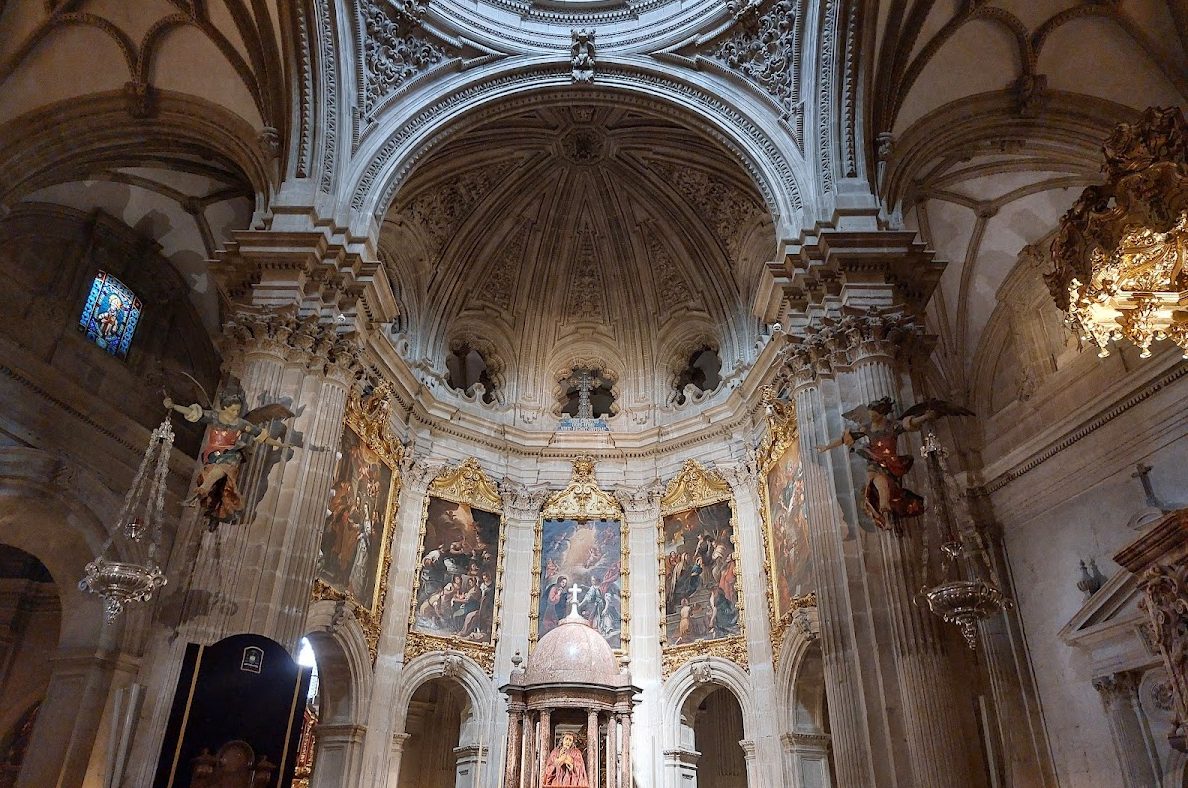
Gaspar Cayón and Vicente Acero built the Main Chapel around 1730. Its central feature is a tabernacle of pink marble by Domingo Lois Monteagudo. Five paintings by Fernando Marín Chaves are arranged from left to right as the Betrothal of the Virgin, the Nativity of the Virgin, the Incarnation, the Presentation of the Virgin in the Temple, and the Assumption.
The ambulatory, the passage surrounding the main chapel, contains five smaller paintings. They depict the Visitation, the Adoration of the Shepherds, the Circumcision, the Adoration of the Magi, and the Flight into Egypt.
Choir and retrochoir
Martín Bello made the first recorded choir in wood in 1531. After its deterioration, the cathedral chapter commissioned a new choir in cypress wood from Pedro Fernández Pachote in 1741. Pachote produced the stalls, while Torcuato Ruiz del Peral created the sculptural imagery. Work on the imagery continued until 1772, and the choir was completed in 1781.
The retrochoir is a mid-eighteenth-century Neoclassical work by Domingo Lois Monteagudo in pink marble. Three niches contain a central statue of the Virgin of the Pillar, presented to the cathedral by Zaragoza, and lateral statues of Saint Anthony of Padua and the Archangel Michael.
Chapel of Saint Torquatus
The Chapel of Saint Torquatus began as a sixteenth-century work by Diego de Siloé. Francisco Moreno made its altarpiece in 1736. Saint Torquatus stands at its centre, flanked by six sculptures representing the other apostolic men. The upper part depicts the baptism of Saint Luparia, traditionally regarded as the first woman baptized by Saint Torquatus.
A silver urn beneath the altar contains the remains of Bishop Manuel Medina Olmos. The chapel therefore preserves both the cathedral’s association with its traditional first bishop and the memory of a twentieth-century bishop killed during the Civil War.
Transferred Pietà
The cathedral also houses the restored reproduction of Michelangelo’s Vatican Pietà acquired by Manuel Martínez-Carrasco Reyes y Almansa in 1930. It was intended for his family pantheon at the Church of Santiago in Guadix. After the sculpture was destroyed during the Spanish Civil War, its remains were recovered in 1970, restored by María Ángeles Lázaro Guil in 2001, and transferred to the cathedral.