St. Stephen’s Cathedral, Litoměřice: A Baroque Cathedral in Czechia


Site at a Glance
- Rating
- 4.5
- Popularity
- Low
- Country
- Czechia
- Primary era
- Early Modern
- External website
- Open
- Eras represented
- Early Modern, Modern
- Civilizations
- Habsburg, Holy Roman Empire, Kingdom of Bohemia
- Site type
- Religious
- Remains
- Cathedral
On this page21 sections
History
St. Stephen’s Cathedral, Litoměřice, is a Baroque cathedral in Czechia and the cathedral and chapter church of the Roman Catholic Diocese of Litoměřice. It also serves as the parish church of the cathedral parish of St. Stephen. Dedicated to St. Stephen, traditionally regarded as Christianity’s first martyr, the cathedral occupies a site with religious foundations reaching back to the 11th century and is a protected cultural monument of the Czech Republic.
Romanesque Foundation and Gothic Rebuilding
In 1057, Spytihněv II, a duke of Bohemia from the Přemyslid dynasty, founded a Romanesque basilica on the site. A Romanesque basilica is a church with a longitudinal plan and basilican structural arrangement. The church was dedicated to St. Stephen and became the chapter church of the Litoměřice Chapter, which was established in the same year.
During the fourteenth century, the Romanesque church was rebuilt in the Gothic style. This medieval building continued the site’s role as the spiritual centre of the chapter until the older structure was replaced in the seventeenth century.
Baroque Cathedral
The earlier church was completely demolished between 1662 and 1664. A new cathedral was then built for the newly established Diocese of Litoměřice. Construction lasted four years and was directed by Domenico Orsi, an Italian-born architect active in the Bohemian lands during the Baroque period. Giulio Broggio and other architects of Italian origin are also associated with the design. Baroque architecture is characterized by dramatic spatial compositions, rich ornament, and strong visual effects.
The cathedral was consecrated on 21 September 1681 by Bishop Jaroslav Ignác Šternberk, the second bishop of Litoměřice. The six large chapel altars were consecrated in the same year. Much of the interior was created during the episcopate of Maximilian Rudolf von Schleinitz, the first bishop of Litoměřice, and the furnishings have remained substantially intact.
Schleinitz commissioned five large altarpieces from Karel Škréta, whose paintings became central works in the cathedral. Bishop Šternberk brought the relics of St. Felix of Sutri from the Roman catacombs of St. Cyriaca in 1676. In 1692, he installed the relics of St. Victorinus of Amiternum in the chapel of Our Lady of Joy.
Repairs, Burials, and Later Religious Use
Major structural-stabilization repairs took place particularly in 1716, 1778, 1825, and 1892. The cathedral’s devotional and commemorative functions continued through later centuries. Its crypt and chapel crypts received the remains of several Litoměřice bishops and chapter canons, until burials inside churches were prohibited.
In the late twentieth century, the remains of Bishop Emanuel Arnošt of Valdštejn were exhumed from the so-called Josephine tomb and examined anthropologically. They were then reinterred in the cathedral crypt in front of the altar of Our Lady of Sorrows. A separate tradition placed the hearts of deceased bishops in the cathedral pillars. This practice ended after the death of Bishop Josef Koukl in 2010, when a commemorative plaque was installed instead.
Conservation continued in the modern period. The altarpiece showing the Archangel Raphael accompanying Tobias was restored over approximately two years and returned to the cathedral in October 2011. Three other paintings by Škréta, including the principal altarpiece, had also been restored by 2011 by the National Gallery of the Czech Republic. On 13 December 2015, Bishop Jan Baxant opened the cathedral entrance as a Holy Door during the Extraordinary Jubilee Year of Mercy. This allowed visitors to obtain indulgences under the conditions set out in Pope Francis’s decree Misericordiae vultus.
Remains
St. Stephen’s Cathedral stands on Dómský Hill, known in the Middle Ages as St. Stephen’s Mountain, beside Dómské Square. It is a large Baroque church about 50 metres long, 22 metres wide including the chapels, and 20.5 metres high. Its altar is oriented east. The building uses stone, brick, and masonry and has a single nave whose exterior resembles a three-aisled basilica. Three communicating side chapels open on each side of the nave, producing six large chapels. Each contains a large altar, a smaller altar, and a crypt associated with the burial of bishops and chapter canons.
Exterior and Bell Tower
Cathedral Façade
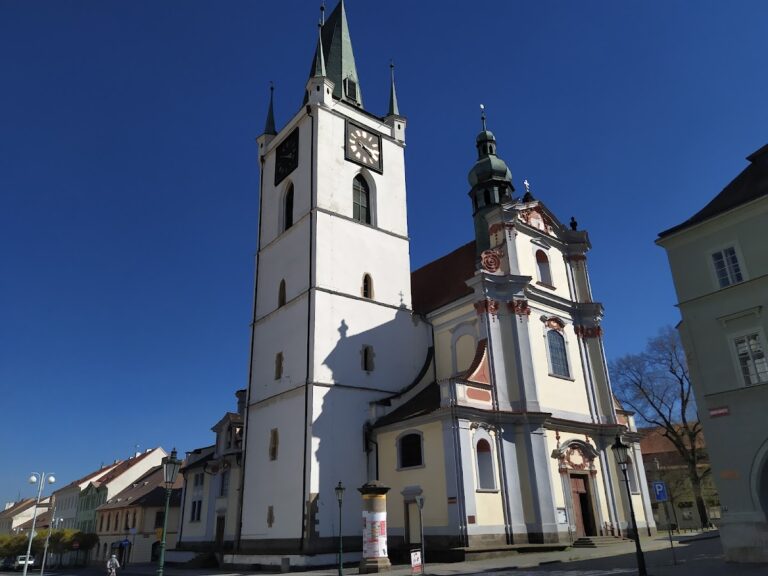
The main façade was conceived with two towers as part of its design. Their forms merge visually with the façade at the level of the main cornice, creating the building’s characteristic front. Above the entrance are the coat of arms of Bishop Maximilian Rudolf von Schleinitz, a statue of St. Stephen the Protomartyr dated 1700, and the coat of arms of Bishop Hugo Franz von Königsegg. Statues of St. Felix and St. Victorinus stand on either side of the entrance.
Bell Tower
The separate square bell tower has a footprint of approximately 9 by 9 metres and rises 65 metres. A connecting arch joins it to the cathedral, and the arch bears the personal coat of arms of Bishop Emanuel Jan Schöbel. Bishop Hugo Königsegg initiated the first stage between 1711 and 1720, when the tower base reached a height of 11 metres and supported a wooden Baroque belfry. Bishop Antonín Ludvík Frind later initiated its completion. The tower acquired its present form between 1879 and 1881 according to a design by the Austrian architect Baron Heinrich Ferstel.
Presbytery and Principal Altar
Altar of St. Stephen
The principal altar in the presbytery is dedicated to St. Stephen and displays Karel Škréta’s large painting The Stoning of St. Stephen. Above it is Škréta’s smaller image The Virgin Mary as Queen of Heaven. Beneath the main painting stands a crucifix donated by Bishop Jaroslav Ignác Šternberk. Its ivory figure of Christ rises above a base with a relief of St. Stephen described as Augsburg work. A large polychrome wooden antependium, or decorated frontal covering, depicts an episode from St. Stephen’s life. Two large yellow-metal candlesticks beside the altar date from the first half of the seventeenth century, and a crypt lies beneath it.
Presbytery Furnishings
On the right side of the presbytery hangs a copy of Bernardo Strozzi’s painting of St. John the Baptist, donated in 1844. Four paintings of the Evangelists by the Litoměřice painter Jan Gruss, also dated 1844, hang above it. The baptismal font, with a statue of St. John the Baptist, dates from the first half of the nineteenth century. The nave contains a plaque commemorating the cathedral’s consecration by Bishop Šternberk on 21 September 1681.
Chapels on the North Side
Our Lady of Sorrows
The altar of Our Lady of Sorrows contains a tabernacle and a Gothic polychrome wooden pietà from the earlier collegiate church. Until 1900, the pietà was kept behind a glass cover supported by two angels. The antependium depicts Christ’s burial. The chapel also contains the reinterred remains of Bishop Emanuel Arnošt of Valdštejn.
Family of Christ
The altar of the Family of Christ was formerly dedicated to St. Ludmila and was altered in 1933 by Bishop Josef Gross. Its painting by Kryštof Tietze is dated 1690. The predella, the lower section of an altarpiece, bears an image of Our Lady, Mother of Good Counsel, while a wooden relief below shows the death of St. Anne. Angel statuettes once formed part of the altar and were later placed in storage. A statue of the Sacred Heart of Jesus was moved to a nearby niche. The opposite pillar contains the walled-in hearts of Bishop Vincence Eduard Milde, who died in 1853, and Bishop Hille, who died in 1865.
Our Lady of Joy
The altar of Our Lady of Joy contains the so-called Meissen Madonna, a panel painting of the Virgin and Child from Meissen made in the manner of Eastern devotional images. A gilded carved reliquary, a container for preserving relics, stands on the altar mensa and holds the relics of St. Victorinus of Amiternum, placed there in 1692. An oval painting of the saint hangs above it, while the antependium depicts his martyrdom. The chapel also contains an altar dedicated to St. John of Nepomuk, whose martyrdom appears on its wooden antependium.
Chapels on the South Side
Guardian Angels
The Guardian Angels chapel contains Škréta’s painting of the Archangel Raphael accompanying the youthful Tobias. Its carved wooden antependium depicts the Dream of the Patriarch Jacob. Relics of St. Zdislava were placed on the altar in a sealed reliquary on 12 November 2009. The chapel’s altar of St. Barbara has a relief of her beheading and statues of St. Agatha and St. Apollonia.
Holy Princes of the Apostles Peter and Paul
The chapel of the Holy Princes of the Apostles Peter and Paul contains an original painting by Karel Škréta and a wooden antependium with scenes from the lives of the two apostles. Its pillar altar of the Fourteen Holy Helpers, a group of saints traditionally invoked for protection during illness and danger, contains a painting by František Antonín Müller and statues of St. Ambrose and St. Augustine. Opposite it is the marble epitaph of General Julius Radicati, who died at the Battle of Lovosice on 1 October 1756. Empress Maria Theresa ordered the monument’s erection.
St. Wenceslas
The altar of St. Wenceslas displays Karel Škréta’s painting of the saint’s death and a richly gilded reliquary containing the relics of St. Felix of Sutri. An oval painting of St. Felix decorates the reliquary lid. The antependium shows St. Wenceslas pressing grapes and the martyrdom of St. Felix. Nearby, the altar of St. Mary Magdalene has a painting by Josef Czech, a predella relief of Mary Magdalene washing Christ’s feet, a painting of St. Paulina above it, and statues of St. Catherine and St. Veronica.
St. Adalbert
The chapel of St. Adalbert contains a painting by Karel Škréta that was restored from 8 August 2012 and returned to its original position on 12 December 2013. A decorated glass coffin above the altar contains the relics of St. Clement from the Roman catacombs. The antependium depicts a legend of St. Adalbert. The pillar altar of St. Sebastian includes statues of St. Francis Xavier and St. Roch. It is a plague altar because the saints shown are associated with protection against plague. Its painting is by Josef Czech, its statues are by Jan Antonín Eckert, and a relief beneath the painting depicts the death of St. Rosalia of Palermo.
Interior Furnishings and Music
The interior furnishings are predominantly early Baroque, with black-and-gold surfaces and auricular ornament, a fluid sculptural decoration based on ear-like and organic forms. They include the principal altar, six large chapel altars, smaller pillar altars, a richly carved pulpit, choir stalls, nave benches, two confessionals near the main entrance, and credences and cupboards in both sacristies.
The pulpit bears figures of the Church Fathers, influential early Christian theologians, including Ambrose, Jerome, Augustine, Gregory the Great, and Athanasius. Its painting of St. Matthew is an 1781 copy by František Josef Kutschera of a work by Škréta. The sounding board carries a statue of the Saviour, and the summit bears the coat of arms of Bishop Schleinitz.
The choir gallery contains a large organ in old Rococo cases. Its electromagnetic mechanism was made by the Dresden firm Jehmlich in 1942. The instrument has four manuals, 56 stops, and 3,944 pipes, with the largest pipes measuring 5.5 metres and the smallest less than one centimetre. A smaller choir organ dating from 1620 has stood on a side gallery since November 2010.
The cathedral’s principal interior paintings include five large seventeenth-century works by Karel Škréta, among them The Stoning of St. Stephen, the Archangel Raphael accompanying Tobias, and a painting of St. Adalbert. Other works are by Josef Czech, Jan Petr Molitor, Kryštof Tietze, František Antonín Müller, and other painters, preserving the layered artistic character of the Baroque cathedral.
Nearby sites