Our Lady of the Assumption Co-Cathedral, Opava: A Gothic Church of the Teutonic Order
Site at a Glance
- Rating
- 4.8
- Popularity
- Very Low
- Country
- Czechia
- Primary era
- Medieval
- Eras represented
- Medieval, Early Modern, Modern
- Civilizations
- Holy Roman Empire
- Site type
- Religious
- Remains
- Cathedral
On this page17 sections
History
Our Lady of the Assumption Co-Cathedral in Opava, Czechia, is a large Gothic church associated with the Teutonic Order and built on the site of an earlier Romanesque church. Construction probably began shortly after 1204, and the building became Opava’s largest ecclesiastical structure and a major landmark of the city.
Foundation and medieval development
The form of the earlier Romanesque church from the early thirteenth century is unknown. A document issued by King Wenceslaus I on 12 May 1237 records the parish in Opava and its possession by the Teutonic Order. The order was a Catholic religious and military institution that held estates, patronage rights, and ecclesiastical responsibilities in Central Europe. Its connection with the parish explains the order’s early ownership and administrative role.
Work on the church was interrupted after the death of King Ottokar II. Construction resumed after the return of his illegitimate son, Nicholas I of Opava, from Hungarian captivity. Once completed, the church served as an important religious institution within the city and as a dynastic setting for the Opava branch of the Přemyslid dynasty, the medieval ruling family of Bohemia and related territories.
Shortly before 1452, Duke William of Opava added a Holy Sepulchre Chapel to the western bay of the southern aisle. Its altar was dedicated to the Resurrection of Christ, and William intended the chapel to become a burial place for the Opava Přemyslids. Members of the dynasty had previously been buried in the Church of the Holy Spirit.
Religious conflict and changes in church administration
A city fire on 9 August 1461 destroyed the rood cross. The fire also damaged the rood screen, a partition separating the choir reserved for the religious order from the nave used by the congregation. The screen was subsequently removed and was never rebuilt.
In 1540, Opava’s municipal council obtained the church’s patronage rights from the Teutonic Order. King Ferdinand I confirmed the transfer in 1542 on the condition that the parish be served only by regular Catholic priests approved by the Bishop of Olomouc. Blažej Sibenlot became parish priest in 1555.
The Reformation, a movement that challenged Catholic doctrine and church structures in western and central Europe, strongly affected Opava during the second half of the sixteenth century. In 1565, the Lutheran preacher Martin Zenkfrei was installed in the parish church despite the efforts of Bishop Wilhelm Prusinovský of Víckov to expel him. After Zenkfrei’s death in 1569, Sibenlot agreed, in return for 400 gold pieces and an annual payment of 200 gold pieces, not to obstruct Lutheran preachers. Catholic worship consequently ceased in the parish church.
At the end of October 1569, Bishop Wilhelm Prusinovský came to Opava to restore Catholic worship. When he opened a service in the church on 6 November, Protestant opponents prevented the accompanying Jesuit Stephan Rimmel from preaching. Armed nobles escorted the bishop from the building, and he found refuge in the nearby Church of Saint Wenceslaus.
During the Bohemian Revolt, an uprising against the Habsburg monarchy that began in 1618, the church, its parish court, and its school were taken from the Catholics on 29 June 1619 with the consent of the Silesian Estates and handed to the Protestants. On 12 August 1632, the Opava Estates paid homage in the church to Duke Charles Eusebius of Liechtenstein. An engraving of the ceremony preserves an image of the former interior, including its late Gothic high altar and sanctuary, which were later destroyed by fire.
Fires and Baroque rebuilding
An Opava city fire in 1689 damaged the church. Emergency measures included boarding over the roof, recasting a bell cracked by heat, and cleaning the metal of other bells that had melted in the flames. The southern tower was restored by autumn of that year, while roofing work continued until 1693. Hans Georg Hausrucker rebuilt the church in 1699 in collaboration with Jordan Zeller.
On 25 August 1758, another city fire burned the church. Only one of its 21 altars, the Altar of the Holy Trinity, survived. The recently completed high altar, the large organ regarded as the most valuable in Austrian Silesia, and three large bells were also destroyed.
The church was subsequently altered and refurbished in the Baroque manner. The new high altar was designed by the Eichstätt architect Maurizio Pedetti and made by the sculptor Jan Schubert between 1782 and 1784. Schubert also produced the pulpit and the corresponding baptismal font superstructure. The Baroque refurbishment was completed in 1788, and the church was solemnly consecrated on 12 June 1789 by Karl Godefried von Rosenthal, auxiliary bishop of Olomouc.
A cult of Saint Valentine was associated with the establishment of the Saint Valentine Chapel in 1784. Relics of the saint had been ceremonially transferred to Opava’s Church of Saint Adalbert in August 1688. Seven representative Classical sedilia, seats for clergy during services, were probably made for the 1789 consecration.
Changes around the church and modern status
A cemetery and the Saint Michael’s Chapel surrounded the church until 1796. The chapel had been destroyed in the fire of 1758 and was never rebuilt. A theatre was constructed on the former cemetery site in 1804.
During the 1880s and 1890s, an association promoted a Gothic Revival transformation, meaning a nineteenth-century return to medieval Gothic forms. The project received the support of Archduke Eugene, Grand Master of the Teutonic Order. Friedrich von Schmidt surveyed the church in 1887, and his pupil Georg von Hauberrisser prepared two proposals for restoring its Gothic appearance. Changing principles of monument conservation prevented the more extensive proposal from being carried out, and only a small number of details were adopted, principally on the west facade.
In 1928, museum director Edmund Wilhelm Braun and parish priest Paul Heider arranged for tombstones from a closed cemetery at the site of the present Church of Saint Hedwig to be transferred to niches on the exterior of the choir. The church survived heavy shelling by the Red Army during the Second World War.
Since 1995, the church has been a national cultural monument of the Czech Republic. Since 1996, it has also served as the second seat of the Bishop of Ostrava-Opava. A co-cathedral is a cathedral that shares a bishop’s seat with another cathedral. Comprehensive reconstruction has been under way since 2004.
Remains
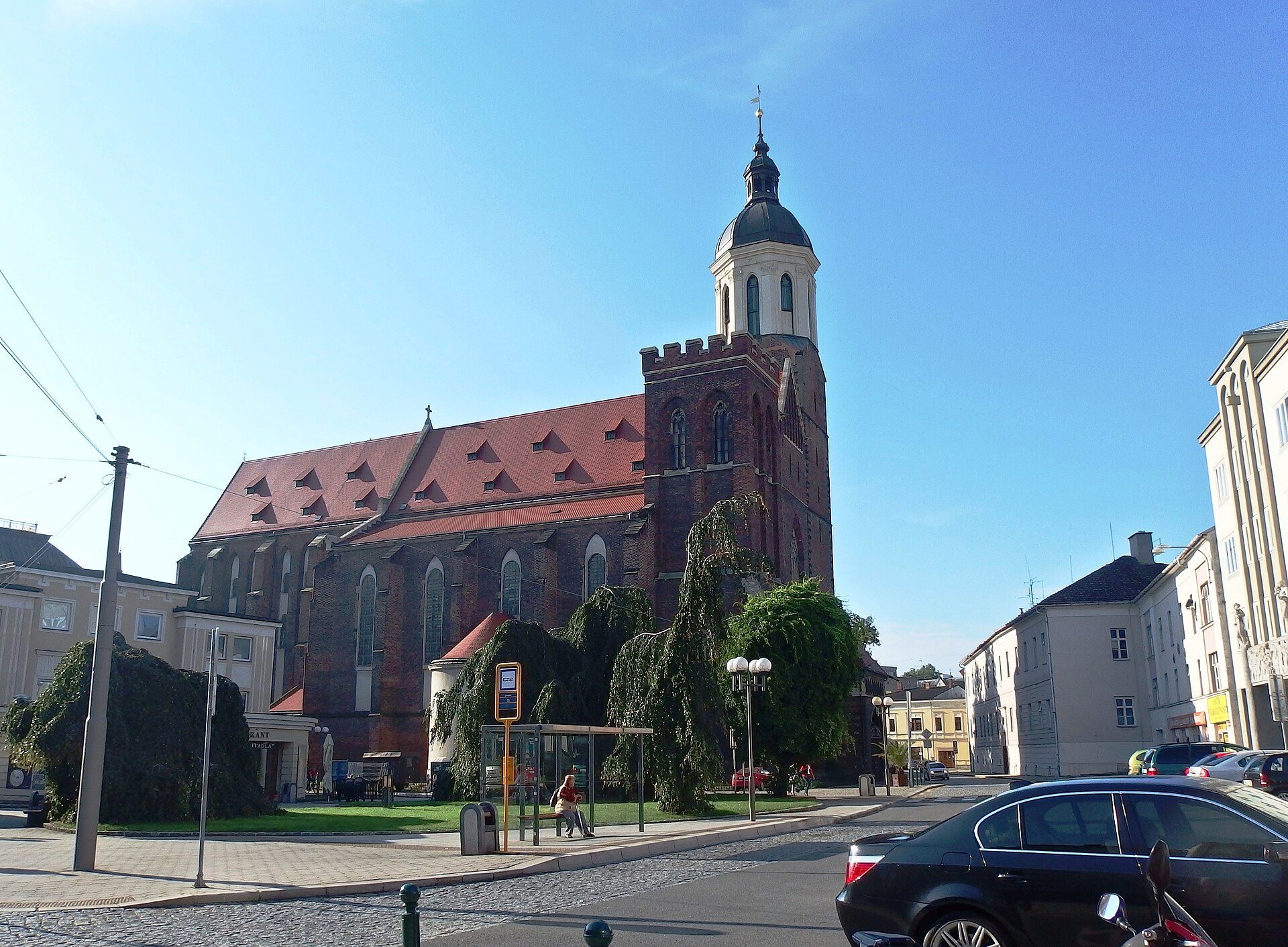
Our Lady of the Assumption Co-Cathedral is a large three-aisled hall church, in which the nave and aisles are approximately equal in height. Its main altar faces east. The building is constructed of exposed red brick and combines its original Gothic character with later Baroque alterations and a limited number of Gothic Revival additions. Two towers define the west front, while the attached chapels, choir, roof, and interior furnishings preserve evidence of successive rebuilding campaigns.
Towers and exterior
Southern tower
After 1540, the southern tower received a representative upper structure. A gallery was built at the crown of its square lower section, and a slender pyramidal spire rose above the octagonal upper section to more than 70 metres. In 1686, the tower was given a new bulbous crown with a lantern, decorated with eighteen gilded finials. That form was restored after the fire of 1689. The southern tower is described as 102 metres high and as the highest church tower in Silesia.
Roof and west facade
The roof was covered with slate in 1688, replacing the original shingles. After the fire of 1689, it was again roofed with shingles because the experience with slate had been poor. Between 1902 and 1906, two Neo-Gothic gargoyles shaped as winged monsters were installed on the west facade. These details were among the limited Gothic Revival changes adopted during the nineteenth-century restoration campaign.
Choir exterior
Niches on the exterior of the choir contain tombstones transferred in 1928 from the former cemetery near the present Church of Saint Hedwig. Their placement preserves gravestones from that earlier burial ground within the exterior fabric of the cathedral.
Chapels and interior furnishings
Holy Sepulchre Chapel
The Holy Sepulchre Chapel occupies the western bay of the southern aisle. It was attached shortly before 1452, during the period when Duke William of Opava intended it as a burial place for the Opava branch of the Přemyslid dynasty. Its altar was dedicated to the Resurrection of Christ.
Saint Valentine and Saint Anne Chapels
The Saint Valentine Chapel occupies the ground floor of the southern tower and dates in its present association with the church to the eighteenth-century revival of the saint’s cult. The Saint Anne Chapel contains a late-seventeenth-century painting of Saint John of Nepomuk, probably the oldest representation of this saint in Austrian Silesia.
High altar and choir
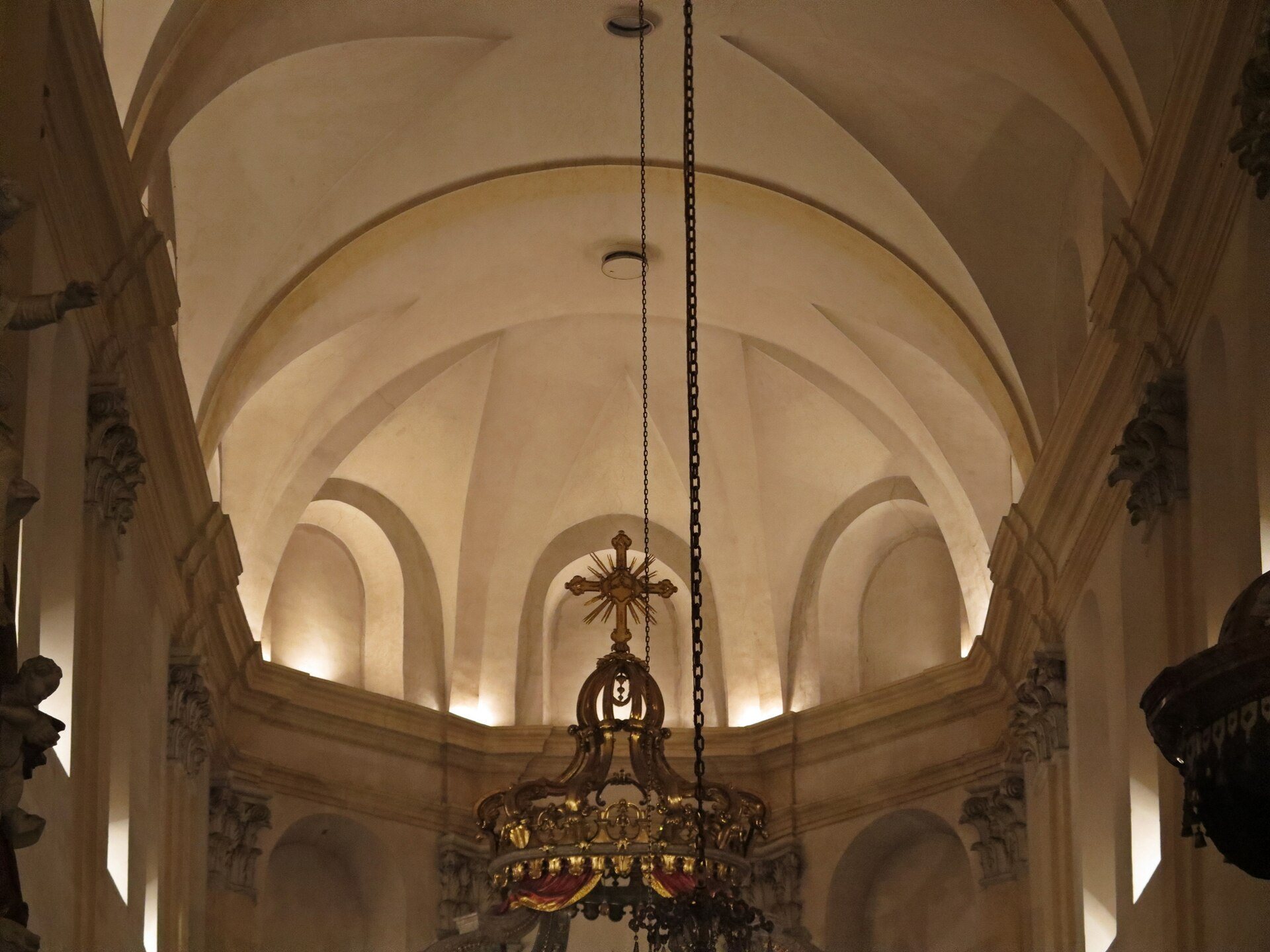
The Baroque high altar is a baldachin altar, meaning an altar sheltered by a canopy. Maurizio Pedetti designed it, and Jan Schubert built it between 1782 and 1784 to replace the Lehner altar destroyed in the fire of 1758. The choir also contains Schubert’s pulpit and the matching superstructure of the baptismal font, made during the same period.
Eleven paintings from a Marian cycle by Ignác Raab are displayed on the choir walls, together with four paintings of saints: Saint Sebastian, Saint Patrick, Saint Hedwig, and a holy bishop. The interior also preserves seven representative Classical sedilia, probably made for the consecration of 1789.
Relics and liturgical objects
The church preserves numerous vestments and sacred objects. Among them is a large gilded-silver reliquary of the Holy Cross made in 1900 by the Viennese firm Adler. A reliquary is a container for a relic. The Holy Cross relic was traditionally believed to have been kept in the church since the Middle Ages. It was taken to Vienna in 1567 for protection from Protestants and returned to Opava after the dissolution of the Viennese Poor Clare convent in 1782.
Other reliquaries preserve associations with Saint Notburga and Saint John Sarkander. The collection also includes a gilded-silver Mass chalice made in 1735 by the Olomouc goldsmith František Josef Rossmayer. Its medallions depict saints. The chalice was probably produced for the Premonstratensian monastery at Svatý Kopeček near Olomouc in connection with the 1732 coronation of its Marian image, and probably reached Opava after the monastery was dissolved in 1784.
A second gilded-silver chalice was made by the Brno goldsmith Antonín Josef Ignác Anderle in the second quarter of the eighteenth century. It depicts the legend of Saint John of Nepomuk and was probably not originally intended for the Opava church. It entered the church’s collection later, possibly in connection with the local Brotherhood of Saint John of Nepomuk.
Teutonic and later ecclesiastical vessels
A ciborium, a covered vessel used to contain consecrated hosts, bears the coats of arms of members of the Teutonic Order. Its body was made in the mid-seventeenth century by the Opava goldsmith Jakub Mannlich. An early-eighteenth-century lid was added later and attached with a screw to a Gothic reliquary cross from the second third of the fifteenth century, which may originally have been a pax, a liturgical object once used to convey the kiss of peace.
The heraldic plaques identify Adam Oswald of Liechtenstein, Jan Egolf of Westernach, and the Opava dean Jan Kaspar Hirle. The church also possesses a monstrance, a vessel used to display the consecrated Eucharistic host, made in 1786 by the Augsburg goldsmith Kaspar Xaver Stippeldey. It bears the coat of arms of Franz Sigismund Adalbert Friedrich, Baron von Lehrbach, land commander of the Franconian bailiwick of the Teutonic Order. Grand Master Antonín Viktor presented the monstrance to the Opava church in 1830.
Organ
The present organ was made by Rieger Orgelbau in 1893 within a case dating from 1863. It has 62 stops distributed across three manuals and a pedal, and it has been renewed several times.