St. Mary’s Cathedral: Gorzów Wielkopolski’s Cathedral Church


Site at a Glance
- Rating
- 4.5
- Popularity
- Medium
- Country
- Poland
- Primary era
- Medieval
- External website
- Open
- Eras represented
- Medieval, Early Modern, Modern
- Civilizations
- Holy Roman Empire
- Site type
- Religious
- Remains
- Cathedral
On this page16 sections
History
St. Mary’s Cathedral in Gorzów Wielkopolski, Poland, is the city’s oldest church and the cathedral church of the Roman Catholic Diocese of Zielona Góra–Gorzów. Its surviving medieval building is generally dated to the late thirteenth century and is a brick Gothic church, although a foundation associated with the late twelfth century is also recorded. The church’s origins are linked with the foundation of the city and an earlier urban church.
Medieval foundation and patronage
The church was originally dedicated to the Virgin Mary and the Eleven Thousand Virgins, a medieval Christian martyr tradition associated with Saint Ursula and her companions. Patronage first belonged to the city. In 1299 it passed to the collegiate chapter of Myślibórz, and it was later held by the Teutonic Order, a medieval Catholic military-religious order, and by the Brandenburg electors, the rulers of the historic Brandenburg state.
The present medieval body was constructed in the late thirteenth century and underwent relatively limited alteration after that period. An east-facing chancel, the part of a church reserved for the altar and clergy, was added in 1489. Around 1500, further altars were established, including those associated with the bakers’, shoemakers’, and clothmakers’ guilds.
Reformation and Protestant use
After the Reformation, the sixteenth-century religious movement that led many communities away from Roman Catholic authority, the church served an evangelical congregation from 1537 until 1945. In the nineteenth and twentieth centuries, that congregation belonged to the Landberg I church district within the Prussian ecclesiastical province of Brandenburg. Protestant worship brought extensive changes to the interior. Sixteen of the original seventeen altars were removed, while galleries, new seating, a pulpit, and organ installations were added.
The interior was plastered in 1561, covering its wall paintings. An organ gallery followed in 1566, and a new organ was installed in 1598. Further galleries accommodated guilds and different sections of the congregation, including women, pupils, clothmakers, tailors, and joiners. New seating was installed in 1617, followed by a Baroque pulpit in 1619. Around 1821, the interior was remodelled in the Classicist style and extensively painted white.
Postwar Catholic cathedral
The church was severely devastated in 1945. In September of that year it was reconsecrated as a Roman Catholic church under the dedication of the Assumption of the Virgin Mary, the Catholic feast commemorating the belief that Mary, the mother of Jesus, was taken bodily into heaven. It became a cathedral on 12 December 1945. From 1945 until the creation of the Diocese of Zielona Góra–Gorzów in 1972, it was formally under the Archdiocese of Berlin.
Between 1953 and 1956, the building was readapted for Catholic liturgy. Colored wall decoration discovered in 1953 was restored using older models. The cathedral contains the graves of Bishops Wilhelm Pluta and Teodor Bensch, whose postwar work was associated with the Polish Roman Catholic Church in Gorzów. Bensch’s grave is in the entrance vestibule, while a monument to Pluta stands in front of the church. The building is protected as an immovable monument under registrations dated 15 January 1954 and 19 October 1976.
Religious and civic events
The cathedral served as the center of the Gorzów August events in 1982. Pope John Paul II visited the church on 2 June 1997 and prayed at Bishop Wilhelm Pluta’s grave. A fire broke out in the cathedral tower on 1 July 2017. The spire and cupola were temporarily removed during the repairs, and the first Mass in the cathedral after the fire was presided over by Bishop Tadeusz Lityński on 1 February 2021.
Remains
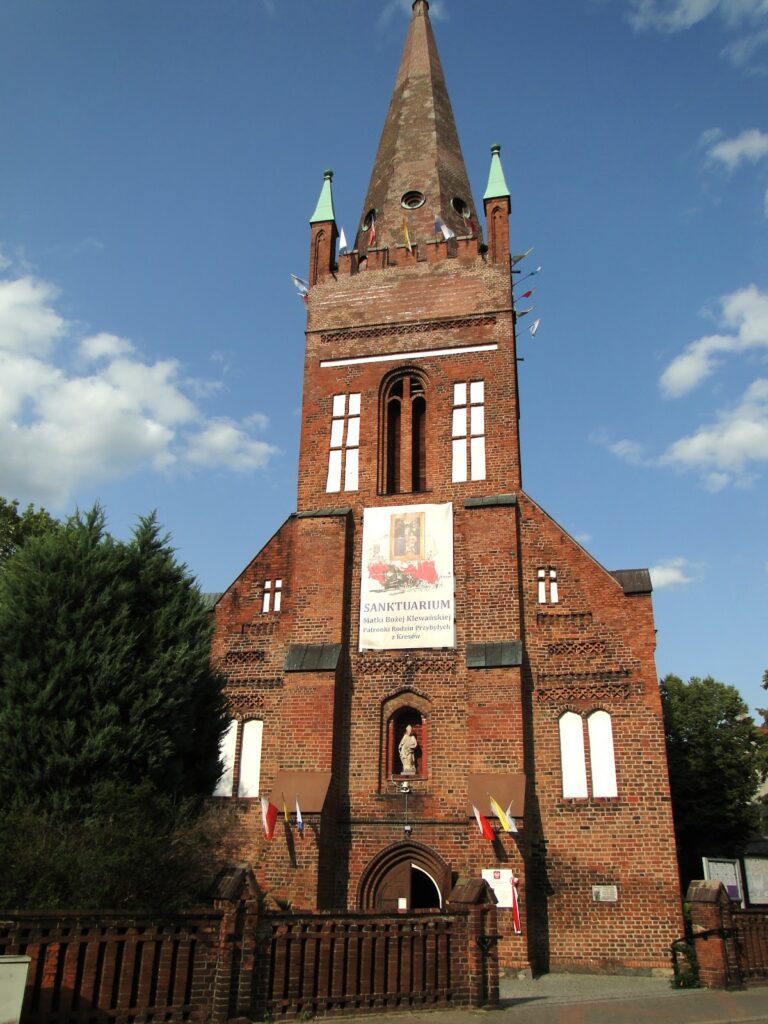
St. Mary’s Cathedral is a brick Gothic church with a three-aisled pseudo-basilical nave, meaning that its central aisle rises above the lower side aisles without the full upper window level of a true basilica. A western tower marks the entrance end, while a rectangular sacristy extends along the northern elevation. The church follows the traditional east-west arrangement, with the principal entrance to the west and the high altar at the opposite end.
Medieval structure and tower
Nave, chancel, and sacristy
The main body retains the form of the late-thirteenth-century medieval church and was altered only relatively slightly after its construction. The chancel was added on the eastern side in 1489, creating the area associated with the altar and clergy. The rectangular sacristy survives along the northern wall. Together, these elements define the principal plan of the brick-built church.
Western tower
The western tower was heightened in 1621 and received a Baroque cupola, a rounded dome-like roof. After a fire in 1708, it acquired the form that it has today. The same year, lightning damaged the bell called Ave Maria over a length of several dozen centimetres. The bell also lost its suspension loop and has remained silent since then.
Interior furnishings
High altar
The principal furnishing is a Renaissance-Mannerist high altar from around 1600. Originally made as a polyptych, an altarpiece formed from several panels, it now has the three-part arrangement of a triptych. Its lower section, called a predella, depicts the Last Supper. The central zone shows the Crucifixion, while the crowning section presents Jonah in the whale’s mouth. Figures of the twelve Apostles occupy the side wings and came from an earlier altar.
The Renaissance triptych was replaced in 1845 by an altar painting by the German painter Karl Begas. That painting was placed in museum storage and returned to the church during renovation in 1939. After the region came under Polish administration, a new high altar was installed. The Renaissance triptych returned to the high altar in 1991.
Crucifixion group and Marian image
The oldest fifteenth-century furnishing is a Late Gothic Crucifixion Group mounted on the rood beam, the beam spanning the church and traditionally carrying a Crucifixion scene. The cathedral also contains an image of the Assumption of the Virgin Mary transferred from the Church of the Assumption of the Virgin Mary in Buchach.
Wall marks and western doors
The southern exterior walls preserve depressions associated with the use of a fire-drill for producing fire during church ceremonies. Other depressions, known as “fever holes,” were probably connected with a medieval belief that brick dust could be used for healing. Numerous nails or studs remain set into the doors of the western portal. Participants in a 1917 collection for widows and orphans of soldiers killed during the First World War drove them into the doors.
Bells and organ
Tower bells
Four bells hang in the tower. Prayer weighs 4,000 kilograms, Faith 1,300 kilograms, Hope 1,200 kilograms, and Love 1,100 kilograms. Together they weigh approximately 7,500 kilograms and were cast in 1921 by the bell foundries of Heinrich Ulrich and Friedrich Weule in Apolda. The fifteenth-century Ave Maria, cast in 1498 and weighing 135 kilograms, hung in the tower until 2017. It is now exhibited in the Gorzów museum.
Organ
The cathedral’s organ has approximately 2,300 pipes, 43 stops, and three manuals with pedal. It is the largest organ in the Gorzów region.