Sulmona Cathedral: Episcopal Church and Minor Basilica in Italy


Site at a Glance
- Rating
- 4.6
- Popularity
- Low
- Country
- Italy
- Primary era
- Medieval
- External website
- Open
- Eras represented
- Medieval, Early Modern, Modern
- Civilizations
- Italian, Kingdom of Naples, Norman, Spanish
- Site type
- Religious
- Remains
- Cathedral
On this page17 sections
History
Sulmona Cathedral is the principal Catholic church of Sulmona, Italy, and the episcopal seat of the Diocese of Sulmona-Valva. Constructed outside the city walls in the eighth or ninth century, it developed through Romanesque, Gothic, and Baroque phases and is dedicated to Saint Panfilo, the bishop regarded as Sulmona’s patron saint. The church belongs to the Roman rite and remains associated with the saint’s relics and local devotion.
Early church and medieval rebuilding
Local tradition places the cathedral over a temple from the Roman period. The early church was built as a place for the body of Bishop Panfilo, which legend says had been transferred from nearby Corfinio. Emperor Louis II has been proposed as the figure who initiated its construction, although the precise circumstances remain uncertain. The original dedication was to the Virgin Mary.
The church underwent several transformations during the twelfth century and was then dedicated to Saint Panfilo. The Chronicon Casauriense, the chronicle of the Abbey of San Clemente at Casauria, describes a major building campaign begun in 1075 under Bishop Trasmondo, who was also abbot of San Clemente. Gualtiero completed the work in 1119. The chronicle presents this campaign as a new construction rather than a restoration, and the church was consequently known for a long period as “at the New Saints.” The relationship between this building and the earlier church is not certain.
Saint Pelino, a Christian bishop and martyr traditionally associated with the ancient city of Corfinium, is also represented at the cathedral. His presence connects the church’s devotional identity with the religious traditions of the surrounding area.
Earthquakes and Baroque reconstruction
A severe earthquake damaged the church in 1456. Further extensive destruction followed the earthquake of 1706, which led to a reconstruction in Baroque forms. The sacristies collapsed, and the bell tower and adjoining episcopal palace were damaged beyond the rebuilding carried out after the disaster. Work concentrated on the upper church, including the vaults of the three naves and the Baroque stucco and painted decoration.
The reconstruction retained the original ground plan, the lower section of the facade, and the Gothic crypt. This combination of preserved medieval fabric and later decoration accounts for the cathedral’s mixture of Romanesque, Gothic, and Baroque elements. The Chapel of Saint Panfilo was built in 1662, before the earthquake, in thanksgiving for the miracle against the plague of 1656 attributed to the saint.
Modern status and collections
Pope Pius VII elevated the church to the rank of minor basilica on 25 September 1818. The cathedral was declared a national monument in 1902. It also preserves one of the important ecclesiastical archives of Abruzzo, with material dating from the eleventh century onward. Its holdings include parchments, codices, diplomas, and baptismal registers. Many documents and sacred furnishings once kept in the cathedral are now exhibited in the Civic Museum of Sulmona.
Remains
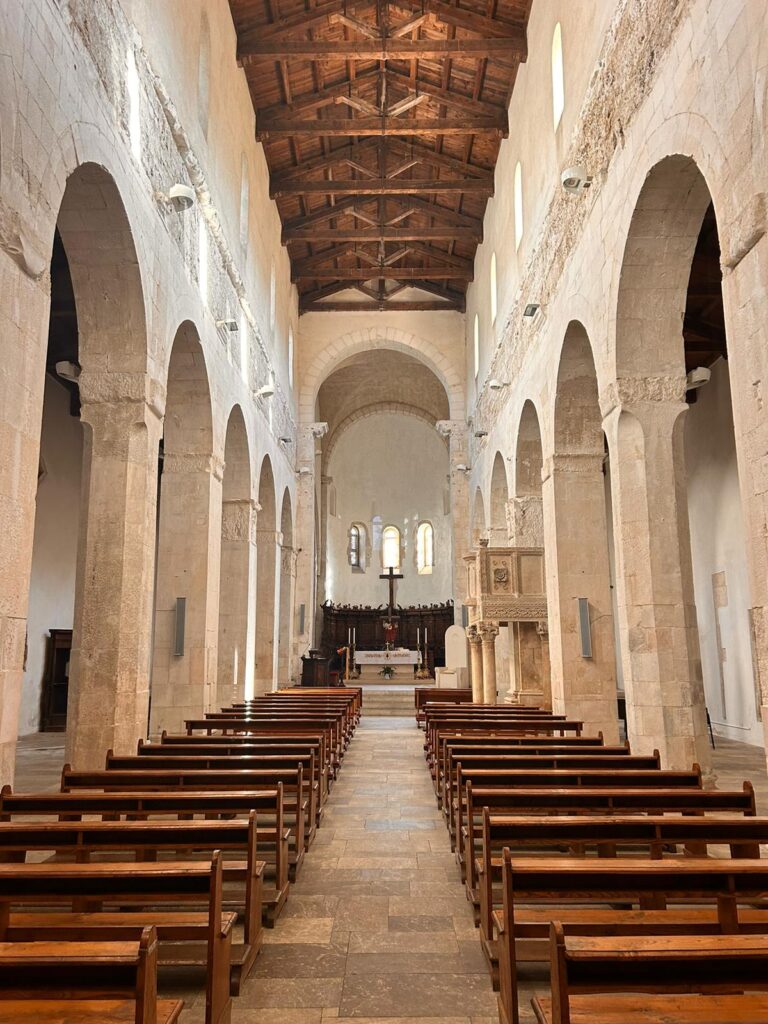
The cathedral retains a basilican ground plan with three naves divided by Romanesque columns. Its surviving fabric brings together Romanesque construction, Gothic elements, and Baroque alterations. The lower facade and the crypt preserve substantial parts of the medieval church, while the upper interior reflects the rebuilding that followed the earthquake of 1706.
Facade and entrance monuments
Gothic facade and portals
The lower facade is finished with a Gothic cornice that continues along the right side toward an ogival portal, an entrance crowned by a pointed arch. Columns beside the portal carry small shrine niches containing statues of Saint Panfilo and Saint Pelino. Nicola Salvitti made the statues in 1391. A late fourteenth-century fresco by Leonardo da Teramo occupies the lunette above the portal.
The portal on the left has Lombard-style inscriptions and incorporates part of a Roman stone slab. A smaller side portal from the seventeenth century leads to the sacristy. The three apses are marked by anthropomorphic Romanesque motifs. The facade also bears the Ovidian half-line “Sulmo mihi patria est,” meaning “Sulmo is my homeland.” Ovid was a Roman poet associated with Sulmo.
Entrance-wall monuments
Two funerary monuments stand on the interior wall of the entrance facade. One commemorates Bishop Bartolomeo De Petrinis and dates to 1422; the other is probably connected with the bishop’s sister. Behind the monuments are fifteenth-century frescoes showing the Crucifixion and the Redeemer between two saints.
Main church and presbytery
Nave decoration
The central nave vault carries tempera paintings of episodes from the lives of Saint Panfilo and Saint Peter Celestine. Amedeo Tedeschi executed the paintings in 1906. Peter Celestine, also known as Pope Celestine V, was a thirteenth-century hermit and pope associated with Abruzzo, and his presence reflects the cathedral’s local devotional connections.
The side naves contain marble altars, a baptismal font of the Neapolitan school dated 1757, and a fourteenth-century Crucifix. In the chapel to the right of the presbytery stands the wooden Ecstasy of Saint Teresa, made by Giacomo Colombo in 1707.
Presbytery and Chapel of Saint Panfilo
A polychrome-marble staircase in front of the presbytery descends to the Chapel of Saint Panfilo, which contains the saint’s remains and connects with the crypt behind it. The chapel was built in 1662 in Baroque style. The presbytery leads to wooden choir stalls made by Ferdinando Mosca in 1751 and to an eighteenth-century high altar in polychrome marble.
Crypt and devotional remains
The crypt is the oldest part of the church. It has three semicircular apses and three naves supported by columns. Its lateral columns are monolithic limestone shafts believed to date from the tenth century. The masonry around the apses differs from the inner core, indicating variations within the surviving construction.
Columns, vaults, and Saint Panfilo altar
The crypt originally had sixteen columns, but the number was reduced to fourteen when the seventeenth-century altar of Saint Panfilo was installed. Three rows of columns are irregularly spaced and do not align perfectly, giving the groin vaults an irregular arrangement. At the foot of the central staircase is the Chapel of the Saint, whose local-stone altar is inlaid with polychrome marble. A niche in the altar holds a reliquary bust of Saint Panfilo, made in 1458 by Giovanni di Marino di Cicco of Sulmona from gilded copper, silver, and enamel.
Madonna delle Fronaci
The crypt contains the Madonna delle Fronaci, a twelfth-century bas-relief of the Virgin and Child carved from polychrome stone. Tradition associates it with Borgo Pinciaro in western Sulmona, an area linked with tile-producing kilns. Two thirteenth-century marble slabs decorated with raised rosettes are incorporated into the work. Its painted rear panel, showing two angels holding a heraldic emblem, is later, and two Roman weights serve as knobs. The sculpture was probably reused after an earthquake.
Fourteenth-century funerary monument
A funerary monument occupies a niche on the right wall of the crypt. Dating from the second half of the fourteenth century, it has a pointed, tympanum-crowned arcosolium, a tomb recess with an arched top, and an Agnus Dei, or Lamb of God, at the summit. The fresco shows the Virgin and Child between Saint Michael the Archangel and Saint John the Baptist. A medallion on the inner arch contains Christ and the symbols of the Evangelists. Traces of a sinopia, an underdrawing made before a fresco is completed, depict a mounted knight on the front of the sarcophagus.
Choir and Celestine room
Rows of wooden seats along the crypt’s side walls belonged to a sixteenth-century choir commissioned by Bartolomeo Balcone and restored after the earthquake of 1706. An adjoining room dedicated to Celestine V preserves part of the saint’s heart in a case, together with clothing and sacred vestments, a bust, a wooden Crucifix from the hermitage of Sant’Onofrio al Morrone, documents written in his own hand, and a penitential cilice, a garment or device traditionally used for bodily mortification.
Organs and galleries
The eighteenth-century Grand Organ above the entrance is attributed to Adriano Fedri of Atri. Its gilded wooden case and choir gallery are attributed to Ferdinando Mosca, and the instrument is currently nonfunctional. A second organ stands on a gallery against the rear wall of the left transept. Remo Zarantonello built it in 1953, and Eligio Bevilacqua restored it in 2011. It has digital transmission, two 61-note keyboards, and a 32-note concave-radial pedalboard.
Nearby sites