San Catervo: Cathedral and Minor Basilica of Tolentino


Site at a Glance
- Rating
- 4.2
- Popularity
- Very Low
- Country
- Italy
- Primary era
- Modern
- External website
- Open
- Eras represented
- Classical, Medieval, Early Modern, Modern
- Civilizations
- Papal States, Roman
- Site type
- Religious
- Remains
- Cathedral
On this page17 sections
History
San Catervo is a Roman Catholic cathedral and co-cathedral in Tolentino, Italy, rebuilt in Neoclassical form during the early 1820s after the city’s church was elevated to cathedral status. Its history reaches back to a fourth-century Roman funerary chapel commissioned by Settimia Severina for her husband, Flavius Julius Catervius, and later for their son Basso. Christian tradition identifies Catervius, a Roman senator, prefect, and martyr, as the first person to bring Christianity to the Tolentino area.
From funerary chapel to Benedictine abbey
The original sacred building was identified by the inscription on Catervius’s marble sarcophagus as a Panteum cum tricoro, meaning a pantheon-like structure with three apses. Its circular plan and vaulted form drew on the Pantheon of Agrippa, while its Christian use made it Tolentino’s first Christian church.
Benedictine monks, members of a monastic order following the Rule of Saint Benedict, founded an abbey on the site in the ninth century. After 1256 they commissioned a new Gothic church and incorporated the earlier funerary building into it. The Benedictines retained the church and abbey until 1490, when the church was placed in commendam. This arrangement assigned its administration or revenues to a person who did not necessarily serve as the resident cleric, in this case the Tolentino nobleman Giovanni Battista Rutiloni.
In 1507 Rutiloni gave the church to Pope Julius II, who installed Lateran Canons, members of a Catholic canonical community associated with the Lateran tradition. They remained at San Catervo until the Napoleonic suppressions.
Cathedral rebuilding and later history
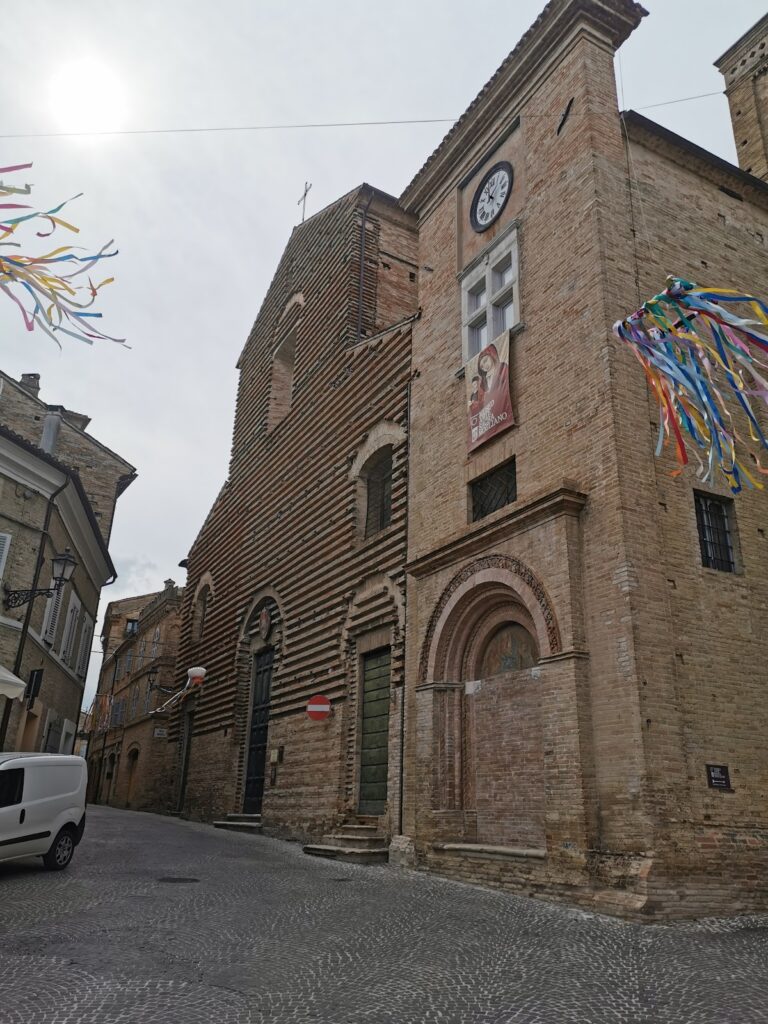
When the church was chosen for cathedral status, it was completely rebuilt in the early 1820s at the initiative of Bishop Vincenzo Maria Strambi. Giuseppe Lucatelli initially directed the project, followed by Count Spada of Macerata. The new Neoclassical church was given the opposite orientation from its Gothic predecessor, turning the former apse into the site of the present entrance.
Strambi’s chapel was renewed after his canonization by Pope Pius XII in 1950. Pope John XXIII elevated San Catervo to the status of a minor basilica in January 1961. A minor basilica is a Catholic church granted a special papal distinction because of its religious, historical, or pastoral importance.
Excavations carried out between 1989 and 1993 exposed the remains of the earliest funerary chapel and fragments of its decoration. The 2016 earthquake in central Italy severely damaged the basilica. Restoration work carried out afterward revealed medieval pillars that had supported the vaults, around which the nineteenth-century pillars had been built.
Remains
San Catervo has a Latin-cross plan, three aisles, and two chapels on opposite sides of the transept, the cross-arm of a church. This three-aisled arrangement preserves the basic layout of the former large Benedictine church, while the Neoclassical rebuilding altered its direction and created the present entrance in the position of the earlier apse.
Early Christian and medieval remains
The funerary chapel
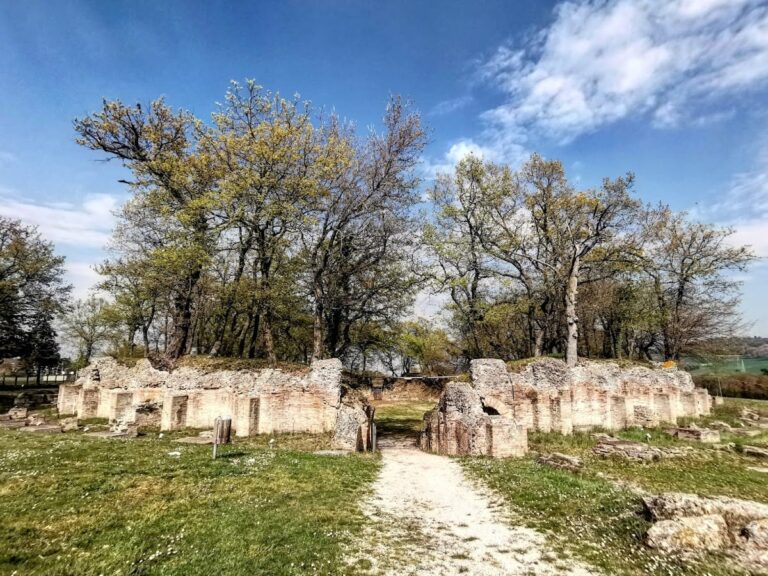
Beside the apse, a doorway leads to the excavation area of the fourth-century funerary chapel. Its foundations can be seen beneath a glass floor, together with fragments of its early decoration. Excavation also uncovered an important ninth- or tenth-century fresco fragment showing the Wise Virgins, linking the area to the medieval use of the site.
The room called the prison of San Catervo
Another room is traditionally called the “prison of San Catervo,” because it was believed to have been the place of his martyrdom. The room was actually built after the funerary chapel. Its surviving frescoes date from the late fourteenth or early fifteenth century and include saints, the Madonna and Child, and illusionistic details such as a painted hanging cloth.
Medieval church elements
Several parts of the medieval church survive within or beside the rebuilt structure. These include the Romanesque portal, a medieval entrance characterized by massive construction and rounded arches, the 35-metre-high bell tower, and portions incorporated into the chapel of San Catervo. Restoration after the 2016 earthquake also exposed the medieval pillars around which the later pillars had been constructed.
Chapel of San Catervo
Sarcophagus and earlier furnishings
The chapel of San Catervo, formerly the Chapel of the Holy Trinity, is a surviving component of the medieval church that was modified in 1927. It contains the fourth-century Roman marble sarcophagus of Flavius Julius Catervius, transferred from the funerary chapel. The original setting was an altar faced with geometric marble panels. Before the 1927 alterations, the chapel had a terracotta floor and a lower wall zone decorated with painted textile motifs.
Fresco decoration
Marchisiano di Giorgio painted the walls and pointed cross-vault of the chapel for the Confraternity of San Catervo, with the commission documented in 1502. A cross-vault is formed by the intersection of two vaulted surfaces, while an ogival vault uses pointed arches. The frescoes reflect influences from Perugino and Pinturicchio.
The principal scenes include a Madonna enthroned with the Child and Saints Catervo and Sebastian, the Adoration of the Magi, and the Crucifixion. The enthroned Madonna scene has been interpreted as containing possible portraits, with Saint Sebastian perhaps representing Giorgione and Saint Catervo perhaps representing Giulio Campagnola. These identifications remain uncertain.
The Adoration of the Magi fills the left lunette and includes a broad landscape. It was damaged at an uncertain date when a window was inserted. The right wall carries a detailed Crucifixion with numerous figures, including a possible portrait of Giovanni Battista Rutiloni and a young man in a black hat who may be a self-portrait of the painter.
The vault shows the Evangelists at the centres of its compartments, with Sibyls beside and below them. Sibyls are prophetic female figures from classical religious tradition who were later included in Christian artistic programs. The unusually large number of Sibyls gives this decoration a distinctive character.
Chapels, baptistery, and exedrae
Chapels on the right
The first chapel is dedicated to Saint Giles and contains an altarpiece of the saint by Emidio Pallotta, an example of academic classicism. The second chapel, dedicated to Saint Joseph, contains Alcide Allevi’s nineteenth-century Transit of Saint Joseph, whose rigorous Neoclassical drawing, restrained emotion, and bright coloring shape the work.
The baptistery opens from the right wall and contains a seventeenth-century painting of the Baptism of Christ. The third chapel is dedicated to Saint Vincenzo Maria Strambi and has his portrait on the altar.
Exedrae
The right exedra, a recessed architectural space, contains a thirteenth-century wooden figure of the Deposed Christ. The left exedra has a relief bronze altar frontal and a 1954 Blessing Christ by Luigi Galli.
Chapels on the left
The third chapel on the left is the Chapel of Carmel. Its 1898 altarpiece of Saints John of the Cross and Teresa of Avila was painted by Francesco Ferranti. The second left chapel is dedicated to the Sacred Heart and contains a Sacred Heart altarpiece attributed either to Alcide Allevi or to his pupil Girolamo Capoferri, set within an eighteenth-century frame.
The final chapel is dedicated to Saint Blaise and contains Gaetano Giorgini’s 1829 painting of Saints Blaise, Lucy, and Apollonia.
Presbytery and apse
Choir and altar painting
The presbytery contains a modern wooden choir incorporating elements from the former fifteenth-century choir. In the apse, Filippo Spada’s The Assumption with Saints Nicholas of Tolentino, Settimia, Catervo, Thomas of Tolentino, and Nicholas is signed and dated 1827.
Nearby sites