Fiesole Cathedral: The Episcopal Church of Fiesole


Site at a Glance
- Rating
- 4.6
- Popularity
- Low
- Country
- Italy
- Primary era
- Medieval
- Eras represented
- Medieval, Early Modern, Modern
- Civilizations
- Grand Duchy of Tuscany, Holy Roman Empire, Italian, Republic of Florence
- Site type
- Religious
- Remains
- Cathedral
On this page20 sections
History
Fiesole Cathedral is the episcopal church and seat of the Diocese of Fiesole in Fiesole, Italy. Formally known as the Cathedral of San Romolo, it is dedicated to Saint Romulus, who is regarded as the evangelizer of Fiesole. The cathedral was transferred in 1028 to a new site within the city walls by Bishop Jacopo of Bavaria, establishing the medieval church whose Romanesque character still defines the monument.
Relocation and Medieval Enlargement
The earlier cathedral stood lower on the hill near the Badia. Tradition identified that church with the place of Saint Romulus’s martyrdom. After the episcopal seat moved, the former cathedral became the Badia di Fiesole, a Benedictine monastery governed by the Rule of Saint Benedict. The monastery remained associated with the earlier religious foundation until it was closed in 1778.
Fiesole Cathedral was enlarged during the thirteenth century. Inscriptions dated 1201, 1256, and 1260 record work from this period, including one placed on the fifth column of the right nave. The bell tower dates from 1213. Further work took place in the fourteenth century under Andrea Corsini, adding to the cathedral’s medieval development.
Renaissance Changes and Later Restoration
In 1584, Bishop Francesco Cattani da Diacceto ordered the relics of Saint Romulus to be moved from the crypt to a new monumental altar of inlaid marble in the raised presbytery. Alessandro Fei painted the altarpiece for this altar. It was later removed and is now preserved in Santa Maria Primerana. Fei also painted the late sixteenth-century fresco cycle devoted to the Stories of Saint Romulus in 1589 for Bishop Cattani da Diacceto, with funding from Ludovico. The paintings, once attributed to Nicodemo Ferrucci, were restored in 2019 and are now identified as works by Fei del Barbiere.
The cathedral received additional alterations and embellishments in subsequent centuries. Its bell tower was rebuilt in the eighteenth century and acquired projecting Guelph merlons in 1739. The new sacristy was also built during that century. Between 1878 and 1885, a state-funded restoration supervised by the Civil Engineers of Florence radically altered the building and included the complete rebuilding of the facade. A monument near the presbytery commemorates Bishop Corsani, who promoted this nineteenth-century restoration.
Continuing Religious Use
Fiesole Cathedral remains an active Roman Catholic cathedral. Its later history includes the installation of the Mascioni organ, opus 466, built in 1933 and 1934. The same firm enlarged it between 1999 and 2000, increasing its number of stops from 50 to 63. The cathedral is recognized as a Romanesque monument and measures approximately 55 metres in length and 27 metres in width, with a central nave about 11 metres wide.
Remains
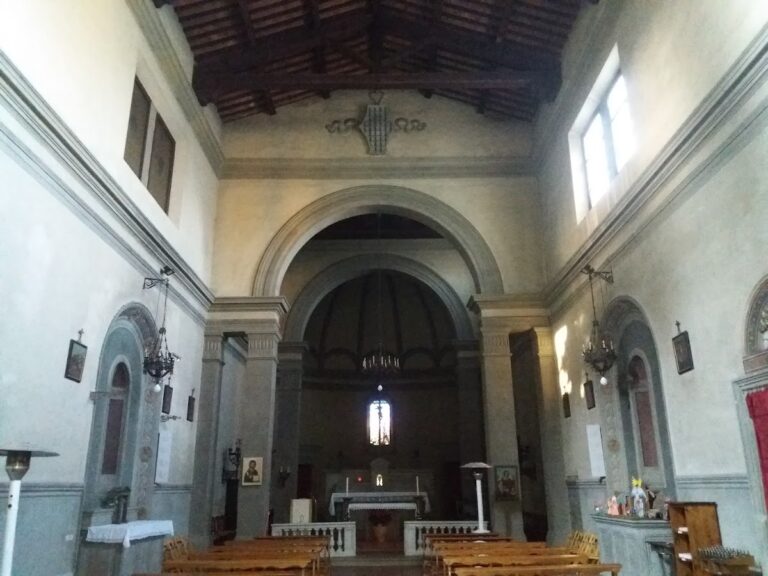
The cathedral combines a Romanesque exterior of partly squared stone blocks with a basilica plan, in which a central nave is flanked by two parallel aisles. Stone columns divide the interior spaces, while a timber roof with trusses covers the church. The raised presbytery stands above the crypt, and a single apse with a semi-conical roof completes the eastern end. The principal features are arranged between the facade, the nave and aisles, the presbytery, the chapels, and the lower crypt.
Exterior and Bell Tower
Facade and Side Elevation
The facade stands on a small adjoining square and has a three-part profile with three principal portals. Each portal has carved wooden doors with rectangular panels and a semicircular lunette. The central lunette contains a relief of three semicircular arches carried by small columns with carved capitals. Above the central portal, a cornice forms a small gable-like projection, topped by a splayed circular rose window. The flank facing Piazza Mino contains a small portal and two tiers of single-light windows. The facade is partially restored.
Romanesque Bell Tower
Behind the church and offset to the left is the rectangular Romanesque bell tower, whose summit reaches 42.30 metres. Its belfry has two levels of openings, with single-light windows on the lower level and double-light windows above. Five bells tuned to E3 were cast in 1855 by Terzo Rafanelli of Pistoia. The large bell hangs on the upper level, while four smaller bells occupy the openings below. A further small bell is placed beside the largest bell, although its history is unknown. Projecting Guelph merlons crown the tower.
Nave and Presbytery
Nave Furnishings and Sculpture
The central nave contains a marble inlaid altar frontal dated 1273, a fresco of Saint Benedict from approximately 1420, and a painting of Saint Sebastian from the school of Pietro Perugino, dating to the beginning of the sixteenth century. Terracotta busts of the twelve Apostles line the side-aisle walls. They were originally finished to imitate bronze and were probably made in the late sixteenth century by workshops associated with Valerio Cioli, Andrea di Michelangelo Ferrucci, Giovanni Caccini, and other masters.
A wooden chair associated with Saint Andrew Corsini, made by Pietro di Lando in 1371, is preserved in a niche in the left aisle wall. At the end of the central nave, the post-conciliar high altar is accompanied by an ambon, a raised platform for reading scripture, made by Paolo Annibali.
Raised Presbytery
The raised presbytery contains a Late Gothic altarpiece commissioned from Bicci di Lorenzo in 1450. Its imagery presents the Madonna and Child enthroned between two angels, with Saint Alexander and Saint Peter, Saint Donatus and Saint Romulus, an Evangelist, and Saint John the Baptist. The smaller side altars have Neo-Gothic triptychs, paintings made in three panels, produced in 1886 by Demostene Macciò and Pietro Pezzati.
Apse Frescoes
The semicircular apse has a basin decorated with the late sixteenth-century Stories of Saint Romulus. The cycle is arranged horizontally in two registers of five scenes, surmounted by a Glory of Saint Romulus. The paintings were associated with the altarpiece originally made for the 1584 marble altar, which is now preserved outside the cathedral in Santa Maria Primerana.
Presbytery Chapels and Sacristies
Salutati Chapel
The funerary chapel of Bishop Leonardo Salutati contains his 1466 marble tomb monument by Mino da Fiesole. The monument takes the form of a finely carved sarcophagus highlighted with gold and includes a realistic portrait bust set on a bracket. Opposite it is a marble dossal, a decorated panel behind an altar, showing the Madonna adoring the Child between Saints Leonardo and Remigius, with the head of the Savior above. Both works bear the signature opus Mini.
Cosimo Rosselli painted the chapel’s fresco decoration, probably by 1466. The Evangelists appear in the vault, while Saints Leonardo and John the Baptist occupy the rear wall.
Chapel of the Blessed Sacrament
The Chapel of the Blessed Sacrament has nineteenth-century decoration. It contains copies of both sides of a painting from the school of Ghirlandaio, showing episodes from the life of Saint Romulus and Saint Romulus among his companions. The original is preserved in the crypt.
Canon’s Chapel and New Sacristy
The Canon’s Chapel beside the presbytery was formerly a fourteenth-century sacristy. Its frescoes were painted at the end of that century or the beginning of the fifteenth, and it contains a marble dossal by Andrea Ferrucci made between 1492 and 1494. The eighteenth-century new sacristy contains Bishop Salutati’s mitre and a reliquary bust of Saint Romulus commissioned from Francesco Cattani da Diacceto in 1585.
The counterfacade contains a monumental statue of Saint Romulus enthroned, made by Giovanni della Robbia in 1521.
Crypt and Relics
Structure and Medieval Furnishings
A staircase leads to the crypt beneath the raised presbytery. Slender columns support it, and their eleventh-century capitals may have been reused from the first construction. The vault has painted medallions from the Late Gothic and Neo-Gothic periods. On the left side is the original panel of the Stories and Martyrdom of Saint Romulus from the Ghirlandaio school, while the Chapel of the Blessed Sacrament above contains copies of this work.
The bishops’ funerary chapel contains a thirteenth-century icon of the Madonna and Child by the anonymous painter conventionally called the Master of the Bigallo. Probably made around 1215 to 1220, the work is identified as the cathedral’s oldest icon. Known as the Madonna of Help, it stood until 1790 on an altar at the right side of the crypt. That altar was demolished to make room for a granite baptismal font by Francesco Ferrucci del Tadda.
Relics and Later Decoration
An iron grating dated 1349 closes the apsidal part of the crypt. It was made by the Sienese craftsmen Petruccio di Betto and his son Francesco. The relics of Saint Romulus are kept in this area. In 1488, the crypt was renovated at the expense of the Romoli family, who sponsored a new marble altar, the painting of the vault above it, and lunettes on the walls with Stories of Saint Romulus. These frescoes are severely deteriorated because of damp and are attributed to a painter from the circle of Cosimo Rosselli.
Mascioni Organ
The Mascioni organ is electronically operated and arranged in two bodies. Its elevated principal body stands against the end of the left transept arm, while a second body rests on the floor in the apse. Two consoles, each with three manuals and a pedalboard, are located in the raised presbytery.
Nearby sites