Convent of San Domenico: A Dominican Religious Complex in Fiesole


Site at a Glance
- Rating
- 4.5
- Popularity
- Low
- Country
- Italy
- Primary era
- Medieval
- External website
- Open
- Eras represented
- Medieval, Early Modern
- Civilizations
- Grand Duchy of Tuscany, Republic of Florence
- Site type
- Religious
- Remains
- Monastery
On this page21 sections
History
The Convent of San Domenico is a Dominican religious complex in Fiesole, Italy, founded in 1406 between Fiesole and Florence by Giovanni Dominici and Jacopo Altoviti, bishop of Fiesole. Both founders were friars of Santa Maria Novella. The complex developed during the early Renaissance and became an important centre for Dominican religious life, education, and artistic patronage in the Florentine area.
Foundation and Dominican formation
Construction was interrupted in 1409 and resumed in 1418 through the patronage of Barnaba degli Agli. The church was completed and consecrated in 1435. Known as Il Conventino, or “the little convent,” in contrast with the larger Santa Maria Novella, it was the second Dominican convent established in the Florentine area.
The friars later transferred to San Marco in Florence around the middle of the fifteenth century, but San Domenico retained an important role in Dominican formation. It became a training centre for young friars, including Antonino Pierozzi, later known as Antoninus of Florence. He became archbishop of Florence and was subsequently canonized.
Fra Angelico and the convent’s artistic life
Fra Angelico, the fifteenth-century Dominican friar and painter, lived at the convent and created works for both the religious community and its church. His paintings included the Fiesole Altarpiece, the Annunciation, and the Coronation of the Virgin. These commissions connected the convent with the development of early Renaissance religious painting and with the devotional life of the Dominican community.
The Napoleonic suppressions dispersed or removed several works associated with the complex. The Fiesole Altarpiece remains at the convent, although it is displayed in a different position from the one for which it was originally made. Other paintings were transferred to collections in Italy and elsewhere in Europe.
Expansion and later changes
The church was enlarged between 1488 and 1592 through the construction of side chapels. These additions reflected the continuing involvement of Florentine and Dominican patrons. The nave vault was completed in 1685, and its decoration was added in the early eighteenth century.
The first Napoleonic suppression in 1810 began a period of decline, followed by the sale of the convent to Carlotta Barbolani di Montauto. A small number of friars returned in 1817, but a further suppression in 1866 interrupted Dominican possession once more. The order returned permanently in 1879 after repurchasing the convent from the Capponi and Martelli families.
The complex in the modern period
Arnold Böcklin spent the final years of his life near the monastery. The convent continues to belong to the Dominican Order and remains a Catholic religious institution within the Diocese of Fiesole. Since 2016, parts of the complex have also housed the Language Centre, Human Resources Service, and part of the Budget and Financial Affairs Service of the European University Institute. The complex is recognized as an Italian cultural property.
Remains
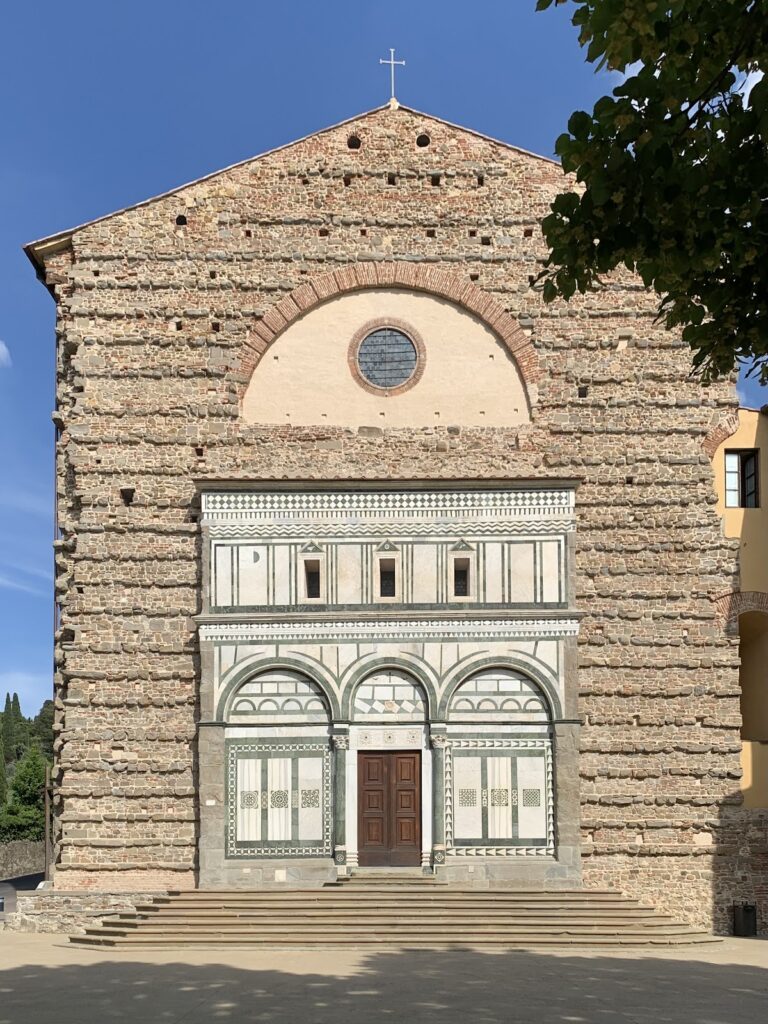
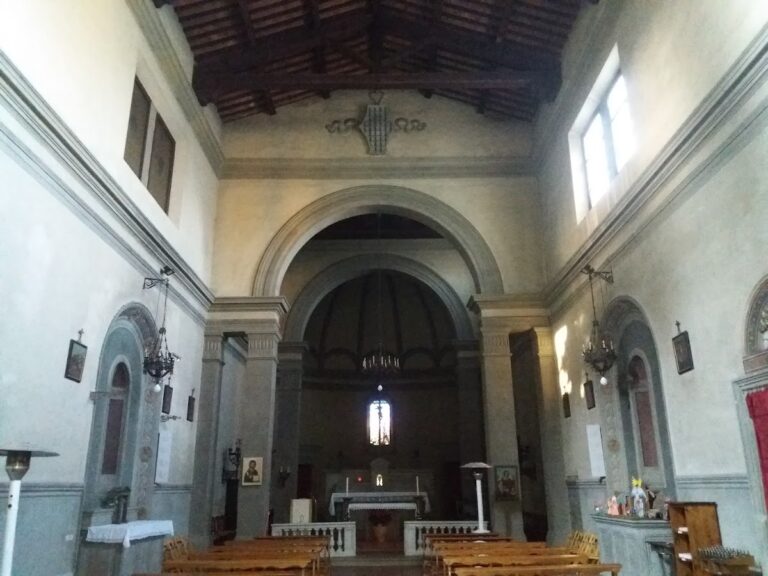
The church has a restrained facade, a single-nave interior, and a sequence of side chapels built mainly between the late fifteenth and sixteenth centuries. Later additions include a portico, bell tower, presbytery, painted vault, and gilded wooden tabernacle. The chapels preserve paintings, sculpture, inscriptions, and altered frames that reflect the convent’s long history of Dominican devotion and private patronage.
Facade, tower, and nave
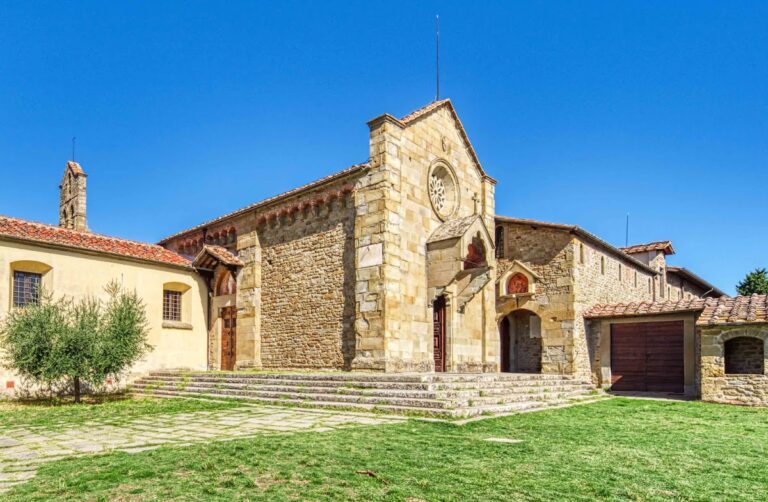
Entrance portico and bell tower
The entrance portico was built in 1635 by Andrea Balatri and funded by Alessandro and Antonio di Vitale de’ Medici, Jewish converts protected by the Medici. By Medici concession, they were allowed to use a coat of arms identical to that of the Medici. Balatri also built the bell tower between 1611 and 1613, giving the exterior complex its principal seventeenth-century additions.
Vault and counterfacade
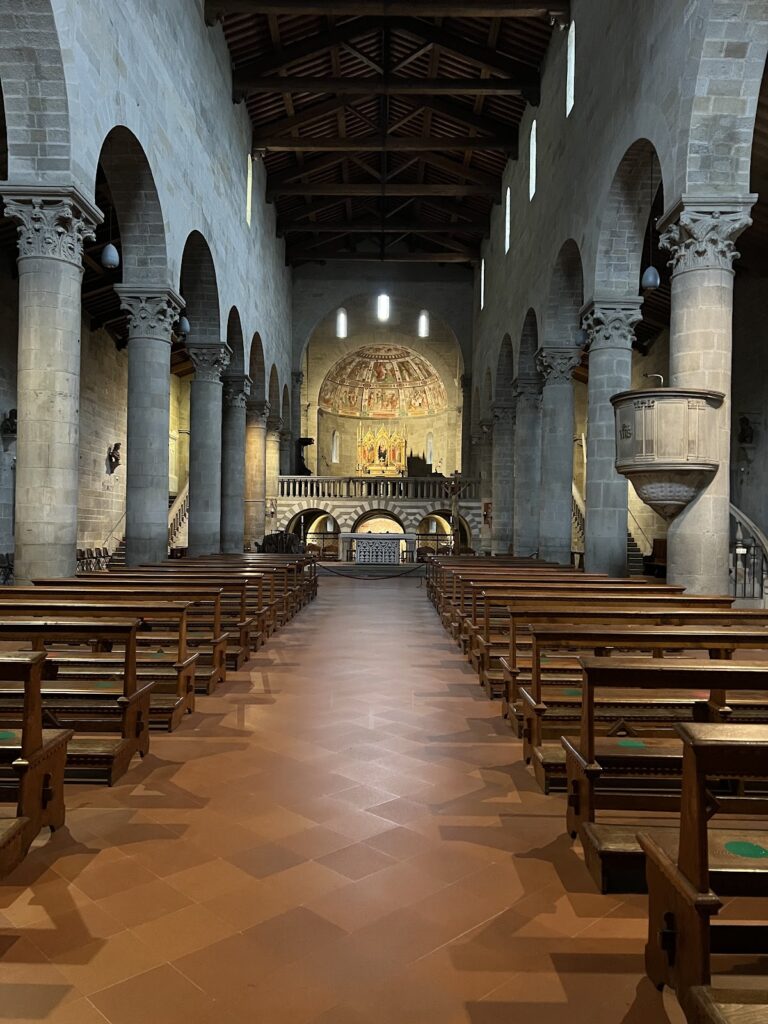
The church interior has a single nave with side chapels whose arches carry classicizing reliefs. The nave vault, completed in 1685, was frescoed in 1705 by Matteo Bonechi with the Glory of Saint Dominic. Rinaldo Botti and Lorenzo del Moro painted its illusionistic architectural framework and ornament, a technique known as quadratura, which creates the appearance of architectural structures on a flat surface. The same painters decorated the triumphal arch with Saint Dominic Receiving the Rosary from the Madonna.
The counterfacade contains plaques commemorating the Dominican friar Angelo Cattani da Diacceto, who became bishop of Fiesole in 1566, and Fra Bernardo di Simone del Nero, nephew of Pope Leo XI. Above the plaques are Cristofano Allori’s Saint Francis at Prayer, Giovanni Montini’s Saint Dominic, and Pier Dandini’s Madonna Interceding with Jesus.
Right-hand chapels
Chapel of Saint Dominic
The first chapel on the right, dedicated to Saint Dominic, was built around 1490 to 1495 by Melchiorre Dazzi. It contains a fourteenth-century wooden Crucifix from the Badia Fiesolana. A panel of the Crucifixion between the Virgin and Saint Jerome, attributed to Jacopo del Sellaio, hangs on the left wall and was deposited by the Florentine Galleries.
Chapel of the Madonna and Child
The second right-hand chapel was built in 1493 after Cornelia di Giovanni Martini commissioned it in 1488. Perugino’s Madonna and Child Enthroned between Saints John the Baptist and Sebastian was painted for this chapel. Grand Duke Peter Leopold acquired it in 1786, and it is now in the Uffizi. An early nineteenth-century copy by Garibaldo Ceccarelli hangs in the chapel.
In 1786, Lorenzo di Credi’s Baptism of Christ replaced the Perugino panel. The painting had originally been made around 1490 to 1495 for the church of the Compagnia di San Giovanni Battista, known as the Scalzo. Its treatment of the subject was strongly influenced by earlier works by Verrocchio and Leonardo.
Chapel of Saint Antoninus
The third right-hand chapel was built between 1588 and 1592 by the Genoese Dominican Cipriano da Brignole and his family. Their commissioned Miracle of Saint Antoninus by Giovanni Battista Paggi was stolen in 1850. The original frame, which bears the family coats of arms, now contains Fabrizio Boschi’s Saint Antoninus as a Young Man Presented to Giovanni Dominici, painted around 1615 to 1617.
Left-hand chapels and presbytery
Chapel of the Annunciation
The chapels on the left were financed by the Gaddi family. The third chapel, nearest the presbytery, is dedicated to the Annunciation. It formerly housed Fra Angelico’s Annunciation, which was sold to Duke Mario Farnese in 1611 and is now in the Prado. Jacopo Chimenti, known as Empoli, replaced it with another Annunciation dated 1615.
The right wall contains a late-fifteenth-century wooden Crucifix by Antonio da Sangallo the Elder, probably transferred from the Oratory of the Santissima Annunziata on Via della Chiesa in Florence. On the left wall is Francesco Conti’s Saint Antoninus Resurrecting a Child of the da Filicaia Family, formerly in the Da Filicaia Chapel at San Pier Maggiore and donated in 1930.
Gaddi Chapel of the Adoration
The second chapel on the left was completed in 1559 by Niccolò Gaddi, a nobleman associated with Cosimo I and a major collector. It contains Giovanni Antonio Sogliani’s Adoration of the Magi, commissioned by Niccolò’s father, Sinibaldo, and begun in 1515. The painting remains in its late-sixteenth-century frame. It may have been completed by the young Santi di Tito, who may also have painted the portraits of Gaddi family members at the sides.
Chapel of the Coronation
The first chapel on the left was erected by Taddeo di Angelo Gaddi and dedicated to the Coronation. It formerly held Fra Angelico’s Coronation of the Virgin, now in the Louvre. Its present altarpiece is Fra Angelico’s Madonna and Child with Saints Thomas Aquinas, Barnabas, Dominic, and Peter Martyr, which was formerly on the high altar and dates approximately to 1419 to 1421.
The work was originally a triptych, or altarpiece with three painted sections. Lorenzo di Credi converted it into a square altarpiece in 1501 and later modernized its sky. The changes preserve evidence of how a major early Renaissance work was adapted to a later interior and devotional arrangement.
Presbytery and altar
A serliana, a three-part opening with a central arch and lower rectangular openings at the sides, introduces the presbytery. Giovanni Caccini added the presbytery in 1606, replacing the fifteenth-century structure, and a second serliana separates it from the choir behind. The high altar is dominated by a monumental gilded wooden tabernacle made by Andrea Balatri between 1611 and 1617 and decorated with statues of Dominican saints.
The high altar also holds Lorenzo Gelati’s nineteenth-century Madonna of the Rosary in a seventeenth-century frame possibly made for Fra Angelico’s Coronation of the Virgin.
Chapter house and dispersed works
Chapter house frescoes
The chapter house contains Fra Angelico’s frescoed Crucifixion, dating from around 1430, together with a fresco of the Madonna and Child and its sinopia. A sinopia is an underdrawing made on the preparatory plaster beneath a fresco. Both works probably date from the 1430s. The convent is also associated with a fresco known as the Madonna of the Blessing, whose sinopia was transferred to canvas and exhibited in the chapter house.
Fiesole Altarpiece and related paintings
Fra Angelico’s former Fiesole Altarpiece included a five-panel predella, the narrative strip beneath an altarpiece, showing the Resurrection with approximately 300 figures. Its outer panels included 24 Dominicans, probably painted with assistance from Fra Angelico’s brother Benedetto. The predella is now in the National Gallery in London. Saints from its lateral panels are in the Musée Condé at Chantilly and the Hawkins-Jones collection in Sheffield, while other figures are held in separate collections.
Two quatrefoils from the upper part of the altarpiece, the Announcing Angel and the Announced Virgin, are in a Vienna collection. Other works formerly associated with the convent include Fra Angelico’s Crucifixion with the Mourning Figures and Saint Dominic from the refectory, now in the Louvre; his Annunciation, now in the Prado and dated around 1425 to 1426; his Coronation of the Virgin, now in the Louvre; and his Madonna and Child between Saints Dominic and Thomas Aquinas, now in the Hermitage in Saint Petersburg. The latter fresco measures 196 by 184 centimetres.
The convent also formerly held Perugino’s Madonna and Child Enthroned between Saints John the Baptist and Sebastian, an oil painting on wood measuring 178 by 164 centimetres and now in the Uffizi. Other works associated with the complex include a Crucifixion with the Virgin, Saint John, and Saint Dominic; a wooden Crucifix attributed to Antonio da Sangallo the Elder; and Savonarola and Two Companions Pointing Florence toward Christ and the Virgin, attributed to Zanobi Poggini.
Nearby sites