Basilica of Our Lady of the Assumption: Cathedral of Teramo


Site at a Glance
- Rating
- 4.6
- Popularity
- Medium
- Country
- Italy
- Primary era
- Medieval
- External website
- Open
- Eras represented
- Medieval, Early Modern
- Civilizations
- Kingdom of Naples, Kingdom of Sicily
- Site type
- Religious
- Remains
- Cathedral
On this page16 sections
History
The Basilica of Our Lady of the Assumption is the Roman Catholic cathedral of Teramo, Italy, begun in 1158 in the Romanesque period under Bishop Guido II. It stands in the historic center along the route of the ancient Roman cardo and serves as the cathedral of the Diocese of Teramo-Atri. Dedicated to the Assumption of the Virgin Mary and Saint Berardo of Pagliara, Teramo’s patron saint, it was built to house Saint Berardo’s relics after the earlier Cathedral of Santa Maria Aprutiensis and much of the city were destroyed by Count Robert III of Loritello in 1155–56.
The Romanesque foundation
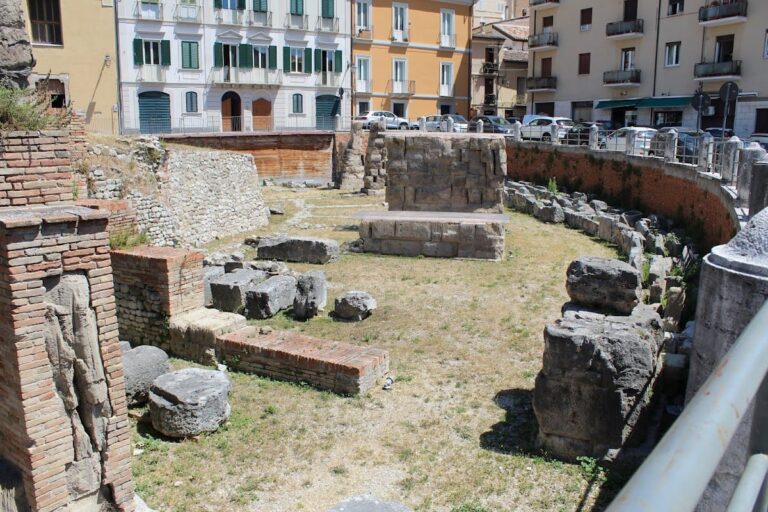
Construction began on the new cathedral in 1158, and the building was completed in 1174 and consecrated in 1176. Its first form had three naves, a raised presbytery, a roof supported by timber trusses, and a central octagonal tiburium, a raised polygonal structure emphasizing the central part of a church. Worked stone from the neighboring Roman theatre and amphitheatre was reused in the construction. Part of the amphitheatre was demolished to create space for the cathedral.
The new church initially carried Saint Berardo’s association especially closely because the building was intended to receive his relics. The earlier cathedral’s destruction had created the need for a new ecclesiastical center, and Guido II’s campaign established the Romanesque core that later bishops would repeatedly enlarge and reshape.
The Gothic extension
Between 1331 and 1335, Bishop Niccolò degli Arcioni substantially altered the cathedral by extending it northward. The new body was slightly misaligned with the older structure and occupied the level of the former presbytery. It replaced the earlier three apses and introduced a Gothic phase with tall pointed arches, a second stepped-gable facade, and a false door on the side opposite the original entrance.
The new portal was completed in 1332 and bears the name of Deodato Romano. Its sixteenth-century wooden doors were later destroyed and replaced by reproductions made by Luigi Cavacchioli in 1911. Further changes followed in the second half of the fifteenth century, when a large Gothic triangular gable was placed above the portal. The gable carried statues of the blessing Redeemer, John the Baptist, and Saint Berardo.
Early modern changes
The cathedral continued to change as its liturgical and architectural needs developed. Construction of a New Sacristy began in 1586, and it was completed sufficiently for the old sacristy, positioned between the organ and the bell tower, to be abandoned in 1594.
During the episcopate of Tommaso Alessio de Rossi, which lasted from 1731 to 1749, the interior underwent a major Baroque transformation. The Romanesque columns and six bays were replaced by pillars supporting two domes. The roofs over the side aisles were raised and reduced to two slopes, stucco decoration was introduced, and smaller portals were opened beside the main entrance. The monumental Chapel of San Berardo was also constructed during this campaign.
Restoration and renewed identity
Between 1932 and 1935, restoration directed by superintendent Riccoboni sought to recover a medieval appearance. The work involved the almost complete reconstruction of the Romanesque core attributed to Guido II. From 1935 to 1948, attached shops, houses, and buildings used for canonry services were demolished around the cathedral. Among them was the house where the poet Giannina Milli was born.
Bishop Antonio Micozzi reopened the cathedral for worship on 29 September 1933 and formally dedicated it to Santa Maria Assunta. Pope John Paul II reaffirmed this title in a decree of 30 September 1986, which also confirmed Teramo as the seat of the Diocese of Teramo-Atri. The cathedral became a national monument by royal decree on 21 November 1940 and was raised to the rank of minor basilica by Pope Pius XII on 30 May 1955.
In 1969, superintendent Mario Moretti completed the isolation of the cathedral by demolishing the Arco di Monsignore, a connection built in 1738 between the cathedral and the bishop’s palace. The bell tower also required a concrete plinth for consolidation. The nearby Canon’s Well was demolished after being judged a later addition to a medieval structure, while its four supporting lions were preserved and transferred to the monumental staircase.
A later restoration lasting three years culminated in the reopening of the cathedral for worship on 8 September 2007. The work brought to light the crypt dedicated to Saint Berardo, a passage leading from the crypt toward Piazza Martiri della Libertà, and remains of earlier buildings beneath the floor near the main entrance. Saint Berardo’s relics, formerly kept in the crypt, are now housed in his chapel. Other burials include the civic historian Muzio Muzij, the politician and scholar Principio Fabricii, the philosopher and politician Melchiorre Delfico, members of the Delfico family, and numerous bishops in the burial area beneath the apse.
Remains
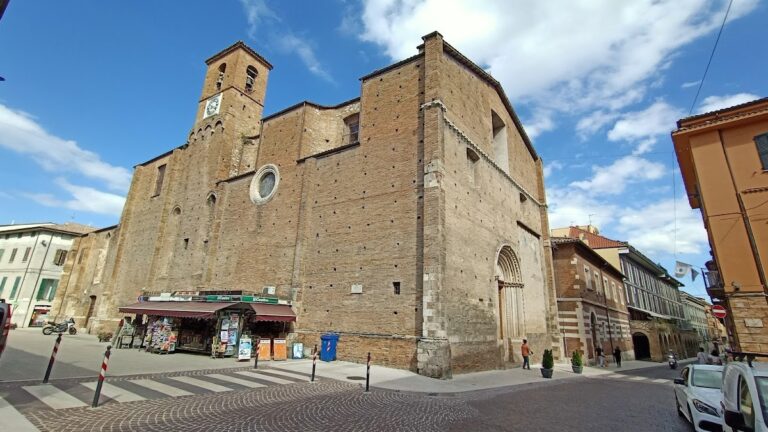
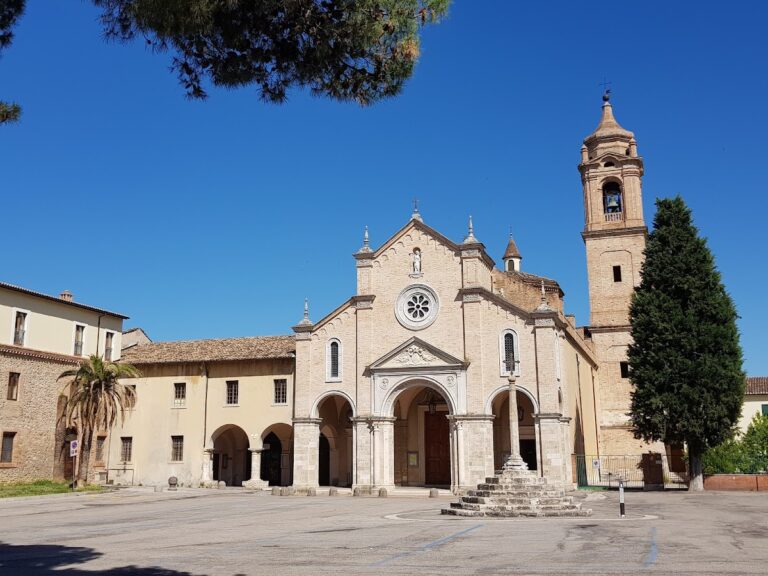
The cathedral combines a Romanesque core with a Gothic northern extension and Baroque interior elements. Its rectangular stone-and-brick facade faces the principal approach, while the later extension stands at a slight angle to the earlier building. The surviving walls incorporate carved stones taken from the Roman theatre and amphitheatre, and the bell tower rises on the right side at the junction between the two principal medieval building phases.
Facades and exterior fabric
Main portal
The principal portal, completed in 1332, is round-headed and deeply splayed. Three projecting orders frame the opening, with two twisted columns on each side. Bands of Cosmatesque decoration, a medieval Italian technique using geometric patterns of colored stone and glass or marble tesserae, enrich the portal. An inscription identifies Deodato Romano as its maker and gives the date of completion.
Additional columns rest on supporting lions beside the entrance and carry statues of the Annunciation Angel and the Virgin Mary. These sculptures are attributed to Nicola da Guardiagrele or to a follower. The architrave bears the arms of Bishop Niccolò degli Arcioni between the arms of Atri and Teramo, linking the portal to the bishop’s Gothic building campaign and to the cathedral’s regional ecclesiastical setting.
Gothic gable and false door
The rectangular facade has an upper profile with Ghibelline merlons, swallowtail-shaped battlements traditionally associated with the medieval faction linked broadly to imperial authority in Italy. Above the portal is the large Gothic triangular gable added during the second half of the fifteenth century. A round window occupies its center, while an upper niche contains a statue of the blessing Redeemer. Pointed side niches hold statues of John the Baptist and Saint Berardo.
The northern Gothic extension retains a second stepped facade and a false door that was never opened. The extension stands at the level of the former presbytery and contains tall pointed arches. On the false door facing Piazza Martiri della Libertà, a sculpture of the Annunciation by Venanzo Crocetti is installed below a second work by the same artist depicting the Madonna and Child in a semicircular niche.
Reused Roman stone
Worked blocks from the Roman theatre and amphitheatre remain visible in the cathedral walls. Among the reused elements are reliefs with weapon friezes, an inverted relief showing a helmet, and other carved pieces that were re-employed or displaced on the exterior walls of both side elevations. Their presence reflects the material reuse incorporated into the medieval construction.
Bell tower
The bell tower is approximately 50 meters high and stands on the cathedral’s right side. Its lower section was built between the twelfth and thirteenth centuries, its middle section belongs to the fourteenth century, and its elaborate octagonal crown was created in 1493 by the Lombard architect Antonio da Lodi. String courses divide the tower into superimposed sections. Bifora windows, paired-arched openings divided by a central support, appear in the third and fourth sections, while the fifth and sixth contain the bell chambers.
Above the upper bell chamber, Antonio da Lodi created a terrace with decorated turrets at its four corners. An octagonal prism rises from the terrace and ends in a pyramidal roof, a metal sphere, and a weather vane. Bifora openings pierce its lower level, while the upper level has round openings surrounded by polychrome decoration.
The tower contains seven bells. Five larger bells operate electrically with swinging motion, and two function as clock bells. The largest, named Aprutina, has been recast several times and was last recast in 1930 by the Colbachini foundry of Padua. The two clock bells date from 1830. One bell in the upper chamber was cast by Francesco Franceschi in 1622, while the three smaller bells are attributed to the Mari foundry of Torre de’ Passeri.
Chapel and interior furnishings
Chapel of San Berardo
The monumental Chapel of San Berardo projects outward toward the Aprutine Seminary and is covered by an irregular octagonal tiburium with merlons. Its interior retains stucco decoration and pendentives, making it the one part of the cathedral where the result of the eighteenth-century Baroque remodeling remains visible. The chapel also houses the relics of Saint Berardo, which were formerly kept in the crypt beneath the cathedral.
Works associated with Sebastiano Majewski include a tabernacle with a canvas showing miracles of Saint Berardo, a Madonna and Child enthroned, and a painting of the Madonna enthroned with the Child, saints, and the patrons of Teramo, dated 1621–29. The tabernacle canvas dates from 1699 and presents several episodes from the saint’s miracles.
High altar and antependium
The gilded-silver antependium, a decorated frontal panel placed before an altar, was made by Nicola da Guardiagrele and his workshop between 1433 and 1448. It replaced an earlier valuable silver antependium stolen in 1416 during disturbances that followed the accession of Queen Joanna II of Anjou.
The work consists of 35 repoussé and chased silver plates mounted in four horizontal rows on a wooden support. Twenty-two brightly colored translucent-enamel lozenges join the plates at their corners. A silver frame encloses the composition, and an inscription states that the frame dates from a restoration in 1734. The central panel, twice the size of the others, shows Christ the Redeemer with the four Evangelists and four Doctors of the Church. Other panels portray episodes from the life of Christ, beginning with the Annunciation and continuing to Pentecost. The final scene depicts Saint Francis receiving the stigmata.
Polyptych and sculptures
The polyptych by the Venetian painter Jacobello del Fiore consists of 16 richly framed panels arranged in two rows. Its central image shows Christ crowning the Virgin. Beneath that scene is a representation of Teramo enclosed between two rivers forming a Y, an image that later became a symbol of the city.
A polychrome and gilded wooden Crucifix was made by an unidentified central Italian master around the transition from the late fifteenth to the early sixteenth century. Restoration in 2010 removed numerous later layers of paint and plaster, revealing the work’s strongly naturalistic treatment of expression and anatomy.
A polychrome wooden Madonna and Child enthroned dates from the beginning of the fourteenth century and is attributed to the Master of Saint Catherine Gualino. Its elongated figure, flowing drapery, refined colors, and delicately modeled face characterize the sculpture. The work entered the cathedral during the twentieth century after coming from an unspecified location in the Teramo mountains.
Organ and subterranean remains
The Mascioni organ, opus 788, was built between 1955 and 1956 and dedicated to Saint Gabriel of Our Lady of Sorrows in 1956. Its pipes are arranged in two separate bodies in the side naves beside the presbytery. The console has two 61-note keyboards and a 32-note concave-radial pedalboard operated through electric transmission.
Beneath the floor lies the crypt dedicated to Saint Berardo, together with the passage leading toward Piazza Martiri della Libertà. Near the main entrance, remains of earlier buildings survive below the floor. The burial area beneath the apse contains the graves of numerous bishops, while the cathedral also preserves the burials associated with Muzio Muzij, Principio Fabricii, Melchiorre Delfico, and members of the Delfico family.
Nearby sites