Linköping Cathedral: Episcopal Seat and Medieval Cathedral in Sweden


Site at a Glance
- Rating
- 4.6
- Popularity
- Medium
- Country
- Sweden
- Primary era
- Medieval
- External website
- Open
- Eras represented
- Medieval, Early Modern, Modern
- Civilizations
- Swedish
- Site type
- Religious
- Remains
- Cathedral
On this page27 sections
History
Linköping Cathedral is an active Lutheran cathedral and parish church in Linköping, Sweden, and the episcopal seat of the Diocese of Linköping. Dedicated to Saint Peter, it stands opposite the former bishops’ palace, now Linköping Castle. Christian worship has taken place on the site since the eleventh century. Stone construction probably began around 1120, and the building was enlarged through Romanesque and Gothic phases that continued into the late Middle Ages.
Early church and diocese
A wooden cemetery chapel probably occupied the site in the early eleventh century. Excavations in 1915–1916 and 1960, together with Viking Age grave slabs and part of a coffin inscription, indicate that the area was already used for burials and probably had a church or chapel. The surviving fragment of the inscription is in Latin and means “Remember me in your kingdom.”
The first stone church was probably begun around 1120. It was a Romanesque basilica, a church with a central nave and two side aisles, and was approximately half the size of the present cathedral. A document from about the same time records the Diocese of Linköping and names Gislo as its first historically certain bishop.
In 1153, Linköping hosted a regional church council that addressed the building of churches in every parish, the requirement for church marriages, and taxes owed to Rome. The papal representative Nicolas Breakspear attended the council and later became Pope Adrian IV, the only English pope. Linköping also acquired royal and political importance. John Sverkersson was elected and crowned king there in 1219, and from 1220 Birger Jarl served as governor. Birger’s brother Bengt Magnusson later became bishop of Linköping.
Expansion in the thirteenth century
Around 1230–1232, Bishop Bengt authorized a larger cathedral because the earlier church could no longer accommodate the needs of the diocese. He and Birger Jarl secured a letter from Pope Gregory IX appealing to the clergy and parishes of Linköping’s diocese to support the work.
The extension proceeded eastward with a new choir and transept, the crosswise part of a church that projects beyond the nave. These late Romanesque sections survive in the present building. Their carved capitals show connections with Magdeburg Cathedral. The transept was later extended, probably in preparation for the coronation of Birger Jarl’s son, Valdemar Birgersson, as king in 1251.
Builders then began an English-influenced longhouse, probably reaching the third pair of western piers. Craftsmen from Trondheim were among those involved. During the second half of the thirteenth century, German hall churches became another architectural model, and the earlier stone church was gradually dismantled as the enlarged cathedral took shape.
Gothic completion
Between 1308 and 1360, during the episcopate of Bishop Karl, the cathedral was extended westward by two bays, giving it its present length. The western facade was influenced by Cologne Cathedral and was initially planned for two towers. Foundation problems caused the twin-tower scheme to be abandoned, and the facade instead received three portals and a large rose window.
A sacristy was built beside the southern arm of the transept around 1310, although it was demolished in 1747. The western extension also received an ambitious program of Gothic sculpture, probably completed around 1320. Several artists influenced by English High Gothic sculpture worked on the decoration. English, German, and local influences were combined in the late medieval building.
Linköping Cathedral and Vadstena Abbey Church were among the largest building projects in Östergötland during the later Middle Ages. The cathedral attracted pilgrims, and the Diocese of Linköping was one of Sweden’s wealthiest dioceses.
Construction was interrupted around 1420 during the Engelbrekt rebellion, a Swedish uprising against Danish influence and royal government. The unfinished walls were temporarily protected by a gabled roof. Under Bishop Henrik Tidemansson, who served from 1467 to 1500, the choir was completed with a star vault by builders brought from Cologne under the supervision of the Cologne master Gierlach. Adam von Düren, brought to Linköping in 1487, was the last major medieval master builder associated with the work. Under Bishop Hans Brask, the original lead roof was replaced with copper, bringing the long medieval construction process to an end.
Reformation, fire, and rebuilding
The cathedral’s medieval prominence declined after Sweden’s Reformation in 1523, when the country changed from Roman Catholic to Lutheran worship and church administration. Many altars and images were destroyed. Two fires in the spring of 1546 damaged plaster, wall paintings, and window glazing.
In 1567, during the Northern Seven Years’ War, inhabitants burned Linköping while fleeing Danish forces commanded by Field Marshal Daniel Rantzau. The cathedral roof burned, parts of the vaults collapsed, and much of the furnishing was lost. King John III Vasa authorized repairs after entering the city and donated an altarpiece by Maarten van Heemskerck in 1582. Repairs were largely complete by 1596, although the copper roof was replaced with shingles.
A free-standing bell tower south of the cathedral was built in 1623 and demolished between 1747 and 1758. During the same period, a western tower was built to the design of Carl Hårleman, using stone from the demolished sacristy. The old sculpture of Saint Peter was moved beside the northern portal. A new roof installed in the late eighteenth century remained until the twentieth century.
Restoration and continuing use
From 1812, a controversial interior “purification” removed or sold much sixteenth- and seventeenth-century furnishing. The burial area was rearranged, stone window tracery was replaced with cast iron, and stained glass was destroyed. Van Heemskerck’s altarpiece was removed from the high altar and replaced in 1832 by plaster figures made by Johan Niclas Byström.
Carl Georg Brunius later emphasized the cathedral’s architectural importance. August and Johan Robert Nyström carried out extensive restoration between 1849 and 1869, including repairs to all the portals, and changed the roof covering to slate. Helgo Zettervall rebuilt the western tower between 1877 and 1886, giving it its present appearance. Gas lighting was installed in 1888 and replaced by electric lighting in 1932–1933.
Restoration in 1959–1961 introduced a new heating system, cleaned the walls and piers, and included partial floor restoration under Kurt von Schmalensee. Work in 1965–1967 restored the seventeenth-century appearance of the roof and choir turrets and returned copper covering to the roof. In 1986, Bengt Olof Kälde’s stone mosaic was installed in the tympanum of the western portal.
Large-scale work at the beginning of the twenty-first century created underground storage, choir, kitchen, workshop, and related spaces beneath the churchyard. The pulpit was moved two bays westward, choir seating and numerous tomb slabs were rearranged, and an integrated digital system was introduced to control lighting, sound, and bells. The cathedral is protected as a historic ecclesiastical monument under Chapter 4 of Sweden’s Cultural Heritage Act because it was built before 1940. About 6,000 masons’ marks made by masons, stonecutters, and carpenters survive on the building.
The cathedral remains an active Lutheran place of worship and the seat of the bishops of the Diocese of Linköping. Its institutional history is also preserved in its four bells. The smallest, Prästklockan, was cast in 1382 to summon nearby clergy and recast by Johan Åhman in 1778. Storklockan weighs about 5,200 kilograms. It was first cast unsuccessfully in 1667, recast in Linköping, recast again by Elias Fries Thoresson in 1764 after breaking in 1759, and dropped again in 1844 without damage. S:t Larsklockan was cast in 1624 and recast in Norrköping in 1711. Böneklockan was cast in Stockholm in 1693 and recast in Linköping in 1794 and Stockholm in 1914.
Bell ringing was once carried out manually by seven bell-ringers, later electrically, and since 2003 through the integrated digital system. The bells continue to be used for services, baptisms, weddings, funerals, major feasts, midday and evening prayer, and commemorations of deceased parish members.
Remains
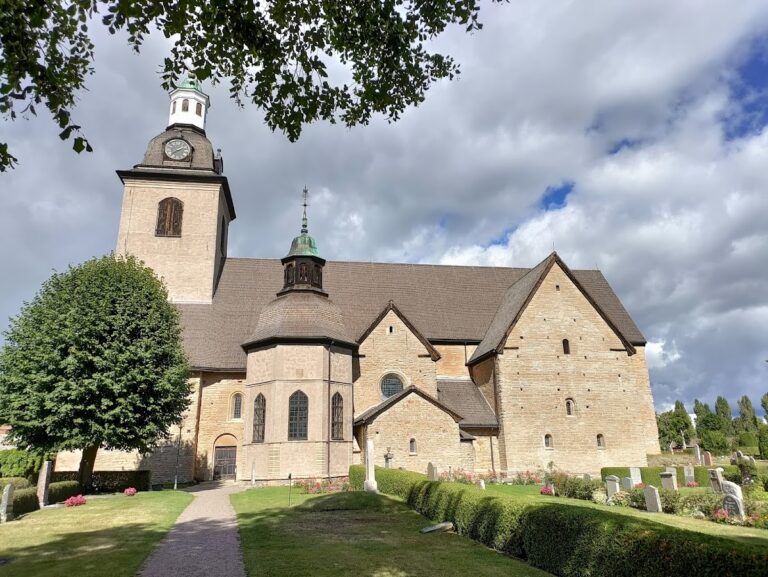
Linköping Cathedral is a three-aisled hall church on an elongated rectangular plan with six bays. Its surviving structure combines a late Romanesque transept, a Gothic choir, and a western tower. The building is approximately 110 metres long, with vaults about 18 metres high. Its western facade is about 35 metres wide, the transept reaches a maximum width of 38 metres, and the church can accommodate about 1,500 people. Vreta limestone is the principal stone, while brick laid in lime mortar is used especially in the western part. The nave has cross vaults, the choir has a star vault, and the exterior is strengthened and articulated by buttresses, blind arcades, and pilasters.
Choir and eastern chapels
Late Gothic choir
The late Gothic choir ends in a polygonal ambulatory, a passage around the outside of the choir, with three chapels arranged radially. The central chapel is flanked by two small towers. The choir and its eastern structures were built in the fifteenth century under the direction of the Cologne builders Gierlach and Adam von Düren.
Chapel of Saint Mary
The Chapel of Saint Mary is one of the three Gothic chapels around the ambulatory and is regarded as an exceptionally refined example of Flamboyant Gothic in Scandinavia. Its bronze altar, made by the lost-wax process and dedicated in 1987, was created by Sven Lundqvist. Its imagery presents episodes from the life of Mary. The chapel also contains the Maria Window, designed by Lisa Bauer and made between 1988 and 1998 with the engraver Lars Börnesson. Engraved glass shows Mary’s face among flowers and Swedish plants whose traditional names contain the word “Mary.”
Nicolaus Hermanni Chapel
The northern chapel commemorates Nicolaus Hermanni, bishop of Linköping from 1374 to 1391 and a leading supporter of Saint Bridget’s canonization. He received Bridget’s remains during their journey from Rome to Vadstena in 1374 and consecrated Vadstena Abbey in 1384. Hermanni died in 1394 and was later buried in the cathedral. His remains were removed after the Reformation, but his tomb slab was preserved in the wall. The chapel also contains a gilded rose weather vane symbolizing the bishop, a large sarcophagus for Erik Ulfsparre and Beata Oxenstierna, and the tomb of Ebba Eriksdotter, mother of Queen Margaret Leijonhufvud.
Chapel of Thomas Becket and All Martyrs
The southern chapel connects the Church of Sweden with the Anglican tradition through its dedication to Thomas Becket, the archbishop of Canterbury murdered in 1170 after a conflict with King Henry II over church privileges. The chapel also commemorates modern defenders of faith, freedom, and human rights, including Martin Luther King, Raoul Wallenberg, Dag Hammarskjöld, and Oscar Romero. Its burial crypt belongs to the Bielke family and carries the family’s heraldic arms. A stone tomb monument for Ture Nilsson Bielke and Margareta Svantesdotter Sture was made around 1615 by Willem van den Blocke of Gdańsk.
Portals and Gothic sculpture
Transept portals
The cathedral has four portals. The smaller northern and southern entrances open into the arms of the transept and originally belonged to the earliest building phases. The northern portal retains a Romanesque character, although both transept portals were replaced by copies during the nineteenth-century restoration.
Southern portal and medieval reliefs
The former principal southern portal was built in the first half of the fourteenth century under an English stonemason. Major sections of its tympanum, the decorated field above a portal, were damaged, and the entrance was replaced by a new portal in the eighteenth century. Surviving medieval reliefs were transferred inside and are displayed as a lapidarium in the northern part of the ambulatory beside the high altar. They show episodes from the life of Jesus, including the Nativity, the Massacre of the Innocents, the Crucifixion, and the empty tomb.
Blind arcades
Blind arcades, decorative arches applied to a wall without forming an open passage, run along the side aisles and belong to different construction phases. The earlier Romanesque arcades near the eastern end are austere, while the fourteenth-century Late Gothic arcades contain elaborate reliefs of people, animals, and plants.
The sculpture includes pairs of men and women, foliage, soldiers, knights, and symbolic figures. Some scenes have been interpreted as allegories of the struggle between good and evil or the seven deadly sins, but the overall theological program remains uncertain. One pair has been tentatively identified as Ingeborg Håkansdotter and her husband, Knut Porse, Duke of Estonia. Other reliefs show seated figures, a person removing a thorn from a foot, struggling youths, a bearded old man with a nearly naked woman, and a knight with a woman accompanied by a double dragon. The northern-aisle figures are especially dramatic and burlesque. The cycle is regarded as an outstanding example of Gothic stone sculpture in Sweden, although the meanings of some scenes and the reasons for deliberate damage remain unresolved.
Western portal and facade
The present western portal was built with the tower during Helgo Zettervall’s reconstruction in 1886. Its tympanum received Bengt Olof Kälde’s mosaic in 1986. The Byzantine-inspired composition shows Christ as Lord of Heaven and Earth with Saint John the Baptist, Mary, Saints Peter and Paul, Nicolaus Hermanni, and Saint Bridget.
Western tower and bells
Western tower
The western tower is square in plan and 107 metres high. Its pointed pyramidal spire is surrounded by four corner pinnacles and crowned by a golden cross. The tower contains a sacristy, waiting room, conversation room, and a ground-floor vapenhus, an entrance chamber where armed men formerly deposited their weapons before entering the church. Some of these rooms have stained-glass windows by Pär Andersson.
Four bells
The tower contains four bells. Storklockan weighs about 5,200 kilograms, S:t Larsklockan about 2,000 kilograms, and Prästklockan about 530 kilograms. Prästklockan bears an inscription giving its weight in older Swedish units. Storklockan carries a Latin inscription beginning “Sanctus, Sanctus, Sanctus,” while S:t Larsklockan bears the monogram of King Charles XII and the keys of Saint Peter.
Altars, furnishings, and memorials
High altar and altarpieces
The present high altar was installed in 2000 between two clustered piers, on the site of the former medieval lay altar beneath the rood crucifix. Its altar table incorporates a piece of limestone. A marble epitaph for Bishop Torsten Rudén hangs on one pier, and a limestone epitaph for Bishop Jacob Lang hangs on the other.
The high-altarpiece triptych by Henrik Sørensen was completed in 1935. It shows the resurrected Christ surrounded by biblical figures, church fathers, saints, reformers, and regional religious figures, including Martin Luther, Olaus Petri, Nicolaus Hermanni, and Saint Bridget. Its modern Expressionist style deliberately contrasts with the Gothic interior.
Maarten van Heemskerck’s former high-altarpiece, painted around 1540, is displayed on the southern wall. This multi-panel work presents the history of Jesus from the Nativity to the Resurrection, with the Crucifixion as its dominant scene. Its style reflects Italian art, ancient Roman sculpture, and the triumphal reliefs of the Arch of Titus. Removed from Alkmaar during the Reformation, it was donated to Linköping by King John III in 1582. King Gustav II Adolf later regarded it as one of the three most outstanding works of art in Sweden.
Sacramentaries and crucifix
Two late medieval sacramentaries, secure architectural receptacles for liturgical vessels or the reserved sacrament, stand beside the high altar. The northern one resembles a Gothic tower, with a profiled base, sculptures of prophets and apostles, a crocketed pinnacle, and a copper tabernacle door. The southern one resembles a fortified urban tower with battlements and armed archers and is traditionally interpreted as an image of the former bishops’ castle. Both were made by an anonymous Cologne-trained stonemason influenced by Netherlandish art during the choir’s construction around 1480–1490.
The large rood crucifix hangs beneath the timber rood arch, the arch separating the nave from the choir and traditionally supporting a crucifix. The cross is 4.3 metres high and the figure of Christ is 2.35 metres high. Made in the first half of the fourteenth century by an unknown woodcarver in an Östergötland workshop, possibly under French influence, it depicts Christ as both suffering and triumphant and bears the symbols of the four Evangelists at the ends of the cross.
Baptismal font and pulpit
The bronze baptismal font probably originated in Lübeck during the first half of the fifteenth century. Its octagonal bowl carries reliefs of Christ’s baptism, the Coronation of Mary, and the apostles. The present stone base dates from the 1930s; the earlier base consisted of bronze angels.
Niclas Österbom’s pulpit was made in 1745. Its hardwood reliefs are mounted on a pine base and depict biblical scenes including Jacob’s dream and struggle, Adam and Eve, the Annunciation, the Visitation, the Adoration of the Magi, and angels visiting Abraham and Sarah. Originally painted white, it was gilded during restoration in 1931 and remains in use almost every Sunday.
Tree of Life
The Tree of Life stands on the stone floor in the western part of the left aisle. Made of gilded silver, gold, and glass on a bronze base, it has 153 gilded leaves, a dove representing the Holy Spirit, and nine fruits representing the fruits of the Spirit. Carl Gustav Jahnsson began the work after winning a competition in the late 1980s. Jan Ostvald completed it after Jahnsson’s death, Torbjörn Vogt made the bronze trunk and fittings, and Wilcke Adolfsson made the glass fruits. The work was completed in 1997.
Tombs and epitaphs
The cathedral contains burials and memorials associated with bishops, nobles, rulers, and regional figures. They include John, Duke of Östergötland; Bishop Kettil Karlsson Vasa; Princess Maria Elizabeth of Sweden; Bishop Nicolaus Hermanni; Bishop Samuel Enander Gyllenadler; Erik Sparre; Ture Nilsson Bielke; and Margareta Svantesdotter Sture. Erik Sparre was later exhumed and reburied at Öja parish church.
Other memorials include the white-and-black marble epitaph of Johannes Terserus, bishop of Turku from 1658 to 1664 and bishop of Linköping from 1671 to 1678; a gilded-copper memorial to cathedral provost Thomas Ihre; an epitaph for Bishop Andreas Rhyzelius; and memorials to cathedral lecturer Erik Phoenix and Elisabet Drevhusen. The earliest surviving funerary object is the fragment of a stone coffin slab from the missionary period, with part of the Latin inscription meaning “Remember me in your kingdom.”
Organs
Linköping Cathedral has four organs. The main western choir organ was built in 1929 by G. Setterqvist, A. Österdahl, and B. Göransson. It has approximately 3,600 pipes, 61 stops, three manuals, and a pedal. Its facade pipes are non-speaking, its action combines mechanical and pneumatic control, and its stop action is pneumatic. The instrument was restored in 2007 while retaining its original construction.
The main organ preserves the facade designed by Niclas Österbom for Johan Niclas Cahman’s organ of 1733–1734. Earlier instruments included an organ commissioned by Bishop Brask in 1523, one built between 1619 and 1629 with royal financial support, an enlarged and restored instrument by Magnus Callander in 1715, and an organ built by Carl Elfström in 1887.
A choir organ built by P. G. Andersen of Denmark was installed in 1973. A portable-keyboard organ made by Henk Klop Orgelbau of the Netherlands in 2001 was donated by Würtembergs Stiftelse. Another organ was also built by P. G. Andersen, completing the cathedral’s present four-organ arrangement.
Nearby sites