Atri Cathedral: A Romanesque-Gothic Co-Cathedral and Minor Basilica in Italy


Site at a Glance
- Rating
- 4.7
- Popularity
- Medium
- Country
- Italy
- Primary era
- Medieval
- External website
- Open
- Eras represented
- Classical, Medieval, Early Modern, Modern
- Civilizations
- Kingdom of Naples, Kingdom of Sicily, Roman
- Site type
- Religious
- Remains
- Cathedral
On this page21 sections
History
Atri Cathedral is a Romanesque-Gothic church in Atri, Italy, built by the Christian community of the city over an ancient Roman site. Its history extends from Roman public buildings and an early medieval place of worship to the major thirteenth-century reconstruction and the Renaissance decoration that shaped its present character. Dedicated to the Assumption of the Virgin Mary, it is now a minor basilica and co-cathedral of the Diocese of Teramo-Atri.
From Atri’s ancient settlement to the early church
Atri was founded around the eleventh or twelfth centuries BC, and the area occupied by the cathedral originally lay inside the city’s cyclopean walls. After Rome conquered Atri in 290 BC, those walls were demolished and a temple dedicated to Hercules was erected on the site. A private house, or domus, later replaced the temple. During the first and second centuries AD, the area became a complex of public baths supplied by underground cisterns.
When the Western Roman Empire declined, the baths fell into ruin. A Christian place of worship called Ecclesia de Hatria was then established among the remains, reusing materials from the earlier buildings. Sculptural fragments from the eighth or ninth centuries, now preserved in the cloister behind the cathedral, point to an early medieval church in this location. The church was probably built in the ninth century and appears in a document issued by Otto I in 958.
The eleventh- and thirteenth-century rebuilding
As the Christian community expanded, a larger church was erected in the eleventh century. It had roughly the dimensions of the present cathedral, although it was lower and divided into five naves. Most of its furnishings disappeared, while part of an ambo and the altar survived. The church was first called Santa Maria di Atria and later Santa Maria Assunta. Cistercian monks were entrusted with it and established a monastery beside the church. An ancient bell, probably cast in 1102, remained in use until it was destroyed in the eighteenth century.
The church may have suffered damage or destruction during the conflicts involving Roberto di Loretello in 1153, although the contemporary record does not establish that Atri itself was destroyed. The church and its religious community appear in documents and papal bulls connected with Alexander III in 1177, Lucius III in 1181, Clement III in 1189, Celestine III in 1194, and Innocent III in 1198. Imperial documents also mention it under Henry VI in 1195 and Frederick II in 1200 and 1221.
Rebuilding began in 1223, following the plan of the earlier church, and the reconstructed building was consecrated in the presence of prelates from Abruzzo. The work was associated with Leonardo di Cristoforo, but the slender columns proved inadequate for the broad arches. Political change also altered the church’s institutional position. During the struggle between Guelphs and Ghibellines, Atri first supported the Ghibelline side and later joined the victorious Guelphs. In recognition of the city’s loyalty to the papacy, Pope Innocent IV established the Diocese of Atri, advised by Cardinal Capocci. In 1252 he reduced its territory and united it with the Diocese of Penne while retaining Atri as an episcopal seat.
Santa Maria consequently became a cathedral, and the Cistercians were replaced by the canons of the cathedral chapter, the body responsible for assisting the bishop and conducting the cathedral’s liturgy. Because the 1223 building remained structurally unstable, another reconstruction began around 1260 under Raimondo del Poggio and Rainaldo d’Atri. These local sculptors and architects are traditionally regarded as founders of the Atri artistic school. The essential structure was completed in 1284, and the church was consecrated under the official title Santa Maria Assunta.
Patronage, decoration, and later status
From the fourteenth century to the beginning of the seventeenth century, the cathedral was enriched by the Acquaviva dukes of Atri and by successive bishops. The Acquaviva ruled the Duchy of Atri and supported important artistic commissions. The bell tower was begun in the early fourteenth century and completed in 1502. Between 1460 and 1470, Andrea De Litio painted the extensive cycle of scenes from the lives of Christ and Mary in the presbytery.
In 1824, Bishop Domenico Ricciardone commissioned small vaults in the central nave and restored the roof, the church, and its paintings. The work also protected the choir frescoes from water infiltration. The cathedral became an Italian national monument on 19 February 1899. That year, the historian Luigi Sorricchio first attributed the choir frescoes to Andrea De Litio. Federico Zeri and Ferdinando Bologna later confirmed the attribution.
A major restoration directed by Guglielmo Matthiae took place from 1954 to 1964. It established much of the cathedral’s present appearance, exposed Roman remains beneath the presbytery, and revealed remains of the earlier Sancta Maria de Hatria. The intervention also altered the interior substantially by removing the Chapel of the Assumption, the sacristy, and an adjoining room, relocating or dismantling several altars, and replacing the central-nave vaults with a wooden-lined concrete roof. The Chapel of the Blessed Sacrament was moved, and Carlo Riccione’s baldachin was transferred to the neighboring church of Santa Reparata. The restoration renewed the adjoining Chapter Museum as well.
Pope Paul VI raised the church to the rank of minor basilica on 12 September 1964, a papal honor granted to churches of particular religious, historical, or devotional importance. Pope John Paul II visited on 30 June 1985 and celebrated Mass there. On 30 September 1986, the union of the dioceses of Teramo and Atri made Santa Maria Assunta the co-cathedral of the new Diocese of Teramo-Atri rather than the seat of a separate diocese.
The cathedral’s identity as a place of pilgrimage is also linked to its Holy Door, a ritually privileged entrance whose opening is associated with special indulgences. Its first mention dates from 1295, and the privilege is connected possibly with Pope Celestine V or Pope Boniface VIII. Tradition holds that the door is opened on 14 August and closed on 22 August in the presence of the bishop, with a plenary indulgence associated with the observance.
Further work followed structural and seismic problems. A faulty floor restoration, particularly the lack of expansion joints, caused sections of the pavement to fail about forty years after the Matthiae restoration. The church closed from 2003 to 2008 while the pavement, underfloor heating, plaster, glass panels over the archaeological remains, and artworks were renewed. Lightning damage to the upper bell tower led to major work from 1996 to 1999. After the 2009 L’Aquila earthquake, minor plaster falls appeared in the left nave near the tower, but the structure remained stable. The basilica was again closed after the August 2016 earthquake and reopened on 14 August 2018, allowing the traditional opening of the Holy Door to resume.
Remains
Plan, facade, and portals
The present church combines Romanesque and Gothic forms. Its interior is approximately 56.60 metres long and 24.70 metres wide, with three naves. The central nave rises above the lateral naves and is carried by heavy octagonal piers. Medieval capitals from the 1223 building and from the reconstruction of 1260 to 1284 are attributed to Raimondo del Poggio and Rainaldo d’Atri. The exterior is faced with Istrian stone.
Main facade
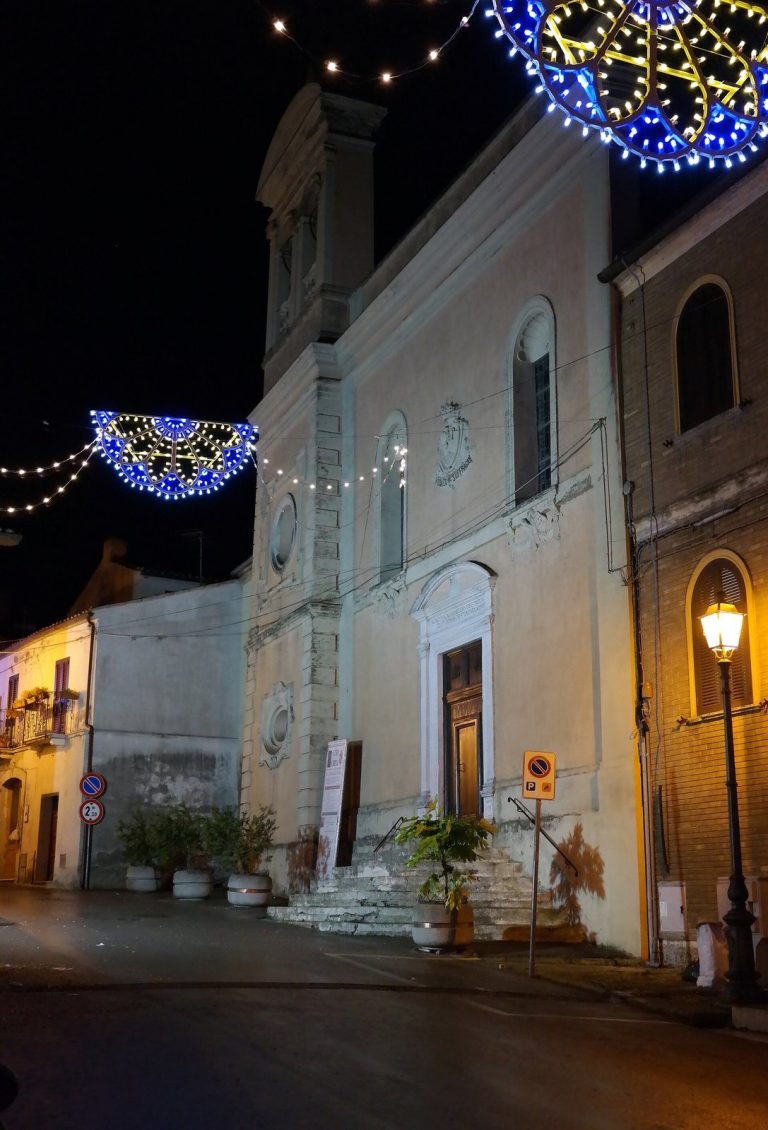
The main facade faces Piazza Duomo. It originally ended in a cusp, but the upper section collapsed in the earthquake of 17 September 1563 and was never rebuilt. A Renaissance band of small arches replaced it. Raimondo del Poggio and Rainaldo d’Atri made the central portal between 1288 and 1305. Its columns, capitals, and two animal sculptures form an important example of Gothic sculpture in Abruzzo. The lunette contains a sixteenth-century fresco of the Assumption of Mary, once incorrectly attributed to Andrea De Litio.
Above the portal is a twelve-rayed wheel rose window, one of the notable rose windows of Abruzzo. Its maker is unknown. A niche above it holds a late-thirteenth-century marble Madonna and Child enthroned by an unknown artist, possibly connected with the Atri school and showing affinities with the Gothic sculpture of Arnolfo di Cambio. To the right are surviving fragments of a monumental thirteenth-century fresco of Saint Christopher, traditionally associated with protection for travelers and pilgrims.
Right-side portals
Three portals open along the right side. Rainaldo d’Atri made the first in 1305. This richly decorated Gothic entrance has openwork ornament, and its lunette contains a Coronation of Mary by the anonymous Master of the Atri Lunettes, a conventional name for an artist or workshop active around 1200 to 1300. The portal serves as the Holy Door.
Raimondo del Poggio made the second portal in 1288. Set between two pilasters and flanked by Romanesque lions, it carries the Lamb bearing a cross and the Angevin arms. Its lunette shows the Madonna and Child between two saints, although the painting is badly faded. The third portal, made by Raimondo del Poggio in 1302 near Santa Reparata, is richly ornamented in the Gothic manner. Its two lions have contrasting poses, one calm as it seizes prey and the other apparently roaring before an attack. The lunette, depicting the Madonna and Child between Saints James and John, preserves the best condition of the three portal frescoes.
Bell tower, rear facade, and cloister
The square bell tower stands on the church’s left side, with an unusually large part of its base incorporated into the interior. The bells can therefore be reached without leaving the building. The tower rises nearly 64 metres, contains 147 steps, and holds seven individually named and inscribed bells. Construction began in the thirteenth century, possibly around 1264. Rainaldo d’Atri completed the square section up to the bell chamber in 1305, while Antonio da Lodi finished the upper part in 1502 with the pointed octagonal stage, globe, and cross. Painted ceramic panels from the early workshops of Castelli decorate the upper levels, with lighter tones in Rainaldo’s section and darker tones in Antonio da Lodi’s addition. Lightning-damaged the original cruciferous globe, which was replaced by a matching lightning-protection sphere; the damaged globe is preserved in the cloister.
The rear facade faces the cloister. It contains Romanesque windows from the eleventh or twelfth centuries, a large open area created by the removal of the sacristy and an adjoining room, a round window lighting the presbytery, and two smaller windows. The cloister now forms part of the Chapter Museum. It was built in the fifteenth century over an earlier twelfth-century structure. The museum and cloister preserve medieval sculpture fragments, objects from the former sacristy, works removed from former altars, sculptures from the Roman baths, and other transferred material.
Presbytery and Roman remains
Archaeological structures
The presbytery occupies the end of the central nave and is raised above the nave floor. It was formerly the canons’ choir, where the cathedral chapter sat. The twentieth-century restoration removed a later marble structure and balustrade, relocated the wooden baldachin, and raised the presbytery to expose the archaeology beneath it. Glass panels in the floor reveal structures from the Roman baths, an associated building, a possible hexagonal basin from a macellum, and black-tessera mosaics from the second century AD. The mosaics show fish and dolphins. Further remains, including two additional fish mosaics, can be seen behind the altar. Some movable fragments were transferred to the Chapter Museum and partly to the archaeological museum, while the masonry remains in place.
The Roman cistern that supplied the baths dates from the second century AD. The archaeological evidence beneath the presbytery thus preserves part of the earlier public complex within the medieval and modern church.
Central altar
The marble central altar was made in the second half of the twelfth century. Its mensa, the altar table, was remade in red stone in 1570, while its white-marble front panel was produced in 1223 and signed “Raulino me fecit.” Red stucco ornament and small inserts of green, yellow, and black breccia decorate the panel, including a bull’s head and an Agnus Dei, the Lamb of God symbolizing Christ’s sacrifice and redemption. The rear panel carries vine ornament arranged in eighteen compartments.
Left nave and medieval paintings
The left nave contains the base of the bell tower, the entrance to the sacristy, remains of the earlier Sancta Maria de Hatria, and numerous medieval and early-modern paintings. The earlier five-nave church had approximately the dimensions of the present building but was lower. Its surviving fabric includes the lower portions of two small apses from its left-hand naves.
High on the left nave is the surviving upper part of a 1340 cycle showing scenes from the life of Christ, attributed to Luca d’Atri or the Master of Offida. The paintings were originally more extensive, but lime covered them during the plague of 1656. Nineteenth- and twentieth-century work revealed fragments. Nearby is a fragmentary fourteenth-century cycle concerning Saint Nicholas and another saint, including a burial scene of Saint Nicholas.
Other works include a fourteenth-century Madonna of Loreto, locally called the Madonna d’Alto Mare and attributed to Andrea De Litio, and a late-thirteenth-century fresco of the Meeting of the Three Living and the Three Dead. The latter shows three richly dressed riders confronting three partially decomposed corpses emerging from the ground and retains part of a Gothic inscription about the fleeting nature of worldly glory. A late-thirteenth-century Apostles’ cycle preserves Saints Andrew and Bartholomew, with a fifteenth-century castle crenellation added above it.
Altars and baptistery
The Arlini altar, made of gilded wood in 1618 for the Arlini merchant family, retains the family arms, a seventeenth-century Neapolitan-school painting of the Coronation of Mary, six candlesticks, and a wooden crucifix. It was dismantled, restored, and reassembled during the 1954 to 1964 works. Near the tower stands the marble Renaissance baptistery made by Paolo de Garviis in 1503. Its baldachin-like form includes floral and vegetal ornament, vases, and three steps. The basin is thirteenth-century and possibly came from Raimondo del Poggio or another local artist; its iron cover is also from the thirteenth century. The baptistery was moved from the entrance near Santa Reparata to its present position in 1763.
The Chapel of the Blessed Sacrament is a small space with a wrought-iron balustrade and lantern, two medieval twisted columns, and an eighteenth-century tabernacle made by artists from Rivisondoli. Small late-sixteenth-century canvases occupy the tabernacle, which was repainted around 1890. A fifteenth-century painted decoration was revealed behind the dismantled organ on the small door linking the left nave with the sacristy. It consists of a vegetal frieze and an angel’s bust.
Family chapel and Madonna d’Alto Mare
The Chapel of the de Corviis contains a limestone altar erected in 1577 for the de Corviis family and moved from the left nave during the mid-twentieth-century restoration. Its central panel once held an altarpiece that is now lost and contains an eighteenth-century wooden crucifix.
A second representation of the Madonna of Loreto’s Translation of the Holy House appears in the left nave. Andrea De Litio painted it around 1460. Known as the Madonna d’Alto Mare, it shows the Madonna and Child above the Holy House, carried by angels over the Adriatic. The lower section, including much of the house, the angels, and the sea, survives only in fragmentary form.
Right nave and Renaissance furnishings
Acquaviva altar
The right nave contains the Acquaviva altar, also called the Chapel of Saint Anne. Paolo de Garviis made the original marble altar in 1502 or 1503 for Isabella Piccolomini, the wife of Duke Andrea Matteo III Acquaviva. Townspeople damaged it, and it was later rebuilt. The present brick altar copies the lost original. Above it is a marble baldachin with four Corinthian columns, nine putti heads, the arms of the Acquaviva and Piccolomini families, and Renaissance Lombard vegetal ornament. The Acquaviva family tombs in the cathedral were destroyed after Napoleon’s 1811 prohibition of burial inside churches.
Paintings and Saint Nicholas altar
The right nave preserves a fourteenth-century Madonna del Latte between Saint Anthony Abbot and two other saints, possibly Reparata and Berardo, attributed to the Master of Offida. Frescoes of Saint James the Greater and Saint Catherine of Siena were probably painted around 1360 by Andrea da Bologna and his workshop. Other surviving works include a possible Saint Ambrose, four fragmentary saints, an unidentified Franciscan nun possibly representing Saint Clare, and fragments of another cycle of saints.
Additional paintings include a late-fourteenth-century Madonna and Child with Saints John the Baptist, John the Evangelist, and an unidentified bishop, also attributed to the Master of Offida; a Byzantine-style Saint Michael and a female saint transferred from San Liberatore during the 1918 to 1920 restoration; a sixteenth-century Christ Blessing; a fifteenth-century Madonna of Mercy; a 1451 Saint Bernardino of Siena; and a Prudence Virgin probably painted in 1477 and partly renewed in 1512.
The sixteenth-century altar of Saint Nicholas is associated with the confraternity of Saint Nicholas of the Tailors. Made of limestone with Corinthian columns, it bears the confraternity emblem and a late-eighteenth-century Neoclassical painting of the Madonna and Child with Saints Nicholas and Homobonus. The painting includes a view of Atri, its churches, and the former bell tower of San Leonardo.
Central nave and choir frescoes
Two sixteenth-century holy-water stoups stand in the central nave. One has a limestone octagonal base with scale and vegetal ornament and a darker basin. The other uses a limestone sculpture of a barefoot woman in traditional Atri dress, carrying the basin on her head. Local tradition calls the figure the Trucculette. Tradition also holds that her face was erased because some clergy considered the figure too sensual, and that a lotus flower once held in her hand was removed.
The eight columns of the central nave and the choir columns preserve frescoes from the fourteenth to the sixteenth centuries. Their subjects include Saint Anthony Abbot, monks and bishops, Saint Lawrence, the Madonna of Loreto, Christ in Pietà, the Madonna and Child, Saint Sebastian, Saint Catherine, Saint Michael, Saint John the Evangelist, Saint Christopher, the Trinity with Three Faces, Saint Onuphrius, Saint Lazarus, Saint Nicholas of Tolentino, and other saints. Several works are attributed to Antonio Martini of Atri, Andrea De Litio, the Master of Offida, or their workshops, and many survive only in upper or central sections.
Andrea De Litio’s choir cycle
The walls, columns, and vault of the choir contain 101 frescoes or panels by Andrea De Litio and his assistants. The three choir walls carry twenty-two scenes from the life of Mary, while the columns and arches show saints. The vault contains the Evangelists, Doctors of the Church, and cardinal and theological virtues. The Doctors of the Church are theologians recognized for the exceptional importance of their teaching. The cardinal virtues are prudence, justice, fortitude, and temperance; the theological virtues are faith, hope, and charity.
The wall paintings were made mainly between 1460 and 1470, with some saints probably added around 1475. The vault was completed in 1480 and 1481, using a more developed Renaissance language with stronger volume and perspective. Fourteen original explanatory inscriptions survive, while others were altered or lost in the seventeenth century. The cycle includes scenes from Joachim and Anna’s meeting at the Golden Gate through the Annunciation, Nativity, Adoration of the Magi, Flight into Egypt, Baptism of Christ, Mary’s burial, the Eucharistic Christ, and the Assumption and Coronation of Mary. Several scenes are fragmentary and contain chronological or compositional irregularities.
The vault pairs the four Evangelists with Doctors of the Church and virtues. John appears with Augustine and Faith and Hope; Luke with Ambrose and Prudence and Patience; Mark with Gregory the Great and Fortitude and Temperance; and Matthew with Jerome and Charity and Justice. At the centre of the starry vault, the Lamb of God is surrounded by cherubim.
The choir saints include Lawrence, Leonard, Sebastian, Pope Saint Sylvester, Stephen, Pope Celestine V, Blaise, Vitus, Reparata holding a model of Atri, Mary Magdalene, Agnes, Margaret of Antioch, Barbara, and Onuphrius. The figure of Pope Saint Sylvester is identified as a portrait of Bishop Antonio Probi, one of the commissioners of the frescoes. The young Duke Andrea Matteo III Acquaviva was the other principal commissioner. The paintings also incorporate views of Atri, the surrounding landscape, the former port of Cerrano, local nobles and commoners, children, domestic interiors, Abruzzo customs, and regional landscapes and ravines. Earlier mid-fourteenth-century frescoes of the life of the Virgin by Luca d’Atri were largely covered or destroyed when De Litio’s cycle was made, although fragments remain.
Sacristy and Chapter Museum
The sacristy contains nineteenth-century frescoes by artists from Teramo and Atri, including a dome filled with musical angels. Its seventeenth-century gilded wooden altar carries reliefs of Saints Lawrence and Reparata, the Annunciation, Mary Magdalene, an unidentified saint, winged satyrs, vegetal ornament, and the Acquaviva arms. Nineteenth-century cupboards, an eighteenth-century Saint Michael copied from Guido Reni, a late-seventeenth-century Saint Charles Borromeo, and an eighteenth-century Mary Magdalene complete the surviving furnishings described for the room.
The Chapter Museum and cloister preserve material moved from the cathedral during successive alterations. Their holdings include sculptures from the Roman baths, the original lightning-damaged bell-tower globe, medieval sculpture fragments, paintings removed from former altars, and objects from the former sacristy. Together with the archaeological remains beneath the presbytery, these collections preserve evidence for the long transformation of the site from Roman public complex to early Christian church, medieval cathedral, and modern basilica.