Archaeological Site of Amathous: A Royal City-Kingdom of Ancient Cyprus


Site at a Glance
- Rating
- 4.4
- Popularity
- Medium
- Country
- Cyprus
- Primary era
- Classical
- External website
- Open
- Eras represented
- Iron Age, Classical, Medieval
- Civilizations
- Byzantine, Crusader, Kingdom of Cyprus, Ptolemaic, Roman
- Site type
- City
On this page27 sections
History
The Archaeological Site of Amathous in Cyprus, at Agios Tychon, preserves the remains of a royal city-kingdom that emerged in the early Iron Age around 1100 BC. Human activity in the wider area reaches back to the Neolithic period, but the date when the city itself was founded remains uncertain. Amathous later became an important centre of maritime exchange, political power, religious practice, and civic life before surviving as a Christian city into Late Antiquity.
Origins and the Royal City-Kingdom
Ancient traditions described the people of Amathous as indigenous to Cyprus, although that interpretation remains disputed. Eteocypriot, an indigenous non-Greek language written in the Cypriot syllabary, continued to be used at Amathous alongside Greek into the fourth century BC. This linguistic evidence reflects the city’s distinctive cultural identity during a period when Cyprus maintained connections with the eastern Mediterranean.
Amathous developed into one of Cyprus’s royal city-kingdoms. During the Geometric and Archaic periods, it maintained maritime and commercial contacts with the Levant, Greece, and Egypt, while archaeological evidence points to a Phoenician trading presence. The city prospered during the Archaic period through agriculture, sheep raising, copper resources, craft production, and maritime trade.
Its political position was tested during the Cypriot revolt against Persian rule in 500 to 494 BC. Amathous remained loyal to Persia and successfully resisted a siege led by Onesilos of Salamis. The Amathousians captured and executed Onesilos. A later tradition held that, after consulting an oracle, they established an annual heroic sacrifice for him, turning the memory of the conflict into a continuing civic and religious observance.
Conflict and the End of the Kingdom
Around 385 to 380 BC, Amathous opposed Evagoras of Salamis while allied with Kition and Soloi. The city later resisted the expansion of Alexander the Great and was required to provide hostages to Seleucus. Its last king, Androkles, eventually supported Alexander’s campaign against Persia and participated in the siege of Tyre in 332 BC.
After Alexander’s death, Androkles supported Ptolemy against the Antigonids. Ptolemy belonged to the Macedonian-Greek dynasty that ruled Egypt and controlled Cyprus during the Hellenistic period. Demetrios Poliorketes defeated the Ptolemaic forces at Salamis in 306 BC and controlled Cyprus until 294 BC, when Ptolemy recovered the island. The Amathousian kingdom ended during the early Hellenistic period, conventionally dated to 312 or 311 BC, when Cyprus was incorporated into the Ptolemaic state.
Ptolemaic rule reduced Amathous’s political importance, but civic life continued. The city’s military harbour was abandoned before it was completed and quickly filled with sand. New baths, a gymnasium, fortifications, and other buildings nevertheless show that construction and urban activity persisted after the kingdom had ended.
Roman and Christian Amathous
Rome annexed Cyprus in 58 BC, and Amathous became the centre of one of the island’s four administrative regions. The city experienced a temporary revival under the Antonine and Severan emperors, although its economy and craft production later declined. Christianity became established during the fourth century AD, and Amathous became a bishopric.
Saint Tychon, described as the city’s first bishop and evangelizer, was associated with a tomb that later became a place of healing and exorcism. The pagan sanctuary on the acropolis was eventually replaced by a Christian basilica, while other basilicas were built in and around the lower city. These changes show the reorganization of Amathous’s religious landscape during Late Antiquity.
Earthquakes in 342 and 365 AD damaged the city. The earthquake of 365 caused the seafront wall to collapse. Amathous survived the first Arab raids but was captured and burned during Muawiyah’s raid in 649. A further attack led by Abul’Awar in 653 to 654 defeated the remaining defenses. The city was then abandoned, and its ruins were not rebuilt.
After Abandonment and Archaeological Investigation
Following abandonment, tombs were plundered and building stones were carried to Limassol. In 1869, large quantities of stone from Amathous were reused in the construction of the Suez Canal. The large stone vessels on the acropolis had already attracted attention during the Frankish period.
British archaeologists excavated at Amathous in 1893 and 1894, and the Swedish Cyprus Expedition investigated approximately 25 or 26 tombs in 1930. After Cyprus became independent in 1960, the Department of Antiquities undertook rescue and systematic excavations. The French School at Athens established a mission at Amathous in 1975. Work by the mission and the Department of Antiquities examined the acropolis, lower city, palace, sanctuary, fortifications, basilicas, harbour, and cemeteries. Excavations in the lower city continued from 1977 to 1991, further French excavations took place in 2001 to 2003, and underwater harbour investigations began in 1984. The archaeological site is managed by the Cyprus Department of Antiquities, and its excavation has revealed evidence for Amathous’s religion, economy, art, political history, and changing identity from the Iron Age through Late Antiquity.
Remains
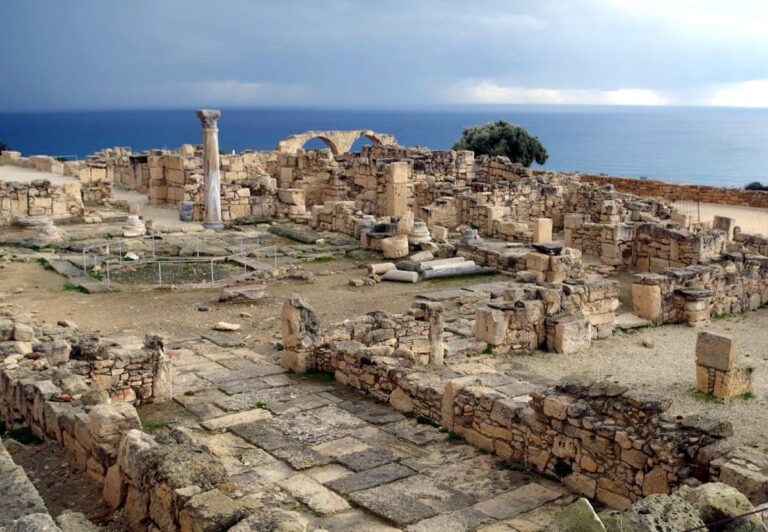
Amathous occupied two unequal coastal hills, the higher acropolis and the lower city. Their elevated positions provided views over the sea and surrounding territory, while the acropolis also served as a natural fortification and observation point. The palace and sanctuary of Aphrodite stood on the acropolis; the lower city contained the agora, residential areas, baths, fountains, harbour installations, and an Early Christian basilica. Only part of the residential district has been excavated.
Acropolis and Royal Complex
Royal Palace
The royal palace stood on artificial terraces in the southern part of the acropolis. Its first construction belongs to the late ninth or early eighth century BC. It was remodeled in the seventh century BC, rebuilt after destruction in the early fifth century BC, and abandoned toward the end of the fourth century BC.
Only part of the palace has been excavated, principally storage areas. Deep, bottle-shaped cisterns or silos, each holding approximately 150 litres, were used for water and agricultural products. Nearby workshops included metalworking and textile production. Administrative objects, an altar, limestone and terracotta figurines, and Hathor-type capitals point to royal and religious activity within the complex. Hathor was an Egyptian goddess associated with fertility, motherhood, sexuality, music, and royal power.
Sanctuary of Aphrodite
The sanctuary of Aphrodite occupied the summit of the acropolis. Its establishment cannot be securely dated before the eighth century BC, although a tomb and ceramic fragments may indicate earlier activity. Later Hellenistic, Roman, and Christian construction partly obscured the earlier remains. At Amathous, Aphrodite was connected with local and Near Eastern forms of the goddess, including Astarte and the Egyptian Hathor.
Two large monolithic stone vessels stood at the sanctuary entrance during the Archaic period. Their handles were decorated with bulls. One was approximately 1.85 metres high and weighed about 12 to 14 tonnes before being removed to the Louvre in 1865. The other was found in fragments on the rocky platform where it had stood. A copy of the Louvre vessel is displayed at the site, and a third monumental vessel was discovered in recent years.
Roman Temple and Christian Basilica
A monumental Roman temple was built over a Hellenistic predecessor during the first century AD, approximately between AD 70 and 100. It was a Greek-type prostyle temple, meaning that its columns stood across the front, with a three-stepped base, a cella, a rear chamber, four facade columns, and distinctive Nabataean capitals. A small chapel with a pediment stood beside it.
The temple was probably adapted for Christian worship during the fifth century AD. Around the late sixth or early seventh century, it was largely dismantled, and many of its architectural blocks were reused in a large three-aisled basilica. The church had a narthex, or entrance hall, an exonarthex, or outer entrance porch, a courtyard, two colonnades, and additional rooms. Its numerous annexes may indicate a monastic or pilgrimage function.
Lower City and Harbour
Agora and Public Buildings
The Roman agora occupied the lower city east of the acropolis. It was arranged around a paved square of approximately 1,200 square metres. The main road bordered it on the south, while roofed colonnades, or stoas, enclosed the other three sides. A monumental square fountain stood at the centre.
The northwest corner contained a large fountain-reservoir, or nymphaeum, with a later basin. Roman baths lay to the east. In the southeast, a Hellenistic circular bathhouse, or balaneion, included a closed circular room and adjoining structures. Part of the western stoa, including a double colonnade, also belongs to the Hellenistic period.
Western Urban Area
West of the agora, excavations have revealed Roman and Early Christian buildings interpreted as administrative buildings or hostels. The area also contained a terraced road, rows of Hellenistic houses, smaller fountains, and an aqueduct. These remains show the extension of civic and residential activity beyond the principal public square.
Harbour Installations
The external military harbour lay south of the agora and is now submerged. Demetrios Poliorketes began it at the end of the fourth century BC during the struggle for control of Cyprus. Construction stopped before completion, and the harbour soon filled with sand. Underwater remains include quays, breakwaters, platforms, basins, and the harbour entrance.
An internal harbour lay between the archaeological site’s entrance and the modern road. Ships were towed into it for protection from strong winds. Together, the two harbour areas reflect the maritime infrastructure associated with Amathous’s coastal position.
Fortifications
City Walls and Gates
A city wall surrounded both the acropolis and lower city from the Archaic period onward. It passed through construction phases from the second half of the eighth century BC through the seventh century BC and into the Roman period. Hellenistic strengthening was associated with the harbour.
Surviving parts include the southwestern corner of the seafront wall, a western tower, much of the northern wall with its towers, and the northern main gate. Routes from the interior entered through this gate. The northern wall connected the foot of the acropolis with the highest part of the lower city.
Late Defenses
After the seafront wall collapsed in the earthquake of 365 AD, a new wall was built across the upper acropolis under Justinian. Further defenses were installed on the upper acropolis during the seventh century, using reused blocks from the palace and the Temple of Aphrodite. Some side gates were blocked after the Arab raids.
Cemeteries and Burials
Eastern and Western Necropolises
Two extensive necropolises lay to the east and west of the city. Their rock-cut tombs range from the Geometric period to the Early Christian period. Many were used repeatedly. Earlier grave goods were pushed into corners, while later Hellenistic and Roman burials were generally placed in upper layers without disturbing the earlier tombs.
The tombs include shaft graves with dromoi, or entrance passages leading to underground chambers, chamber tombs, and a large Hellenistic tumulus. One burial contained a stone pithos, a large storage vessel, with an alabastron, a small container traditionally used for oils or perfumes, holding a cremated skeleton and a wreath of gilded myrtle leaves. The burial may have belonged to a Ptolemaic official who died at Amathous and was buried according to a foreign custom.
Saint Tychon Cemetery Basilica
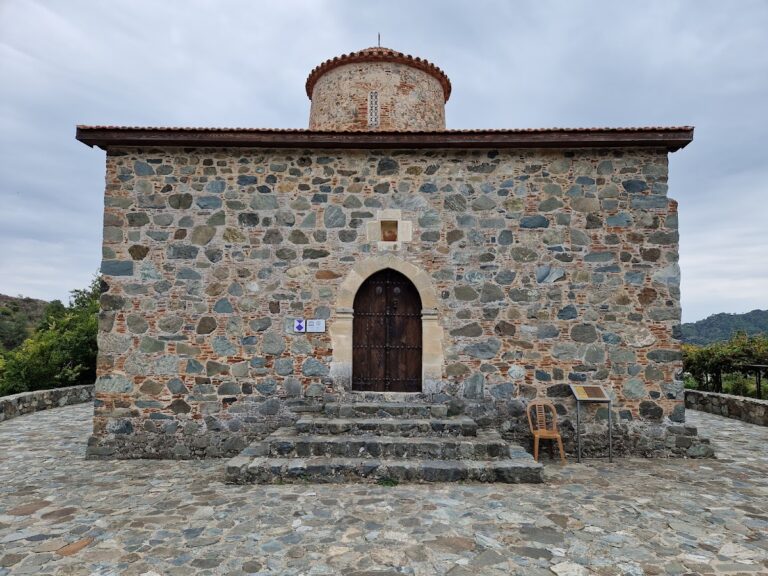
The cemetery basilica of Saint Tychon stood outside the eastern walls. Its first phase was a small single-room church dating to the late fourth century and is described as the earliest Christian place of worship in Cyprus. A second phase belongs to the second half of the fifth century. The visible remains come from a Frankish church of the late fourteenth or early fifteenth century.
Christian Buildings
Basilica West of the Agora
A smaller three-aisled basilica of the fifth century stood west of the agora at the foot of the acropolis. Part of its northern wall was cut into the bedrock, linking the building directly to the underlying terrain.
Eastern Basilica
A large three-aisled basilica with a narthex and courtyard stood east of the agora. It dates to the second half of the fifth century. The sea partly destroyed the building, and the Arab raids in the mid-seventh century caused further damage. Repairs followed later in the same century.
Eastern Necropolis Churches
At the eastern end of the eastern necropolis stood a cave chapel dedicated to Saint Barbara and a small five-aisled basilica. The basilica may have formed part of a monastery, extending Christian activity into the cemetery landscape.
Religious and Artistic Finds
Ritual Evidence
Religious activity at Amathous is represented by installations, figurines, terracotta votive offerings, reliefs, statues, inscriptions, and ritual deposits. The figures include Astarte, kourotrophoi holding infants, worshippers, musicians, riders, boats, chariots, animals, and Egyptianizing images. A kourotrophos is a figure shown holding or nurturing a child.
Archaeological evidence indicates sacrifices of sheep and goats, with fewer cattle, together with offerings of water, honey, wine, oil, flowers, grain, fruit, eggs, and cakes. Magical texts inscribed on lead or mica tablets were placed in tombs and illuminate popular religious practices of the third century AD.
Sculpture and Inscriptions
A colossal statue of Bes, the Egyptian protective deity often represented as a dwarf-like figure, dates from the seventh or sixth century BC. It was discovered at Amathous and is now in the Archaeological Museum of Istanbul. Other finds include Hathor-related figurines, a possible falcon-headed figure of Horus, and ritual vessels and objects. These materials reflect the city’s long-standing religious and cultural connections with Egypt and the Levant.
Two sculptural bases dedicated by Androkles for his sons Orestheus and Andragoras survive from the fourth century BC. Their inscriptions are written in both Greek and Eteocypriot. A monumental fifth-century BC sarcophagus, probably made for one of the city’s kings, bears reliefs of a chariot procession escorted by horsemen and infantry on its long sides. Its ends show nude figures of Astarte and representations of Bes. The sarcophagus is now in the Metropolitan Museum of Art in New York.
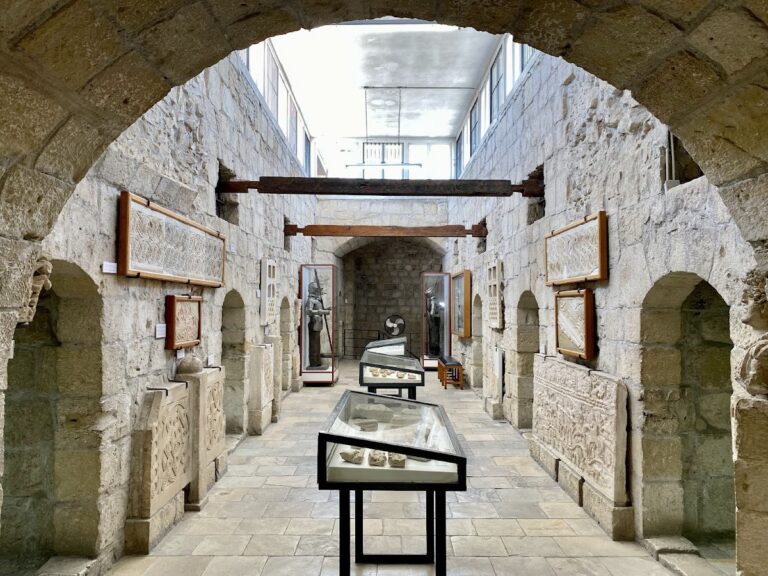
Finds from the necropolises and other excavations are held in the Cyprus Museum in Nicosia, the Limassol District Archaeological Museum, the Louvre, the British Museum, the Archaeological Museum of Istanbul, and the Metropolitan Museum of Art.