Fort Luneta in Głogowie: An Advanced Artillery Work of the Głogów Fortress


Site at a Glance
- Rating
- 3.6
- Popularity
- Very Low
- Country
- Poland
- Primary era
- Modern
- Eras represented
- Modern
- Civilizations
- German
- Site type
- Military
- Remains
- Fort
On this page4 sections
History
Fort Luneta in Głogowie is a 19th-century fortification in Poland, built between 1857 and 1860 as an advanced artillery work of the Głogów Fortress. Known in German as Lünette am Schloss See and in Polish as Luneta przy Jeziorze Zamkowym or Luneta Odrzycka, it stood on the northern forefield near the railway bridge and flood embankment.
Głogów fortress-sapper units constructed the fort with the participation of private construction firms. Its building coincided with the construction of the Głogów-Leszno railway connection. The fort was intended to defend the approach to the fortified bridgehead, a defensive position securing the end of a bridge and its adjoining route, as well as the railway bridge itself.
A second infantry shelter was added in 1914. This later work expanded the fort’s defensive accommodation while the main earth-and-water defenses remained part of the site’s structure.
Remains
Fort Luneta has a pentagonal layout formed by earthen ramparts and enclosed by a moat filled with water. The Odrzyca stream, also identified by the German name Schloss See, flows behind the fort. Together, these elements define the surviving position within the former northern defensive zone.
Ramparts and entrance
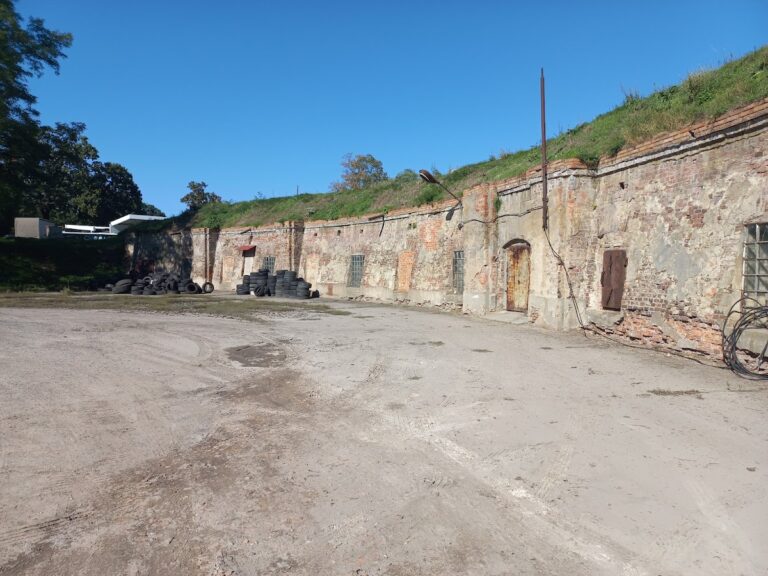
The rear side, or gorge, was closed by a wall pierced with loopholes. At the entrance, this wall was shaped into two projecting bastions, popularly known as the “cat’s ears,” although their form does not closely resemble that description. A gate and drawbridge once closed the entrance, but neither survives.
Structures within the fort
A rectangular brick reduit, a fortified internal structure for the garrison, stands in the courtyard. The five-chamber infantry shelter added in 1914 has vaults built over corrugated sheet metal, providing a later construction within the fort’s earlier defensive framework.
Nearby sites