Torre di Visione: A Medieval Castle Controlling the Route into the Non Valley

Site at a Glance
- Rating
- 4.7
- Popularity
- Very Low
- Country
- Italy
- Primary era
- Medieval
- Eras represented
- Medieval
- Civilizations
- Holy Roman Empire
- Site type
- Military
- Remains
- Castle
On this page8 sections
History
Torre di Visione, also known as Castel Visione, is a medieval hilltop castle in Italy, in the municipality of Ton. First documented in 1199, it stood above the route from the Adige Valley into the Non Valley and was built during the medieval period. Its recorded names include Castro Visioni, Castro de Visiono, Torre Visione, Schloss Vision, Klause Visione, Feste Visiaun, and Visiawn.
Foundation and strategic control
In 1199, Conrad of Beseno, the Prince-Bishop of Trent, granted Alfredino and Manfredino di Ton and Luto di Marostica the hill of Visione as a feudal holding and authorized them to build a castle there. A prince-bishop combined religious office with territorial and political authority, so the grant reflected the interests of the Prince-Bishopric of Trent as a regional power. The exact beginning of construction is unknown, but two sons of Walimbert I of Thun were called “of Visione” in 1256, suggesting that the castle may already have been completed. Torre di Visione was probably the first castle built by the Thun family to be identified in historical records.
The castle occupied a position above the Rocchetta gorge, where the Non Valley opens toward the Rotaliana Plain. It controlled the crossing and passage at Rocchetta, giving it importance to both the bishops of Trent and the counts of Tyrol. Each power sought exclusive authority over a site that supervised movement between the valleys.
Thun and Tyrolean lordship
Tyrolean interest increased from the 1280s. In 1289, Giordano, the son of Albertino, sold his shares in the castle to Count Meinhard II of Tyrol. Meinhard appointed a castellan, an official responsible for supervising a castle, to administer the Tyrolean portion. Between 1307 and 1326, no Tyrolean representative was recorded there, and the Thun family controlled the castle alone. Several bishops, including Bartholomew Querini in 1307, confirmed the Thun family’s feudal rights.
In 1333, King Henry of Bohemia granted Torre di Visione to his vassal Volkmar of Burgstall. After Henry died in 1335, his daughter Margaret Maultasch, the countess of Tyrol, confirmed the holding, followed by Emperor Louis the Bavarian, the Holy Roman Emperor Louis IV. Volkmar retained the castle until 1343, when he fell from favor and died in captivity. Louis of Brandenburg, the emperor’s son and a ruler involved in Tyrolean affairs, then granted it to his confidant Konrad of Schenna. After Schenna’s death in 1346, lords drawn from episcopal and territorial ministerials alternated in its administration. Ministerials were members of the medieval service nobility who held offices, estates, or military duties for higher lords.
Conflicts, destruction, and decline
Shortly before the County of Tyrol passed to the Habsburg Rudolf IV in 1363, Margaret Maultasch granted the castle to Heinrich of Rottenburg. In 1401, Heinrich VI of Rottenburg, his grandson, received custody of Schloss Vision from Duke Leopold IV.
Torre di Visione became involved in the conflict between Georg of Liechtenstein, the Prince-Bishop of Trent, and Duke Friedrich IV of Tyrol. Tyrolean troops occupied it in 1410, before the Rottenburg feud began. In 1418, forces led by Peter of Spaur captured it during the Spaur feud, and the castle was returned to the duke after the conflict ended. After Alexander of Masovia became bishop of Trent in 1423, the Thun family again received the episcopal portions, while Tyrolean captains administered the castle.
In 1525, insurgent peasants from the Non Valley destroyed Torre di Visione during the Peasants’ War. Only a watchtower was rebuilt afterward, and the Thun family no longer lived at the site. The castle continued to appear in episcopal feudal documents, but its physical remains gradually deteriorated. The last remains of the tower collapsed in 1888. Unstable masonry was later dismantled because it threatened the road below and the Rocchetta road fortification, built between 1860 and 1864.
Changing regional importance
The castle’s importance declined during the fourteenth century after Volkmar of Burgstall built the Rocchetta fortress in 1333 closer to the bridge controlling access to the Non Valley. From 1268, the Thun family used the “Castrum Belvesini,” now Castel Thun, as its residence. Its foundation is associated with Heinrich of Visione, linking the later family residence with the earlier castle’s history.
Remains
Hilltop setting and surviving masonry
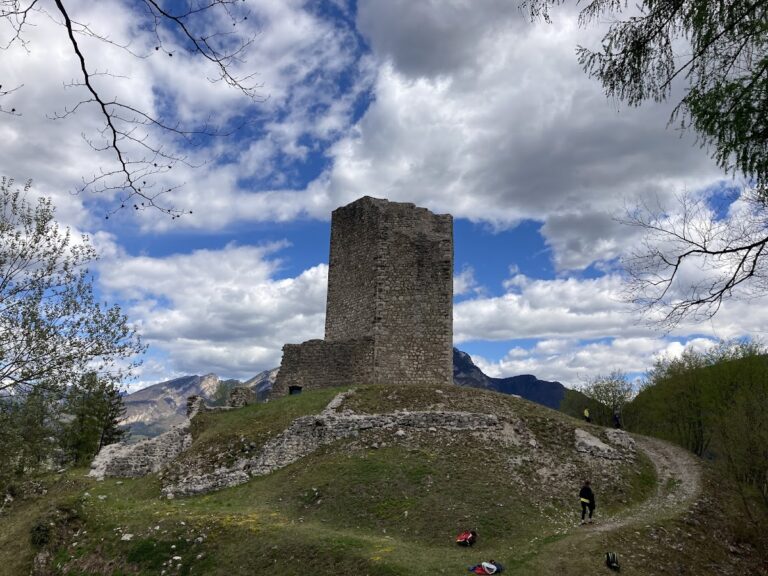
The ruins occupy the highest point of a hill at about 660 metres above sea level, above the Rocchetta gorge where the Non Valley opens into the Rotaliana Plain. They stand on the left bank of the Noce, in the municipality of Ton, approximately 2 kilometres south of Masi di Vigo. The surviving structure consists mainly of fragments of the keep, the principal fortified tower of a castle, with some masonry buried beneath rubble.
The largest surviving wall fragment measures 7.6 metres in length, reaches up to 2.6 metres in height, and is between 0.9 and 1 metre thick. Its construction uses rubble-filled masonry faced on both sides with regularly worked limestone blocks of different sizes. A bossed ashlar block survives at the only preserved corner. Bossed ashlar is stonework whose outer face projects or remains roughly finished around its edges. Another section of wall lies below the keep and may once have been attached to it.
Structures and historical depictions
The castle is thought to have included a heated room, a cistern for storing water, and a gate. Its precise plan remains uncertain, although these features indicate a complex with residential, water-storage, and access arrangements. A sixteenth-century sketch by Pietro Andrea Mattioli presents the castle as a group of several buildings.
The Codex Brandis, produced in the early seventeenth century, shows the keep already partly collapsed. It also depicts additional buildings that may have stood within a curtain wall, the defensive wall enclosing a castle complex. Together, the surviving masonry and these early images provide evidence for a larger arrangement than the fragments visible today.
Nearby sites