Novo Brdo Fortress: A Medieval Serbian Mining Stronghold in Kosovo


Site at a Glance
- Rating
- 4.8
- Popularity
- Very Low
- Country
- Kosovo
- Primary era
- Medieval
- Eras represented
- Medieval
- Civilizations
- Serbian
- Site type
- Military
- Remains
- Fortified Town
On this page13 sections
History
Novo Brdo Fortress is a medieval Serbian hilltop fortification in Kosovo, established in the late thirteenth or early fourteenth century during the first years of King Stephen Uroš II Milutin’s reign. It was built to protect a mining district rich in gold, silver, iron, and lead, and became especially renowned for its silver. The fortress formed the defensive center of a settlement whose mines, merchants, administrators, and religious communities made Novo Brdo one of the most important urban places in medieval Serbia.
Mining origins and urban growth
Mining activity in the region had already expanded during the first half of the thirteenth century under King Stefan Vladislav. He invited miners of German origin, known in medieval Serbia as Sasi, to develop the country’s mining districts. Novo Brdo became one of their principal settlements. The town was known as the Place of the Sasi, while the miners called it Nyeuberghe.
Novo Brdo appears in written records by 1325, when it was already a major mining and trading center. Ragusan merchants maintained commercial operations there, including a customs office and a consulate. In that year, King Stefan of Dečani recorded that Ragusan merchants had paid the lease for the Novo Brdo mine. The settlement’s position within a defensive network was also important. Together with Prizrenac, about 12 kilometers to the southwest, and Prilepac, about 13 kilometers to the southeast, Novo Brdo guarded approaches to the mining district, particularly routes from the south.
Prosperity under the Serbian Despotate
Novo Brdo reached its greatest prosperity during the Serbian Despotate, the late medieval Serbian state ruled by despots after the weakening of the Serbian Empire. Its principal period lasted from 1402 until the Ottoman conquest of the remaining Serbian territories in the fifteenth century. During this era, Novo Brdo was the most important mining center and the second most important town in Serbia. It served as the seat of a regional administrative unit and was governed by a vojvoda, a high-ranking military or administrative official, together with a kefalija, the governor responsible for a town or district.
The mines generated wealth on an international scale. Their glam silver, an ore containing as much as 33 percent gold, was particularly famous. Estimated annual production reached approximately five to six tonnes of silver, while historical estimates of annual mining income range from 50,000 to 200,000 gold ducats. An annual income of 120,000 ducats is also recorded. Commercial connections extended across the Adriatic to Italy and beyond, bringing Sasi miners, Albanian Catholics, Ragusan merchants, and traders from Venice and other Italian city-states into contact with Orthodox Serbs.
Novo Brdo also produced silver coinage from 1349. Some issues bore the inscription “Nouomonte moneta argentea,” meaning the silver coinage of Novo Brdo. Silver production reached its peak between about 1420 and 1440. Serbian rulers assigned mining revenues to monasteries. Prince Lazar supported Ravanica and Drenča, Despot Stefan Lazarević supported Hilandar and the Great Lavra, and Despot Đurađ Branković supported Esphigmenou. In 1405, Stefan Lazarević assigned Hilandar an annual income of 100 pounds of Novo Brdo silver.
The town’s institutions reflected its large and diverse population. The Sasi maintained their own civil court, notaries, mining-tithe accountants, and churches. Their expertise was so highly valued that miners from Novo Brdo were invited to work in Italy and Spain during the fourteenth and fifteenth centuries. Stefan Lazarević confirmed mining regulations and provisions for the Sasi community in 1412. By at least 1439, Novo Brdo possessed its own city statute and was organized as a municipal town. This statute is regarded as the oldest surviving statute of a Serbian city. An archery tournament took place in the town in 1413.
Novo Brdo was also a religiously mixed settlement. Seven Eastern Orthodox churches and two Roman Catholic churches served Orthodox Serbs, Sasi miners, Albanian Catholics, and Ragusan communities. During periods of Ottoman pressure, bishops of the Lipljan ecclesiastical district sometimes took refuge in the town, and the district was occasionally called the Novo Brdo diocese. Orthodox and Roman Catholic communities continued to coexist within the mining settlement.
Ottoman sieges and conquest
The fortress resisted an Ottoman siege in 1412 after a prolonged defense. A second siege began in 1439, as the Serbian Despotate weakened under Ottoman pressure. The defenders held out for approximately two years. The suburbs were captured during the first half of 1441, and the fortress surrendered on 27 June of that year. The Ottomans then plundered and burned the town.
The crusade of 1443 to 1444 led to the restoration of the Serbian Despotate under the Peace of Szeged, and Novo Brdo was returned to Despot Đurađ Branković without a battle. Under Đurađ’s vassal obligations to the Ottoman sultan, a cavalry detachment and a tunnel-digging unit from Novo Brdo later assisted Mehmed II during the Ottoman attack on Constantinople. The city fell on 29 May 1453.
The Ottomans attacked Novo Brdo again in 1455. Heavy artillery forced the defenders to surrender on 1 June. On Sultan Mehmed II’s orders, men of distinguished rank were executed. Approximately 320 boys were taken for the janissary corps, the elite Ottoman infantry recruited in part through the devshirme system, while about 700 girls and young women were distributed among Ottoman soldiers and commanders. Konstantin Mihailović, a resident of Novo Brdo, recorded the episode after being among the boys taken.
Decline and archaeological protection
Mining continued under Ottoman rule but declined sharply after 1455 as conditions deteriorated and skilled labor was lost. Ottoman registers from 1477 and 1498 to 1499 describe a predominantly Christian town with 887 households. A register from 1526 lists 514 households, including 139 Muslim households. Mining revived for a time under Sultan Suleiman I, but declined again during the Ottoman economic crisis of the late sixteenth century.
Coin minting resumed at the fortress during the reign of Sultan Murad IV and ended in 1651. By the middle of the seventeenth century, only 18 Roman Catholic households remained, and both Catholic churches were so damaged that Mass was celebrated in a private house. In 1685, just ten houses stood inside the fortress, while a garrison of 40 janissaries occupied the suburbs.
During the Great Turkish War, an Austrian force led by General Enea Silvio Piccolomini and assisted by local Serbian rebels occupied Novo Brdo in 1686. The fortress was later abandoned and recovered by the Ottomans by 1690 to 1691. Mining and military use then ceased. During the Great Serbian Migration of 1690 to 1691, local Serbs led by Patriarch Arsenije III Čarnojević moved to the Habsburg monarchy.
In 1892, Ottoman authorities reused well-cut stones from the fortress for barracks and other construction in Pristina. The fortress and its surrounding settlements subsequently remained abandoned and deteriorated. It was declared a Monument of Culture of Exceptional Importance in 1948. Systematic archaeological research began in 1952 under the Archaeological Institute of the Serbian Academy of Sciences and Arts, with the National Museum of Serbia joining the work in 1957. Research was interrupted in 1999, while amateur excavation, treasure hunting, looting, and illegal digging continued to damage the archaeological layers.
Conservation and restoration began in 2014 under a UNESCO-supported initiative. By 2016, the citadel and three major structures within it had been conserved or restored, and later work extended to the Lower Town. The site has been included in Kosovo’s protected cultural-heritage database since 2014 and was temporarily designated a special protective site after Kosovo declared independence in 2008.
Remains
Novo Brdo occupies an isolated summit of the Mala Planina or Velika Planja highland, at elevations of approximately 1,090 to 1,124 meters. The hill lies between the Prilepnica, Novo Brdo, and Kriva Reka rivers, which are tributaries of the Binačka Morava. The fortress consists of an Upper Town, or citadel, and a Lower Town, with extensive suburbs spreading east and southeast beyond the walls. Remains of settlements and mines associated with the medieval town extend across the surrounding area.
Fortification layout
Upper Town
The Upper Town forms the citadel. Its irregular, nearly hexagonal plan is flattened on the east, giving the enclosure an almost pentagonal appearance. This flattened side faces the most approachable direction. The citadel measures approximately 50 meters from north to south and 45 meters across. Six towers strengthened its walls: a large rectangular donjon occupied the middle of the flattened eastern side, while five three-sided towers stood at the northern, northwestern, western, southwestern, and southern vertices.
The western tower carries a large cross made from dark red breccia, a stone formed from angular fragments cemented together. A brick inscription is associated with the cross, which remains a distinctive feature of the fortress. Entry into the citadel was through an arched pedestrian gate in the western rampart, positioned between the cross-bearing western tower and the southwestern tower. A small single-nave chapel, a palace, and a heated bathhouse were located within the citadel. The bathhouse is the first known heated bathhouse associated with medieval Serbian history.
Lower Town
The Lower Town is a fortified settlement extending down the western slope. Its elongated rectangular plan measures approximately 180 by 95 meters, with about 45 meters attributed to the Upper Town. Its eastern and western sides are flattened. The eastern side is formed by the Upper Town, while the western side consists of an arched rampart. Polygonal triangular towers occupy the northern and southern corners.
The main entrance was a large ramped cart gate in the southeastern rampart, beside the southern tower of the Upper Town. A second arched pedestrian gate in the northeastern rampart, near the northern Lower Town tower, served as a sally port, an opening used by defenders making sorties during sieges. The southern tower is decorated with three rose windows. The largest, about 70 centimeters in diameter, is on the southern face near the eastern edge of the upper part of the tower. Two slightly smaller windows are set into its eastern face.
Walls, gates, and materials
The fortress has eight towers, three gates, and a large dry moat around much of the fortification. The moat extends from the northern point of the Upper Town around the northern and southern points of the Lower Town. A source of drinking water lies within the fortress. Ordinary gray stone, especially limestone, forms most of the walls, while dark red breccia was used for carefully cut tower corners and gate passages. The contrasting, finely worked blocks distinguish these architectural elements from the less finely worked stone of the remaining fortifications.
Churches and settlement remains
Cathedral of Saint Nicholas
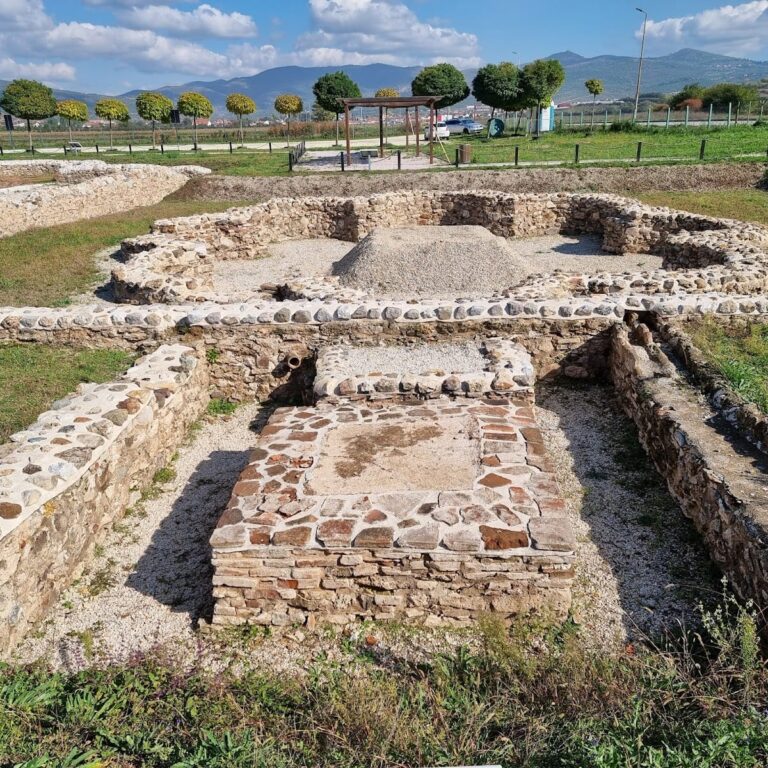
About 200 meters east of the citadel, in the Lower Town, stood the Cathedral of Saint Nicholas, the principal Orthodox church of Novo Brdo. Its foundations were exposed during excavation campaigns in 1957 and 2014. The building began as a single-nave church in the last quarter of the fourteenth century. An eastern extension was later added, but construction continued until the final Ottoman conquest and was never completed. Only the central and northern aisles were built, while the southern aisle remained unfinished.
The extension had a basilica-like plan, unlike the older cross-domed church type, in which a central dome is supported by the arms of a cross. The facade used finely worked blocks of contrasting red breccia and green andesite. Its design drew on the memorial churches of Serbian rulers at Studenica, Banjska, Visoki Dečani, and Sveti Arhanđeli. Sculpted window surrounds, archivolts, or decorative bands following the curves of arches, and rose windows reflected developments associated with the Morava style, a late medieval Serbian tradition known for elaborate stone decoration.
Other religious and civic buildings
The mining settlement contained seven Eastern Orthodox churches and two Roman Catholic churches. The Catholic church known as Santa Maria de Nuovomonte in Dogni Targ, also called the Sasi Church, served Sasi miners and Ragusan merchants and is now situated near the village of Bostan. A second Catholic church, known as the Church of the Saxons, was dedicated to Saint Nicholas.
The town’s market square, called the mercatum or burgus, formed the center of social and commercial life. A hospital owned by the Catholic Church is also associated with the medieval settlement. Together with the fortress walls, towers, gates, churches, mining installations, and archaeological layers, these remains reveal the physical extent of a town whose urban life was closely tied to the surrounding mines.
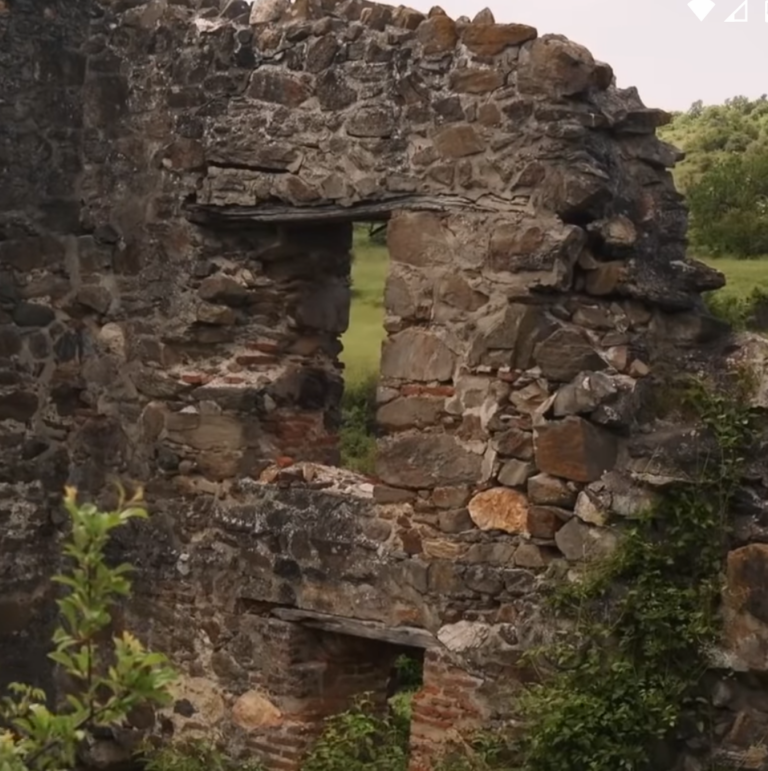
Novo Brdo is now largely ruined, although parts of the citadel have been restored or stabilized. Conservation has also extended into the Lower Town, where the surviving foundations and archaeological layers continue to define the settlement’s former organization.
Nearby sites