Kerelaw Castle: A Medieval and Renaissance Castle in Stevenston


Site at a Glance
- Rating
- 3.8
- Popularity
- Very Low
- Country
- United Kingdom
- Primary era
- Medieval
- External website
- Open
- Eras represented
- Medieval
- Civilizations
- Kingdom of Scotland
- Site type
- Military
- Remains
- Castle
On this page14 sections
History
Kerelaw Castle is a ruined stone castle in Stevenston, United Kingdom, traditionally dated to around 1191. Its early history is associated with Stephen Lockhart, or Loccard, whose land in Ayrshire became known as Stevenstoune, later Stevenston. The manor of the Barony of Stevenston was called Kerelaw. Timothy Pont stated that the property was held for the Lockharts by Richard de Morville, a major Scottish noble who served as Constable of Scotland in the late twelfth century.
From the Lockharts to the Cunninghames
The castle and barony later passed from the Lockharts to the Campbells of Loudoun and then to the Cunninghames of Kilmaurs. In 1488, during the prolonged feud between the Cunninghames and Montgomeries, Hugh Montgomerie, 2nd Lord Montgomerie, sacked and burned Kerelaw while it was held by the Cunninghames. The conflict continued to affect the estates of both families. In 1528, forces led by William Cunningham, 6th Earl of Glencairn, burned Eglinton Castle in retaliation.
Kerelaw was rebuilt after the attack of 1488. One tradition attributes the rebuilding to John de Eglinton. Another local tradition describes the castle as the residence of the Abbot of Kilwinning. Kilwinning Abbey was a medieval Tironensian monastery in Ayrshire, and the tradition may relate to the possibility that a son of Alexander Cunningham, 1st Earl of Glencairn, lived at Kerelaw after becoming the abbey’s commendator. A commendator was an administrator who held the revenues and responsibilities of a former monastery after the Reformation.
The Hamilton estate
From 1545, nine Saltcoats fishermen held leases that required them to transport the Earl’s furniture between Saltcoats and Finlayston each spring and autumn, when the family returned to Kerelaw for the winter. Their obligations also included supplying the Earl with half a barrel of herrings each year.
Sir Thomas Boyd bought the estate in 1609 and soon sold it to Sir William Cunninghame of Cunninghamhead. About thirty years later, Sir Robert Cunninghame of Auchenharvie acquired the castle and surrounding lands. Alexander Hamilton purchased Kerelaw in 1655 and renamed the castle and estate Grange, after the Hamilton family home in Kilmarnock. A later sale of Kerila, or Kerelaw, to John Hamilton is dated to 1685, following the financial difficulties of Robert Reid Cunninghame of Seabank House, whose mining activities had caused financial problems.
The Hamilton family continued to reside at the castle until 1787, when another Alexander Hamilton built Kerelaw, or Grange, House nearby. The older castle then quickly fell out of use. During the 1745 Jacobite rising, a conflict in which supporters of the Stuart claim to the British throne challenged the government, government troops used Kerelaw as barracks. Local tradition says that their leader left a silver spoon there. During the American War of Independence, the castle served as a military hospital.
Later ownership and protection
Alexander Hamilton of Grange laid the foundation stone of the new Eglinton Castle at Kilwinning in 1797 on behalf of the 12th Earl of Eglinton. After Hamilton’s death, the castle, house, and estate were sold to Gavin Fullerton in 1838. Fullerton soon restored the name Kerelaw, which had been replaced by Grange.
The castle declined during the twentieth century. Repairs were carried out in 2014, and vegetation that damaged or obscured the structure was cleared. Kerelaw Castle is owned by North Ayrshire Council and is fenced because of falling masonry and the danger of unwanted access. It is a Scheduled Monument, a legally protected archaeological or historic site of national importance in Scotland. The associated bridge over Stevenston Burn is a Category B listed structure, a designation for a building or structure of regional or more than local importance.
The castle has appeared under several names, including Kerila Castle, Turnlaw Castle, Kerry-law, and Kyryaw Castle. Maps from 1604 to 1608 mark the castle, mains, and mill, while Roy’s survey of 1747 gives the name as Kerry-law.
Remains
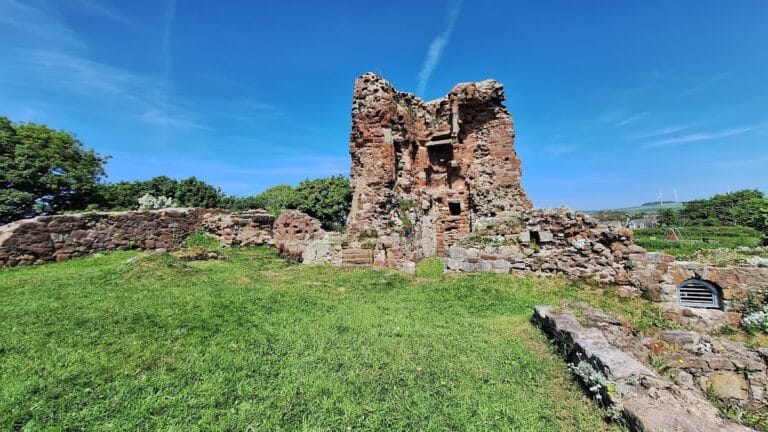
Kerelaw Castle stands as a ruined lowland castle built of stone rubble. Its grounds formed a rectangle measuring up to approximately 35 metres northwestward and 40 metres across. The surviving fabric represents several periods of construction and alteration, including an early fourteenth-century rectangular building arranged around a central courtyard.
The castle buildings
Medieval core
The oldest surviving part is a rectangular structure with a central courtyard and a vaulted lower storey. Its remaining details include fireplaces, windows, niches, and part of a small corner tower at the north-eastern corner. In 1852, arrow-slits and cable mouldings were noted and assigned a date before the fourteenth century. Cable moulding is a rope-like architectural ornament.
Southern wall and later fabric
Three walls survive in different states of decay. The southern wall retains Gothic windows, whose forms were probably influenced by those of Kilwinning Abbey. Their presence has been used to associate substantial parts of the castle with several historical periods, including the Renaissance. The windows themselves may be nineteenth-century additions, making their date uncertain.
The rebuilt castle was traditionally said to have contained several carved coats of arms belonging to Scottish noble families and taken from Kilwinning Abbey. Workers’ cottages were later built within the castle court. Their high corbie-stepped gables, formed by stepped projections along the slopes of the gables, contributed to the picturesque appearance of the ruins.
Estate buildings and garden
Dovecote and estate works
A dovecote dated 1775 stood on the estate until the 1960s, when it was demolished together with other ancillary buildings. A limekiln also formed part of the estate. The wider property included a mill and the Greenhead aqueduct. An estate lodge east of the castle, shown on older maps, survives as a private house.
Walled garden
The former walled garden contained sundials and a complex arrangement of flower beds. A housing estate built in the late 1960s now occupies the garden, while one garden wall survives. An entrance to the former garden is bricked up, and maps from the 1850s show an orchard beside it.
Stevenston Burn and crossings
Bridge beside the castle
An old bridge beside the ruins is now used only by pedestrians. It contains a large cavity, or cave, that formerly allowed pedestrians to reach a path running parallel to Stevenston Burn. The arch and cavity show that the bridge was built in two stages and later widened, with the upstream side forming the later addition. A large, ornately carved quatrefoil embellishment has fallen from the bridge arch and lies downstream. A quatrefoil is a four-lobed decorative motif.
Ford and footbridges
A large-stone cobbled ford once crossed Stevenston Burn in Kerelaw Glen below the castle. Its route continued up the bank past the Kerelaw Mains home farm, while later limestone-quarry workings destroyed the lane leading from the ford. Two footbridges crossed the burn, one at the surviving weir and another beyond the quarry house. Mortared walls faced with dressed ashlar stone survive at the latter crossing. Ashlar is finely dressed stone laid in regular courses.
Nearby sites