Harbottle Castle: A Medieval Border Fortress in Northumberland

Site at a Glance
- Rating
- 4.5
- Popularity
- Very Low
- Country
- United Kingdom
- Primary era
- Medieval
- Eras represented
- Medieval, Early Modern
- Civilizations
- English
- Site type
- Military
- Remains
- Castle
On this page6 sections
History
Harbottle Castle is a ruined medieval castle in Harbottle, Northumberland, United Kingdom, built by the Umfraville family around 1160 during the reign of Henry II. The mound beneath its keep may have earlier served the ancient Britons, while an Anglian stronghold on the site was reportedly held by Mildred, son of Ackman. The medieval castle was presumably established to defend the region against Scotland after the Umfravilles received the land following the Norman Conquest, the Norman takeover of England that began in 1066.
Medieval stronghold
The Scots captured Harbottle Castle in 1174, after which it was rebuilt and given stronger fortifications. In 1296, it resisted a siege led by Robert de Ros and about 40,000 supporters of John Balliol, a former king of Scots whose adherents opposed Edward I of England during the Scottish succession conflict and subsequent wars. Robert the Bruce, king of Scots from 1306 to 1329, captured the castle during the 1310s.
The castle was restored in 1336, but it had fallen into ruin again by 1351. Repairs were carried out at the end of the fourteenth century, and around 1436 the property passed to the Tailleboys family. For much of its later medieval history, Harbottle served as the residence of the Warden of the Middle Marches, officials responsible for administration and defence along the English-Scottish border. It was also used as a prison.
Royal property and later decline
Margaret Tudor, the widowed queen of James IV of Scotland and sister of Henry VIII of England, came to Harbottle in 1515 with her second husband, Archibald Douglas, 6th Earl of Angus. She had been banished by John Stewart, Duke of Albany, who was acting as regent in Scotland. Their daughter Margaret was born at the castle. She later became the mother of Henry Stuart, Lord Darnley, and the grandmother of James VI of Scotland, who also became James I of England.
Further building work took place between 1541 and 1551, followed by repairs in 1563 and 1585. The castle became royal property in 1546, and Sir John Forster, Warden of the Middle Marches, supervised its repair. A survey of 1596 states that Forster had built a new gatehouse and a tower providing lodging for the captain. In 1605, James I, who ruled both Scotland and England from 1603 to 1625, granted the castle and manor to George Home, 1st Earl of Dunbar and Lord Treasurer of Scotland.
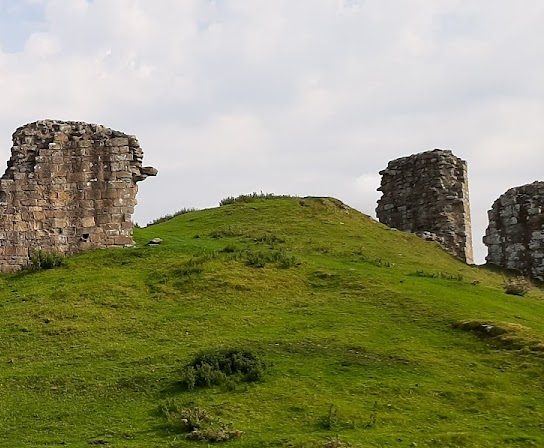
Harbottle Castle subsequently decayed, and much of its masonry was taken away for reuse in other buildings. A survey from 1715 again described the castle as ruinous. The medieval site is now a Scheduled Monument, a designation protecting archaeological and historical sites under United Kingdom law, and a Grade I listed building, a category reserved for buildings of exceptional architectural or historic interest. It is managed by the Northumberland National Park Authority.
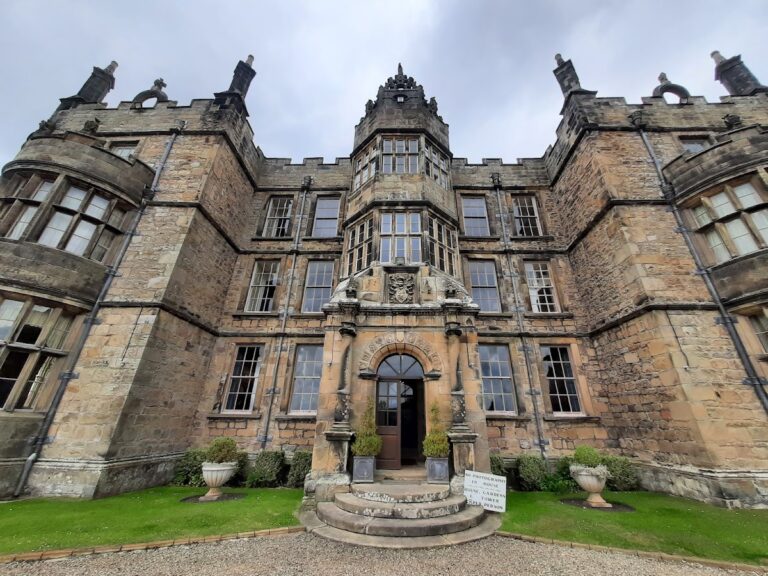
After the medieval castle ceased to serve as a residence, its name was transferred to a separate building at the eastern end of Harbottle village. Stone from the derelict castle was used in a seventeenth-century manor house. Percival Clennell acquired the manor in 1796, and Fenwick Clennell replaced the house in 1829. This later Harbottle Castle is Grade II listed, and its stable block became a separate dwelling in 1890.
Remains
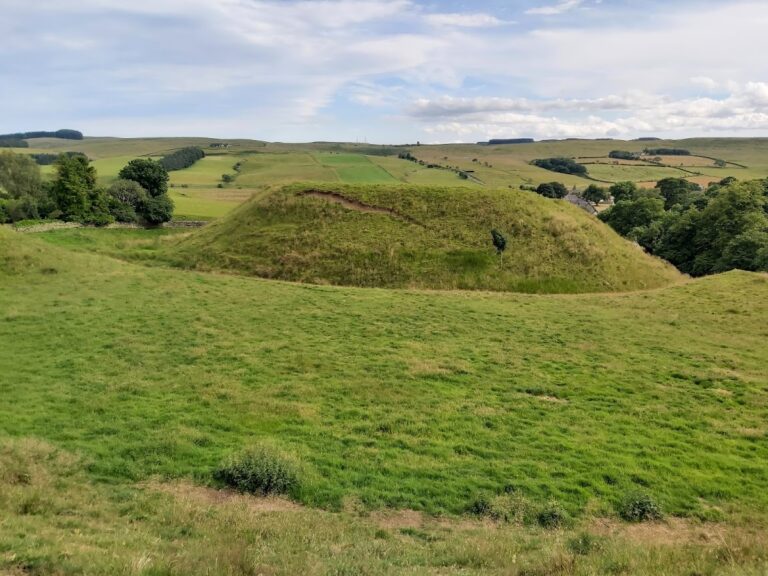
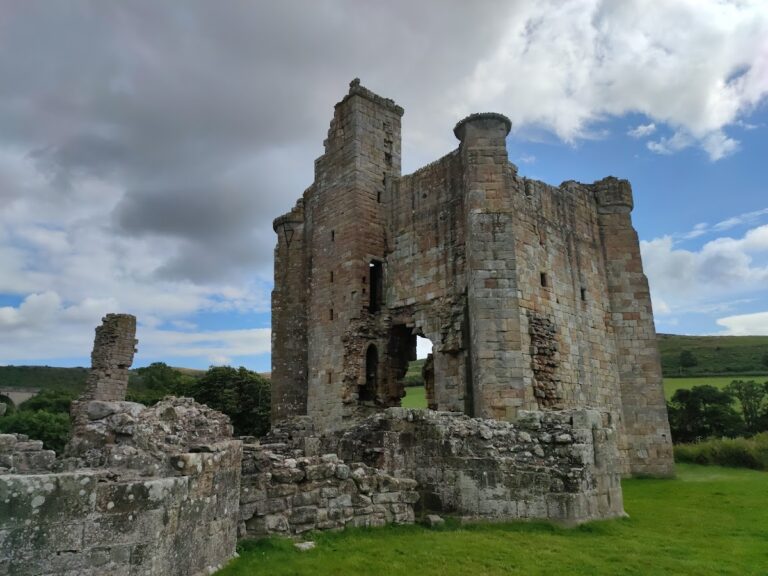
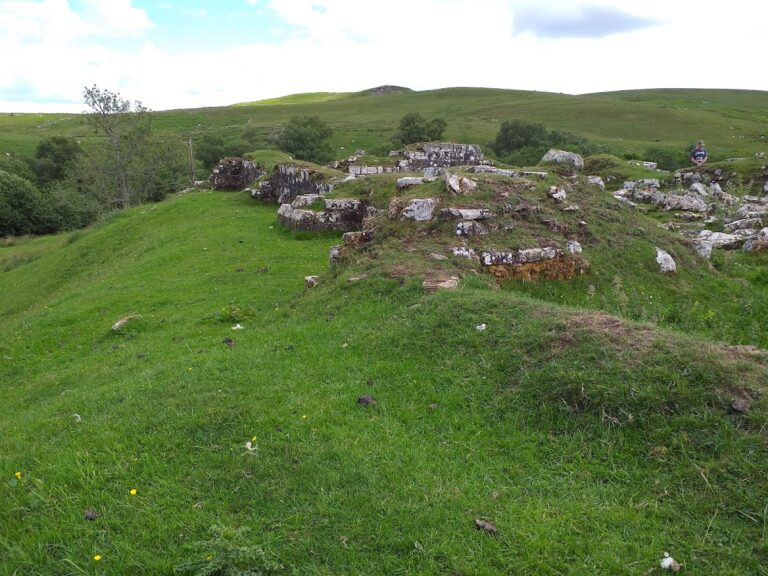
The medieval castle occupies a mound associated with its keep at the western end of Harbottle village, overlooking the River Coquet. Its surviving fabric consists of earthworks, meaning banks, ditches, or mounds forming part of a defensive site, together with some standing masonry. The physical remains represent a castle complex that included a principal fortified tower, a fortified entrance, and a separate tower used to house its captain.
Medieval castle remains
The keep stood on the castle mound and formed the principal fortified tower of the medieval stronghold. The site also contained a gatehouse, the defended entrance to the castle, and a captain’s lodging tower. Both the gatehouse and the captain’s tower were built under Sir John Forster by the time of the 1596 survey. Earthworks and fragments of standing masonry survive, while the later removal and reuse of castle stone have reduced the visible remains of the medieval complex.
Nineteenth-century mansion
The separate building called Harbottle Castle stands at the eastern end of the village rather than on the medieval mound. It is a two-storey mansion with five bays, or distinct structural sections across its front, designed by the architect John Dobson and built in 1829. Its former stable block was converted into a separate house in 1890.
Nearby sites