Edlingham Castle: A Medieval Fortified Manor House in Northumberland


Site at a Glance
- Rating
- 4.6
- Popularity
- Low
- Country
- United Kingdom
- Primary era
- Early Modern
- External website
- Open
- Eras represented
- Medieval, Early Modern
- Civilizations
- English
- Site type
- Military
- Remains
- Castle
On this page9 sections
History
Edlingham Castle is a medieval fortified manor house ruin in the United Kingdom, developed on a site occupied by a manor house by 1174. It guarded one of the few approaches to Alnwick through the hills to the west, and its defences were strengthened during the border warfare between England and Scotland that affected the region from about 1300 to 1600.
The Edlingham and Felton Families
By 1174, John of Edlingham owned a manor house at the site. In 1294, his descendant Walter of Edlingham sold the manor to William de Felton. William transformed the property by adding substantial ramparts and a gatehouse, strengthening the main hall, and constructing further buildings within a courtyard.
The fortifications developed as conflict along the Anglo-Scottish border made defensible residences important in the region. The complex was more precisely a fortified manor house, rather than a large royal fortress, but its position gave it a role in controlling movement towards Alnwick from the west.
Hastings and Swinburne Ownership
Elizabeth de Felton inherited the property in 1396 and married Sir Edmund Hastings. He added the strong solar tower, a principal private living and reception space associated with the lord of a medieval residence. Their descendants held the castle and estate until 1514.
After 1514, George Swinburne, constable of Prudhoe, purchased the property. His family retained it until the eighteenth century. The castle then gradually fell into disrepair, and most of its buildings were dismantled during the 1660s for use in constructing nearby farmhouses. The solar tower remained intact.
Excavation and Preservation
In 1978, the Department for the Environment acquired the site and undertook extensive archaeological excavations. Before this work, rubble filled the solar tower to a height of about three metres, and the excavations helped reveal the surviving arrangement of the castle.
Edlingham Castle is now cared for by English Heritage, the organization responsible for many historic buildings and archaeological sites in England. It has scheduled-monument status, which protects an archaeological or historic site under national law, and is a Grade I listed building, a designation for buildings of exceptional architectural or historic interest. The castle is also associated with the nearby church of St John the Baptist at Edlingham, where William de Felton is buried.
Remains
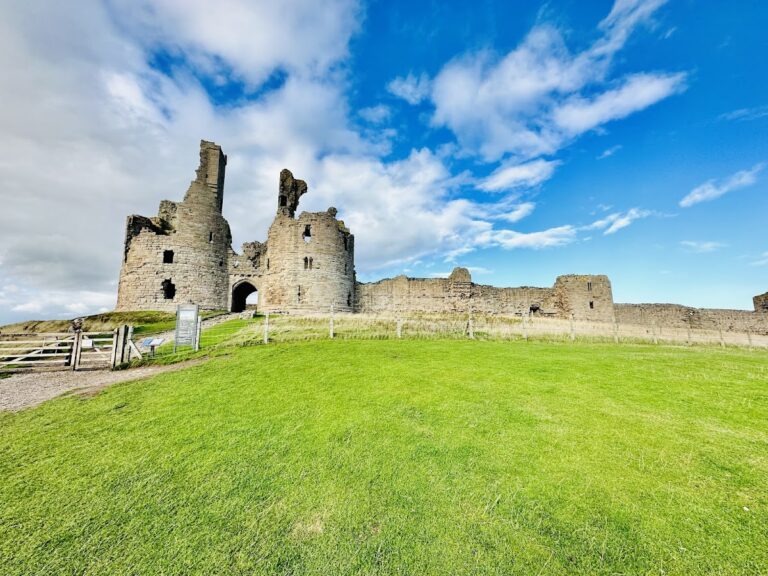
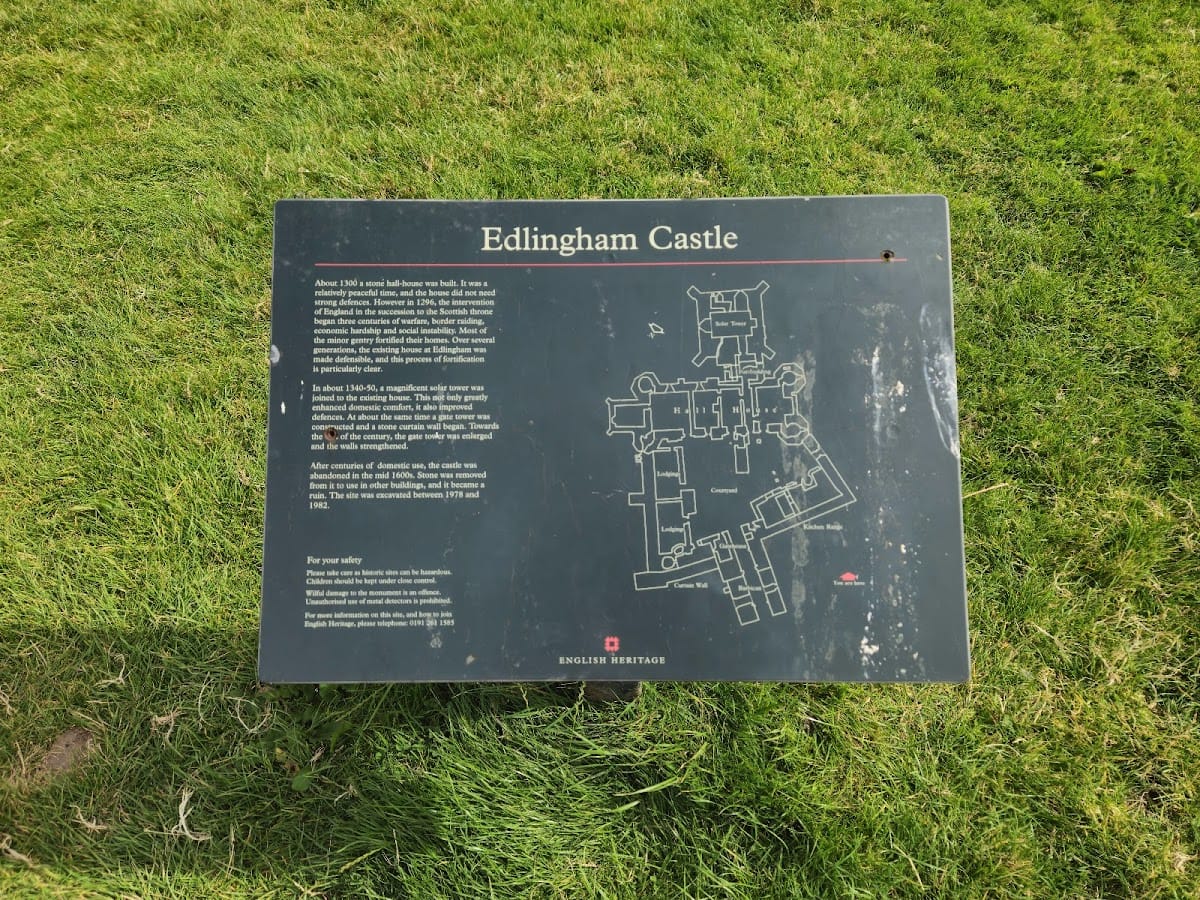
The castle occupies a valley west of Alnwick, with level terrain to the west and hills to the east. Its surviving layout represents a fortified enclosure containing a hall house, entrance defences, the solar tower, and other courtyard buildings. Most of the ruins have been reduced to low remains, while the solar tower survives to a much greater height.
Courtyard and Entrance Defences
Hall House and Courtyard Buildings
Foundations and sections of walls mark the hall house and additional buildings that once stood within the courtyard. The main hall had been fortified during William de Felton’s enlargement of the manor, and much of the visible surviving fabric in this part of the site dates from the sixteenth century.
Gatehouse and Barbican
The entrance area included a gatehouse and a barbican, an outer defensive structure protecting an entrance or approach. Foundations and wall fragments of both features remain visible, together with portions of the strong ramparts that enclosed the fortified manor house.
Solar Tower
The solar tower added by Sir Edmund Hastings remains the most substantial standing part of the castle. A solar was a principal private living and reception room or tower in a medieval residence, generally associated with its lord or owner. Much of the tower still stands, although a major crack runs down several storeys to ground level. Its survival contrasts with the dismantling of most of the surrounding buildings during the 1660s.