Pantokratoras Castle: An Ottoman Coastal Fortress at Preveza


Site at a Glance
- Rating
- 4.4
- Popularity
- Very Low
- Country
- Greece
- Primary era
- Early Modern
- Eras represented
- Early Modern, Modern
- Civilizations
- Greek, Ottoman
- Site type
- Military
- Remains
- Fort
On this page11 sections
History
Pantokratoras Castle is an Ottoman coastal fortress in Greece, at Preveza, built during the early nineteenth century to defend the entrance from the Ionian Sea into the Ambracian Gulf. It stands within a strategically important passage where shallow, rocky waters once forced ships toward naturally deeper channels near the Epirus shore. Control of this route provided control over shipping entering the gulf.
Ottoman and Ali Pasha’s fortification programme
The defensive history of the strait reaches back to 1478, when Sultan Mehmed II, the Ottoman ruler who had captured Constantinople in 1453, ordered the construction of a castle at the passage. The Ottomans called that earlier fortification Preveze Kalesi. It belonged to the wider system guarding the strait, but it was not the present Pantokratoras Castle.
By the late eighteenth century, Preveza was under Venetian rule, while Ali Pasha of Ioannina, an Ottoman provincial ruler who exercised broad control over Epirus and nearby territories, dominated most of the Ambracian Gulf and the mainland around it. After the Venetian Republic fell in 1797, Preveza passed to France. Ali Pasha captured the city in October 1798 and expelled the remaining French and pro-French inhabitants. His son Veli captured Preveza again in late 1806, leaving Ali Pasha as the region’s dominant power.
From 1807, Ali Pasha directed an intensive programme of fortification around Preveza, employing hundreds of conscripted workers. French officers and engineers advised him on the defense of the strait, and the fortress of Saint George was built on the opposite shore. Pantokratoras Castle was planned at the western end of the passage so that ships approaching the Ambracian Gulf could be attacked from a greater distance in combination with the guns of Saint George.
The fortress was built during Ali Pasha’s control of Preveza, between late 1806 and 1820, but its exact construction date remains uncertain. One interpretation places the inner pentagonal fort in 1807 or 1808 and connects its plans with Frédéric François Guillaume de Vaudoncourt, a French artillery colonel involved in military fortification planning. Under this interpretation, the outer section and its large triangular bastion belonged to a later nineteenth-century phase.
Another interpretation places construction around 1818. William Goodisson, an English military doctor, reported that the fortress was still being built during his visit to Preveza in the summer of that year. A map prepared in 1818 showed a church near the site but not the fortress, while its publication in 1820 marked a “New Fortress” beside the church. The coastal bastions appeared on an Austrian map of 1829, and British naval engineers recorded the southern face, including the phase considered later, in 1830. If the two-phase interpretation is correct, that second phase had been completed by then.
After Ali Pasha was expelled from Preveza in 1820, Ottoman forces probably strengthened the town’s defenses. About a decade later, the Preveza Strait became a frontier between the Ottoman Empire and the newly established Greek kingdom. The Ottomans initially called the fortress Yeni Kale, meaning “New Fortress.” The same name had already been used in 1807 for the fortress now called Saint George, about one kilometre to the east. French maps translated the name as Fort Neuf from 1820.
A Church of the Pantokrator stood near the fortress before its construction. Pantokrator is a Christian title for Christ meaning “Almighty” or “Ruler of all,” and the nearby church gave the castle its established name by 1830. The fortress was also known as Uç Kale, meaning “the fortress at the end.”
Military, prison, and conservation history
Following the liberation of Preveza in October 1912, a small Greek naval unit occupied the fortress. Using the surviving Ottoman guns at Pantokratoras and on the opposite hill, the unit controlled shipping entering the Ambracian Gulf.
When Preveza became the seat of a court in 1913, the city required a prison. The prison first operated in the fortress of Aktio and moved to Pantokratoras shortly before 1930. In the early 1940s, the Ministry of Finance granted the fortress to the Ministry of Justice, and reinforced-concrete structures were probably added during this period.
The fortress was involved in Preveza’s civil conflict in September 1944, after the end of German occupation and the collapse of arrangements between ELAS, the Greek communist-led resistance army, and EDES, a rival republican and anti-communist resistance organization. The violence brought reciprocal imprisonments and the executions at Parginoskala. In the early 1950s, the political prisoner Charilaos Florakis was held in the Preveza prison. The dictatorship abolished the prison in 1968.
In the late 1970s, local authorities and other interventions prevented the fortress from being sold, and impoverished families were permitted to live in some of its buildings. The Ministry of Culture designated it a protected monument in 1982, administratively describing it as a Venetian fortress.
During the late 1980s, the Municipality of Preveza commissioned a study from the Aristotle University of Thessaloniki’s School of Architecture. Led by the Byzantine archaeologist George Velenis, with the fortification specialist Ioanna Steriotou, the project was completed in 1991. A later implementation study removed reinforced-concrete additions and cleared infill from underground passages and bastions, helping expose or recover parts of the earlier defensive fabric.
Remains
Fortifications and coastal defenses
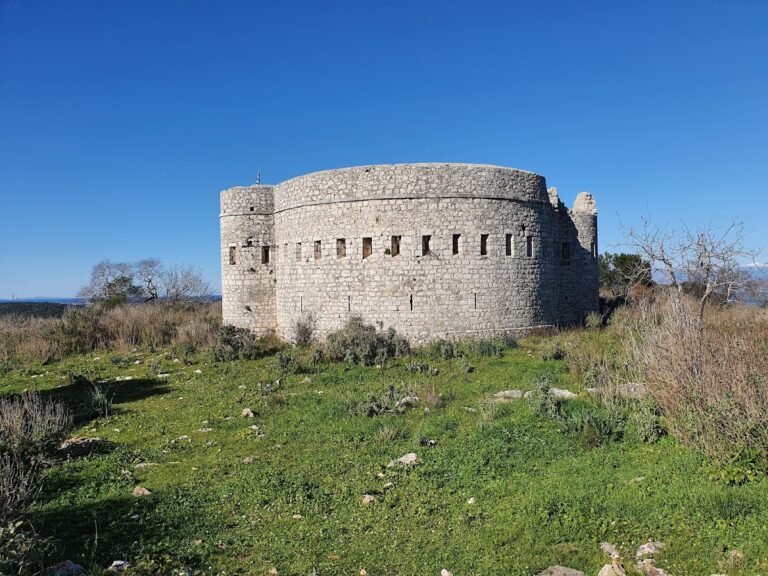
Pantokratoras Castle occupies the mouth of the Preveza Strait, on the route between the Ionian Sea and the Ambracian Gulf. Before an artificially dredged navigation channel was created in the early 1930s, the main deep-water route ran closer to the Epirus shore. The fortress consists of a low outer enceinte, meaning an enclosing defensive wall or fortified area, and an inner pentagonal fort. Its form may reflect two construction phases, although the sequence is not certain.
Wedge-shaped outer work
The western side of the low enceinte contains a wedge-shaped rivellino, an outwork placed before a fortification to strengthen an approach and provide low-level artillery fire. It is one of the few surviving coastal examples of this type. Five arched gun ports face the strait, and vaulted communication corridors run along the length of the structure. The gun ports are set at regular intervals, while the firing positions are not paired with separate enclosed vaulted gun platforms.
Inner pentagonal fort and bastions
The inner pentagonal stronghold forms the central defensive element. It has been attributed by one interpretation to 1807 or 1808, while the outer section and its large triangular bastion may belong to a later phase completed before 1830. The coastal bastions were shown on an Austrian map of 1829. Conservation work in the 1990s cleared deposits from underground galleries and bastions and removed later reinforced-concrete additions, revealing or recovering portions of the earlier defenses.
Buildings and later additions
Garrison and administrative spaces
As an independent outer fortress, Pantokratoras required quarters for its garrison and spaces for administration. Numerous roofed rooms appear to have survived until at least 1912, and photographs from the late 1920s show the same buildings still standing. These structures formed part of the built environment later adapted for prison use.
Chapel of the Holy Unmercenary Saints
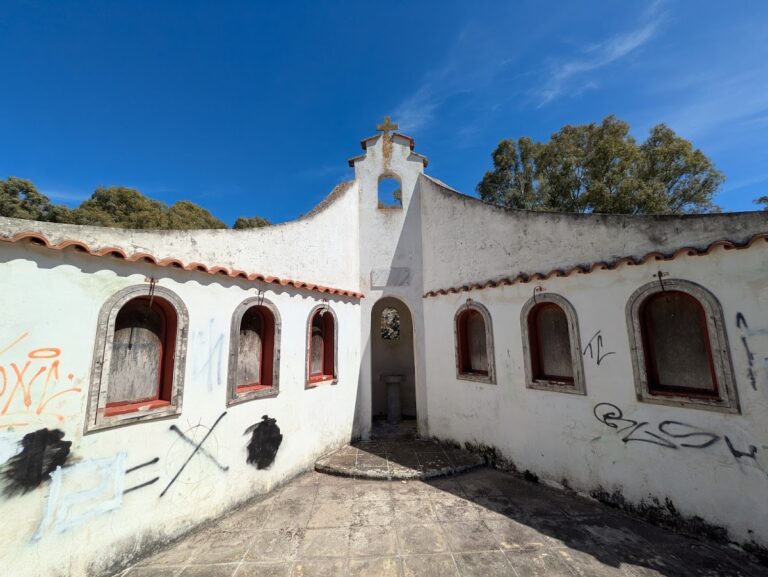
The Chapel of the Holy Unmercenary Saints was established at the summit of the fortress on 2 July 1939 by Andreas Mantoudis, then metropolitan, or senior bishop, of Arta and Preveza. Reinforced-concrete additions were probably introduced during the prison period, particularly in the early 1940s, and some were later removed during conservation.
Church associated with the castle’s name
The earlier Church of the Pantokrator stood near the fortress before it was built. A map prepared in 1818 placed the church approximately where the fortress was later established. Its association with the site explains the name Pantokratoras, which became established for the new fortress by 1830.